

Opportunity knocks

Jeff Nobers
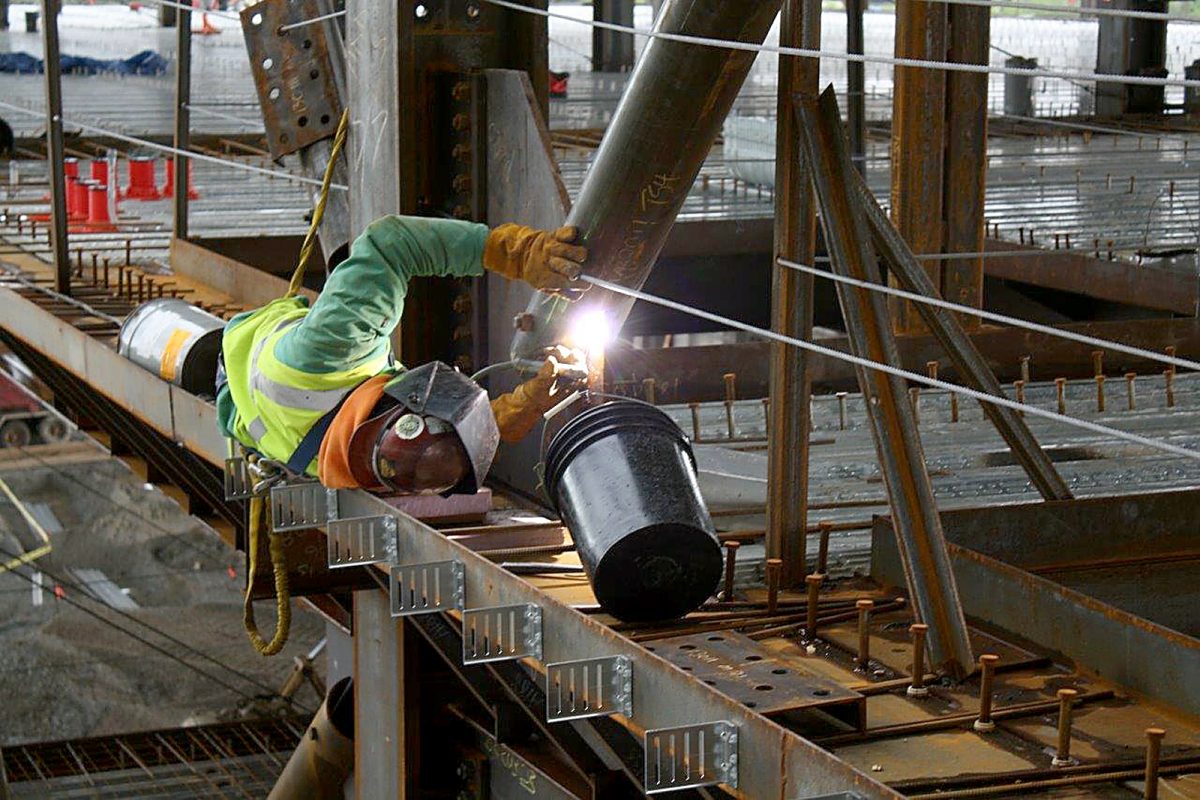
An ironworker for Mascaro Construction welds a beam during construction of the Industrial Scientific headquarters in Robinson Township in this file photo provided by the Builders Guild of Western Pennsylvania. The guild, which represents contractors who employ skilled workers from the 16 trade unions in the area, is projecting that the long-term prospects for commercial construction in the region will require at least 20,000 men and women for trade apprenticeships over the next decade to keep up with the demand for new offices, factories and other commercial construction projects.
Sometimes when he’s paying for gasoline in a convenience store, Jeff Nobers will strike up a conversation with clerks who appear to be in their mid-20s.
He asks them if they have interest in applying for an apprenticeship program in the commercial construction trades that will pay them to go to school while they also receive a good hourly wage and benefits to work alongside experienced carpenters, electricians or other skilled trade workers.
“I give them my card,” he said, hopeful that some of them will take him up on the offer.
Nobers, who recently became executive director of the Builders Guild of Western Pennsylvania, is tasked with getting the word out about the good-paying careers in the commercial construction industry in the region, where business is booming.
“It’s just burgeoning and it’s not just in any one industry,” Nobers said, adding that the builders guild, which represents 16 different trade unions and the contractors who hire them, is looking for men and women to learn a trade to meet the massive demand for commercial construction projects at a time when many of the unions’ members are approaching retirement age.
From natural gas to health care and education “to the manufacturing that’s going to spur off from the petroleum industry” Nobers estimates that commercial construction demand in Western Pennsylvania and the tri-state area is at a historic high.
And the pipeline for projects could be a long one.
In addition to Shell Chemical’s $6 billion ethane cracker now under construction in Beaver County, the region could see several more crackers being built. The crackers are expected to bring petrochemical and plastics manufacturers to the region to be close to the source of the cheap, abundant ethylene feedstock, which could drive the construction of new factories.
Despite the fact that the guild’s 16 unions boast a membership of 41,000, they’re also cognizant of the fact that within the next seven to 10 years, between 40 and 50 percent of their membership will retire, Nobers said.
That means that the guild is faced with the prospect of bringing in 20,000 apprentices in the next decade.
It’s not as if the organization isn’t trying to recruit young adults for the apprenticeship programs now.
Aside from his anecdote about making sales pitches to twenty-somethings manning convenience store cash registers, Nobers is also promoting the careers in more formal ways.
“We’ve participated in 100 high school and community career events over the past year,” he said, adding that the guild also meets with students enrolled at the various career and technology centers in the region’s school districts.
The offer of paid training, a living wage and paid health-care benefits while learning – apprenticeships can last from three to five years depending upon the trade – should be tantalizing for many people who aren’t considering college, but it can be an uphill challenge overcoming a misconception about trades, Nobers said.
“The perception of construction trades is that they’re low-end jobs,” he said, quickly dispelling the myth.
“The carpenters and electricians test is every bit as difficult as college tests you would take,” he said.
And the trades have kept pace with the advent of technology on the job.
Nobers noted that those who work in the Operating Engineers union, running the bulldozers, excavators, cranes and graders that are part and parcel of practically every construction site, now use software programs loaded with global positioning coordinates to complete the site preparation work.
That’s a critical skill to have when taking into account that readying the site for the Shell cracker plant involved the movement of billions of cubic feet of earth, he added.
Despite their growing need for apprentices, the trades don’t take just anyone, he added.
In addition to taking a test for aptitude, applicants must be interviewed and pass a drug test. They must also have a valid drivers’ license, have access to reliable personal transportation, have a high school diploma or GED and be 18 years old.
While tests administered by the various trades are used to determine aptitude, at least one of the unions is accepting applicants with no construction experience.
The Laborers Union is aggressively recruiting new apprentices for training classes at its Joint Apprenticeship Training Center on Deep Creek Road in Saxonburg. All training is jointly paid for by the Laborers Council and the general and specialty contractors who employ Laborers tradesmen and women.
“This represents a tremendous opportunity for a variety of people,” said Phil Ameris, president of the Laborers District Council of Western Pennsylvania. “In addition to the free training, all apprentices are paid and earn benefits. It’s truly a unique way to learn and earn family sustaining wages and benefits.”
In addition to the Laborers union, there are 15 other trade unions that supply skilled labor to the general and specialty contractors of the Builders Guild of Western Pennsylvania.
Nobers noted that over a four-year apprenticeship program, people will earn between $130,000 and $140,000, plus paid health-care benefits and contributions toward a pension.
“That’s in addition to the $10,000 to $12,000 per years it costs to learn the trade,” which is paid for by the guild members, he added.
While stating that about 65 percent of high school graduates head off to college, Nobers said it is assumed that the trades can pursue the remaining 35 percent for apprenticeships.
But in actuality, the numbers don’t break out that succinctly, he added.
“The average apprentice age is 26,” he said. “Many of them went to college and left for a variety of reasons.” Others join a union apprenticeship program after having worked in non-union construction jobs for a few years.
And learning doesn’t have to stop for those who complete their apprenticeships and become journeymen, Nobers said.
Apprentices earn credits toward an associate degree at Community College of Allegheny County, and can eventually finish coursework for a degree in construction estimating or construction management, which offer additional paths for lucrative earning opportunities in the construction industry.
While acknowledging that working in construction, which can be a nomadic lifestyle of moving from job to job “is not for everybody,” Nobers added, “it’s a great opportunity for high school kids or people who started college but didn’t finish.”
For more information on skilled trade apprenticeships, access the Builders Guild of Western Pennsylvania website at www.buildersguild.org, and open the “Careers” section for apprenticeship contacts at each of the area’s trade unions.