

Familiar frustrating end to Wild Things’ season
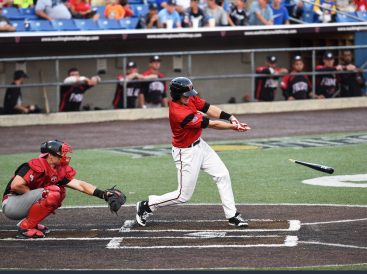
For the eighth time in nine years, the Wild Things and the Frontier League playoffs went their separate ways.
In other words, not much has changed for the local team.
The Wild Things have gone 15 seasons without winning a championship, which is tied for the fourth-longest title drought in independent baseball history and the second-longest in the Frontier League behind Chillicothe, which played 16 years without winning a title.
The Wild Things finished this season with a record of 46-49. That’s an increase of four wins over last year, so there is some improvement going on. But in the Frontier League, you can go from expansion franchise to champion in less than a year. Improving the win total by a few games is nothing to get excited about, especially when the team still has a losing record – for the seventh time in eight years. In the Frontier League, one year usually doesn’t have much impact on the next, unless you’re the Wild Things.
There has been only one postseason game played at Consol Energy Park since 2007. That’s all. One night of playoff baseball in nine years.
You would think that by blind luck the Wild Things would fall into a season of making the finals.
The reasons the Wild Things missed the playoffs, even while playing in the weak East Division, came down to two things: their offense was the worst in franchise history and they couldn’t beat the league’s best teams, going 8-22 against the four clubs that made the playoffs. It also didn’t help that Washington’s two best pitchers, Trevor Foss and Zac Grotz, had their contracts purchased by major league organizations in August, in the midst of the playoff race. You simply can’t replace top-notch pitchers in August, but advancing players to affiliated ball, after all, is what the Frontier League is all about.
Washington was mostly terrific on the mound, OK in the field and woeful at the plate. The Wild Things gave up the fewest runs in the league yet had a losing record. That’s almost impossible to do.
Because of the solid pitching staff and woeful offense, the Wild Things’ season was exciting and maddening, fulfilling and depressing.
Foss’ performance was the highlight. A right-hander who was signed in the offseason out of the Los Angeles Angels’ system, Foss had an 8-3 record and won the league’s ERA title at 2.50. He threw eight complete games and was within one CG of the 16-year-old league record when he had his contract purchased in early August by the Cleveland Indians.
The pitching was good enough to get Washington to the postseason. The hitting, however, was what prevented that from happening.
With the exception of right fielder David Popkins (.281, 15 home runs) and designated hitter Ricky Rodriguez (.289, 9 home runs), the offense sputtered. A few other players had some good stretches, but they lacked consistency.
Washington’s situational hitting was abysmal. Two statistics show just how bad: the team batting average with two outs and a runner in scoring position was an anemic .199, and the Wild Things had only seven sacrifice bunts all season. Some of those sacrifices weren’t by design. Several were attempted bunts for a hit that just happened to advance a baserunner.
Washington finished last in the league in batting average and runs, was tied for last in on-base percentage and was next to last in doubles. Hitting coach Mike Marshall, who spent 11 years as an outfielder in the major leagues, mostly with the Los Angeles Dodgers, had to be frustrated and puzzled on a nightly basis.
The .235 team batting average and 356 runs each are franchise record lows. Oh for the days of the 2005 Wild Things, who had a .298 batting average and scored 645 runs. It might have taken the 2016 Wild Things 200 games to score 645 runs.
The season was unique in that three starting position players retired during a three-day period in early July, but none of the trio was making much of an impact. Center fielder Chris Grayson was one of the players signed to fill the vacated spots and he was an upgrade.
During the late-season playoff push that fell three wins shy of a wild-card spot, Washington played every game with at least two hitters in the starting lineup who sported a batting average of less than .200. Sometimes, it was more than two sub-.200 hitters in the lineup. It’s hard to win with that kind of pop-gun offense.
That the Wild Things were even in playoff contention was a credit to first-year manager Gregg Langbehn, who got the most out of the team given to him. Saddled with such a weak offense, Washington’s record exceeded realistic expectations.
The lack of offense, however, has been a long-running problem for the Wild Things, and one that somebody needs to spend time analyzing and finding ways to correct. Washington has finished last in the league in team batting average four times in six years and hasn’t finished higher than ninth during that span.
As for improving the team, offense is the priority. Focusing on players with speed and are high-contact hitters should be the focus.
It’s hard to be that inept on offense for that long, but if Washington is last in runs and batting average again next year, then you’ll be able to add another year to the championship drought.
Sports editor Chris Dugan can be reached at dugan@observer-reporter.com.