

Charleroi stadium has long, rich history
The announcement by Charleroi Area School Board that it is selling its 79-year-old landmark former football stadium prompted more than a few inquiries about the history of the multipurpose facility located adjacent to the Monongahela River just off Second Street.
Most of the attention focused on the opening of the stadium in 1937, official dedication of the community showcase two weeks after the first game, and the night it faded into history nearly nearly six years ago.
The stadium opened Friday, Sept. 10, 1937, but drew only 4,800 fans to watch coach Carl Aschman’s CHS Cougars roll over Ellsworth-Cokeburg 54-0.
Joe Connell, who led Charleroi to the WPIAL Class AA championship a year earlier when the Cougars used the old Ball Park next to the river for home games, scored the first touchdown in the history of the new stadium when he hauled in a 43-yard pass from Pete Hancock at E-C’s five-yard line and dashed into the end zone. Connell then kicked the extra point.
No one could have anticipated the turnout for the official dedication of the new stadium two weeks later on Sept. 24. The opponent was Dunkirk, N.Y.
“There were people everywhere,” Steve Tucutich, a quarterback on the ’37 team, told us in a 2010 interview as he extended his arms as far as they would go to indicate the huge crowd of more than 10,000 for the Sept. 24 celebration.
“It seemed like every inch of space around the playing field was filled with those who were standing. I don’t think I ever saw that many people at a high school game before that night. What a thrill, something I’ll never forget, and the icing on the cake was that we won, 6-0.”
John Pulaski scored Charleroi’s touchdown on a pass from Hancock.
There was an even larger crowd, however, Nov. 11, 1937.
Charleroi hosted the traditional Mon Valley Armistice Day parade that day, and The Charleroi Mail reported that some 50,000 people were in town for the festivities. It further reported that more than 12,000 fans turned out at the stadium to watch Charleroi and cross-river rival Monessen battle to a scoreless tie.
Charleroi concluded its 1937 season with another game against Dunkirk, this time making the trip to the New York school’s field for a Nov. 19 affair on a snowy Saturday afternoon. Charleroi won that contest 7-0, with Connell scrambling two yards for the TD after Harry Podany had been on the receiving end of a 47-yard pass. Chuck Costanza kicked the extra point.
The last official football game at the CHS Stadium took place on Oct. 22, 2010, with the Cougars defeating Freedom 24-21 in overtime for a fitting end to the legacy of the complex.
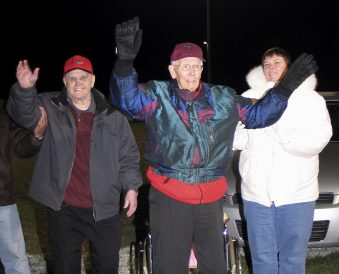
Tucutich and 1937 teammate Charles Walter (Walt) Keibler were special guests at the 2010 finale and were warmly received and recognized by the crowd of some 3,800. Former athletes, coaches, band members, majorettes, cheerleaders and longtime fans joined with their present day counterparts for the ceremonies.
It would be difficult to list all of the events held at the stadium during its 73 years of active existence.
In addition to Charleroi High’s varsity football games – an average of five per season – there were myriad junior varsity, junior high and youth football league contests staged there.
It also was used for home football games by Monongahela Valley Catholic High School and California State Teachers College. And WPIAL playoff games were staged at the site – e.g., the Class B championship affair won 39-9 by Masontown (11-0-0) over Sewickley on Dec. 4, 1937.
The stadium also featured baseball, soccer, track and tennis facilities that drew some of the top individual competitors and teams in the region.
The Pittsburgh Pirates and other Major League teams held tryouts at the stadium, and graybeard baseball fans still recall the 1960 benefit Home Run Derby in which Dick Stuart and Bob Skinner of the Pirates competed against Stan Musial and Ken Boyer of the St. Louis Cardinals.
Professional wrestling shows and amateur and for-pay boxing matches also were presented at the stadium.
Many nonathletic events also called the CHS Stadium home. These included but were not limited to high school graduations, fireworks, band concerts and other community activities.