

From printing to pedaling 1886-1896
The story so far: Wilbur and Orville Wright are teenage brothers living with their family in Dayton, Ohio. The brothers are heading down different paths. Orville is becoming a printer. Wilbur, the older brother, is thinking of college, far from Dayton, and far from Orville.
? Chapter Two
Skates hissed and clicked across the ice. Wilbur darted among the boys. He was eighteen, quick and athletic. He pushed ahead with strong legs and used his shoulders to nudge his way forward. “Coming through!” he cried. Skating toward the puck, he pulled back his club to strike. But at that moment another boy was sliding just as swiftly across the frozen lake. He swung back his club, too, swung it back hard. The club slipped from his hands, and crack – it caught Wilbur. Wilbur was used to giving and taking bruises on the ice. This was something different.
With the help of friends, Wilbur staggered toward his home on Hawthorn Street. “Wilbur! What happened?” his mother called out as he entered the house.
Wilbur just shook his head. It was too painful to try to talk; the club had hit him in the mouth. Teeth were missing. Blood stained his sweater. And Wilbur was frightened. He’d never been injured like this. He’d never felt so out of control.
Wilbur spent the next several months healing at home with his parents, his younger brother, Orville, and his younger sister, Katharine. With time, his mouth healed. But new problems developed. His heart beat too rapidly, and he had trouble with digestion. Even his personality changed. He grew withdrawn; he was no longer the brash young man who charged past others on the ice.
Wilbur’s parents had talked of sending him to college far from Ohio, to Yale University, in Connecticut. Now those conversations faded, and Wilbur stayed home. When his mother fell ill with tuberculosis and began a long decline, Wilbur devoted himself to caring for her. When he wasn’t caring for her, he was in his father’s library, reading.
In a letter home, Wilbur’s older brother Lorin asked Katharine, “What does Will do?” Lorin wondered, “Is he still cook and chambermaid?” Orville wondered about Will, too, though he put it more kindly than did Lorin.
“What will you do next?” Orville asked his brother.
It was hard for Wilbur to answer. He didn’t really know. “I’m all right taking care of things around home,” he finally said. “For now.”
By that time Orville’s career as a printer was well under way. He published his own newspaper, The West Side News, a small weekly paper for his neighborhood in West Dayton. Wilbur had helped Orville with the presses before. Now Orville drew him further in. “Help me with the News,” he told Will. “You’ve always been better with words. I could use the advice.”
“No promises,” said Wilbur. “But I’ll take a look.”
Wilbur did more than look. Soon the front page of The West Side News listed their names this way: Wilbur Wright … Editor, Orville Wright … Publisher. In April of 1890 the brothers expanded the paper into a daily, and it became The Evening Item.
The brothers were working together, but it was a difficult time for them both. Their mother, Susan Wright, died in July. And working together was not at first a success. The Evening Item barely outlasted the summer. The firm of Wright & Wright did other printing jobs, too, but the brothers had almost as little luck with that work as with their papers.
“Work is scarce all around,” Orville said.
“People are more interested in how we’re printing than in what we’re printing,” Wilbur said.
It was true. Friends knew that the Wrights built and ran their own presses, and word of the brothers’ mechanical ability spread. People came by to have things fixed. They especially wanted help with the wheels, gears, and chains on a new and exciting kind of machine – the bicycle.
People enjoyed a new sense of speed and freedom as they rode their bicycles. Orville was the first of the two brothers to buy one, a new Columbia bike, one of the best brands around. Once he had a feel for it, he took it racing with his friends.
Wilbur waited. Finally he bought a used Columbia for half of what Orville had paid, and took it for quiet rides on the outskirts of Dayton. But sometimes the brothers rode together. One thing they talked about while riding was what to do next in their shop.
“We get too little of the work we charge for,” Wilbur said.
“And too much of the work we do for free,” said Orville.
“Well, if people want us to fix bicycles – “
“We’ll fix bicycles.”
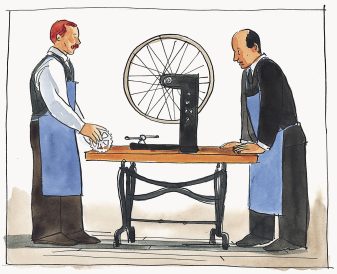
In December, 1892, a sign announcing the “Wright Cycle Exchange” appeared over a shop at 1005 West Third Street. The brothers set up an orderly showroom downstairs. Upstairs they built a workshop, where they repaired bicycles and made them, too.
The new workshop delighted Orville; nothing gave him more satisfaction than solving mechanical problems. But Wilbur felt differently. Ten years after his accident, he still struggled to find a sense of direction.
“It’s nothing against working with you, Orv,” Wilbur told Orville one day. “You know that. But I ask myself, what do I really want to do? Sometimes I still think about college, or teaching.” He paused. “But I don’t know. That’s the worst part. I just don’t know.”
Wilbur would finally find his new direction in the summer of 1896. He would find it in the most unlikely of places, in the most unlikely of forms.
The flying man: August 1896-May 1899