

Spotlight on the Valley
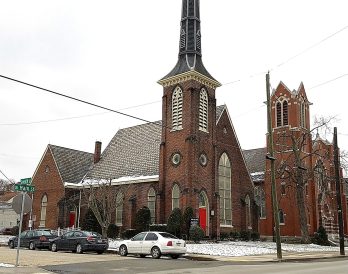
The spotlight will fall on the Bethel African Methodist Episcopal Church in Monongahela when WQED airs a documentary titled “Come By Here: A History of Five Churches.”
The historic Monongahela church, whose congregation dates back to 1834, is said to have played a role in the Underground Railroad, the network of supporters who aided Southern blacks fleeing slavery and heading north to freedom.
The church is one of five included in the documentary that airs at 8 p.m. Thursday by former broadcast reporter, documentary film producer and Ringgold High School graduate Beth Dolinar.
In addition to the on-air broadcast, the 30-minute-long documentary also will be screened at the regular meeting of the Monongahela Area Historical Society that same evening at 7 at First Presbyterian Church, , 609 Chess St., Monongahela. Those who attend are asked to enter the church through the Chess Street entrance.
“The public is invited to attend, free of charge,” said Laura Magone, historical society spokeswoman. “Several people involved in the project will be in the audience, and we will encourage them to speak of their experiences with the documentary.”
Refreshments will be served afterward.
Historical society member Charles Talbert found a documented reference to the church’s connection to the Underground Railroad in a book titled “Homecoming: A Celebration of Monongahela History,” written by Joseph Taylor Armstrong in 1908. Talbert passed this information along to Dolinar as an aid to her research.
According to Talbert, the book is a collection of articles on the history of the river town submitted by different authors. In one account by Armstrong, who lived as a boy in his aunt’s house on Main Street, a barn behind the house was used to hide runaway slaves. Armstrong’s uncle worked on the river, and Armstrong remembers that when he was a boy, he helped transport the slaves across the river by boat.
“A minister of the Bethel AME, the Rev. William Ralph, was also known as one of the fastest teamsters who traveled the Washington Pike, which ran between Monongahela and Washington,” Talbert said.
Ralph is thought to have secreted runaway slaves in his wagon for transport to Monongahela, where they were hidden in the Armstrong barn before transport across the river.
The present church, a brick building in the Gothic Revival style, wasn’t completed until 1871, well after the Civil War and the even earlier era of the Underground Railroad. According to Talbert, however, the congregation met in several buildings in town for services before construction of the church. It was in this era that they developed the Underground Railroad connection, especially through the efforts of Ralph.
The idea for the project germinated last fall when WQED executive producer David Solomon asked Dolinar to work on a documentary that could be aired in February as part of Black History Month.
“While we consider content throughout the year that celebrates the diversity of our region’s population, we make a special effort to spotlight African-American stories with historical significance for broadcast in February,” Solomon said.
Dolinar has been creating both short- and long-form storytelling ventures for WQED since 2006. According to Solomon, her first piece, a short feature on Ebenezer Baptist Church in Pittsburgh, won an Emmy for its look at the valiant recovery efforts of its congregation after a devastating fire in March 2004.
“Looking for fresh material, we decided to focus the documentary on black churches in the region,” Dolinar said.
To help research the subject, the documentarian consulted Shane Austin, a local minister who also teaches a course in black church history at the University of Pittsburgh.
“While there are dozens of black churches in the region, we decided to focus on five, each with a different facet or theme,” Dolinar said.
Besides Bethel AME Church, the documentary includes the music of Mt. Ararat in the Larimer neighborhood of Pittsburgh, which is known for its choir, and the civil and human rights contributions of Ebenezer Baptist Church in Pittsburgh, once visited by the Rev. Dr. Martin Luther King.
Dolinar and her assistant producer, Iris Samson, also wanted to include a segment on tiny churches often found on back streets and country roads, and chose to spotlight the six-member congregation of Allen Chapel in Elizabeth by showing its determination to keep it going.
The fifth and final church in the documentary addresses the role of northern industrialists who went south after the Civil War looking for labor to man their factories. One of these, the owner of the Rosensteel Tannery in Johnstown, allowed his workers to worship in the loft of his business. Eventually, the congregation evolved into today’s Cambria Chapel Zion AME in Johnstown.
“We are thrilled to be able to showcase our own important historical church and documentary to the public,” said Susan Corbelli Bowers, president of the Monongahela Area Historical Society. “It’s exciting that WQED was in town filming a significant project that pays tribute to the Bethel AME church and congregation, which features some of our members who help tell the story.”
In addition to the 8 p.m. broadcast on Thursday, the documentary will repeat at 7:30 p.m. and midnight Feb. 27.