

Thankful Washington mom spreading word about epilepsy

Keith Patterson, front left, is shown with sister Mackenzie, back, and cousins Peyton and Carter. Mackenzie is wonderful with her little brother, who has epilepsy, says their mom, Christina Patterson.
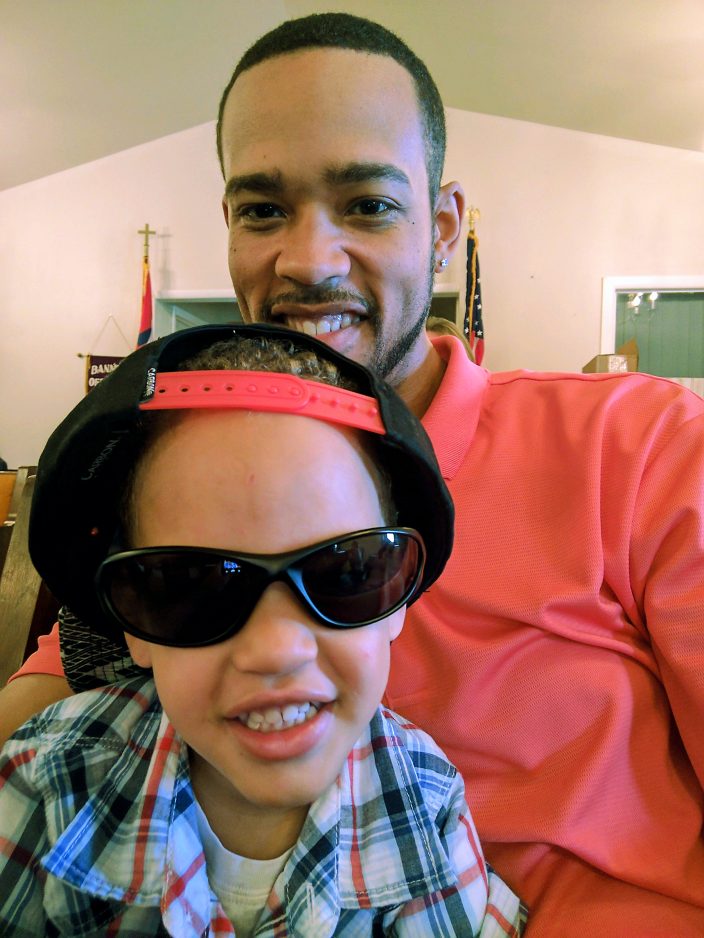
Keith with his father, Chase

Keith and his mother, Christina
Keith Patterson loves Mickey Mouse and monster trucks. Like most 2 year olds, he prefers running around, jumping and climbing to sitting still.
But Keith has to be more careful than others his age, because one minute he can be fine, and the next, he’ll fall to the floor. He’s chipped his teeth, split his lip and had to have stitches in his forehead as a result of such falls.
Keith has Doose syndrome, an epilepsy syndrome of early childhood usually characterized by difficult-to-control seizures. Keith, son of Christina and Chase Patterson of Washington, started having seizures at 6 months old, but it wasn’t until March of this year that his parents finally got a diagnosis. Doctors have been trying different medications, only to find that they didn’t help or even worsened his seizures.
There was a time when Keith would have as many as 40 seizures a day. Due to a new diet and effective medications, though, Christina is especially thankful this holiday season.
“He’s been extremely blessed. Forty (seizures a day) is minimal compared to other children,” she said. “He walks and talks and is extremely smart.”
As November is National Epilepsy Awareness Month, Patterson is talking about Keith’s diagnosis to bring awareness to seizure disorders.
“It’s real and it’s hard,” she said. “Epilepsy can control your life if you let it. It’s not just one seizure or two seizures, it’s an ongoing thing.”
Epilepsy is characterized by unpredictable seizures and can cause other health problems, according to the Epilepsy Foundation. The term covers a wide range of seizures, in which there is a sudden surge of electrical activity in the brain. One in 26 people will develop epilepsy at some point in their lives, and experience a variety of seizure activity.
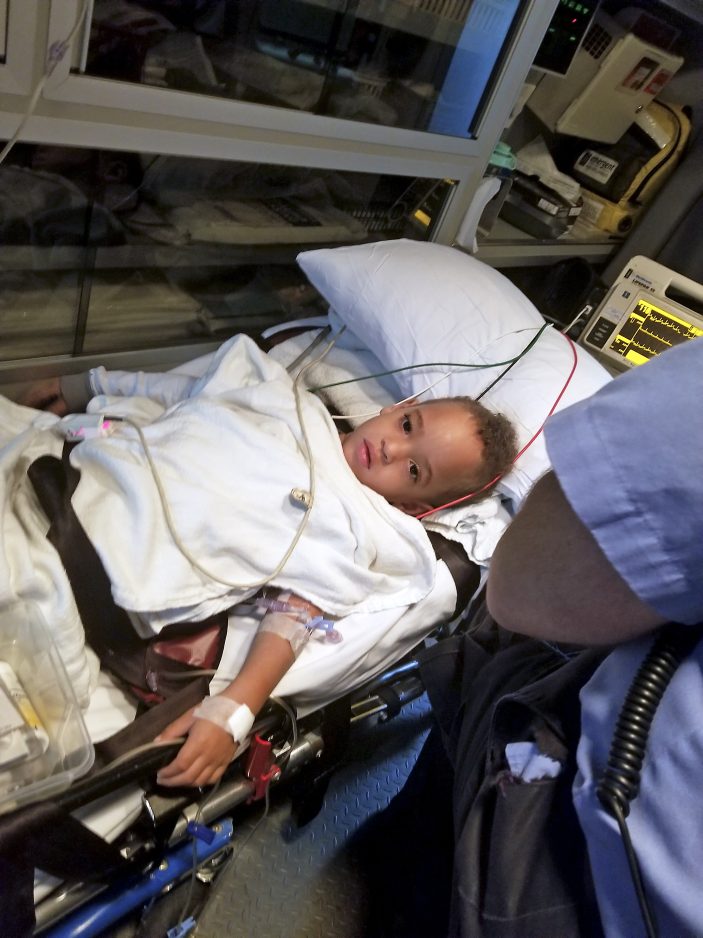
Keith in an ambulance after a seizure
In Keith’s case, the little boy suddenly drops to the floor, or he tenses up and his body jerks forward. To help protect him from injury, he wears a helmet. The family also must be careful with what they allow him to hold in his hands. Forks, pencils and even toys could cause significant injury.
After Keith has a seizure, it takes a little time for him to regain control of his arms and legs.
“We just move on because it’s become a normalcy for us,” said Patterson. “Keith knows he has seizures. He’ll tell other kids he has to wear a helmet because of them.”
Keith is also knowledgeable about his strict diet.
“If he sees other kids with candy, he’ll tell you, “That doesn’t work with my diet,'” said Patterson.
Keith is on the ketogenic diet, which is high in fat, provides adequate protein and is low in carbohydrates.
According to the Charlie Foundation, 30 percent of people who have epilepsy do not respond to anti-seizure medications. The diet offers improvement to the majority of people with epilepsy who use it.
For Keith, the diet has “been the answer to our prayers,” said Patterson. “Even if he has a seizure a day, compared to before …”
Patterson started him on the diet at the advisement of Children’s Hospital of Pittsburgh neurologists. She measures everything in grams, and combines most of his food with butter. Certain things, like sugar, are strictly forbidden.
At first, Patterson wouldn’t let the family, including 10-year-old daughter Mackenzie, eat forbidden foods, like potatoes and rice, in front of Keith.

Keith, with sister Kenzie, has to wear a helmet in case he falls.
“Then I got realistic,” she said. “We just had to learn to adjust. Luckily, he likes pretty much everything. Although, they would like him to eat avocado – that’s not happening.”
Instead of noodles, Patterson makes spaghetti squash. Instead of mashed potatoes, they eat mashed cauliflower.
“Keith enjoys what he can have,” she said. “I’m thankful we’ve always had him eat healthy.”
Although it can take months to fine-tune the diet, Keith seems to be responding favorably. In October, for the first time since he was 6 months old, he started to have days with no seizures. He had an 18-day stretch where he had no seizures at all.
Keith is currently on three medications. The goal of the diet it to control the seizures without medication.
Regardless of Keith’s seizures, the Pattersons try to let their son have as many experiences as possible. Christina continues to research epilepsy and is determined to raise awareness.
“It can be hard at times, but we have a great family support system,” Patterson said. “I know the struggles my son faces daily, and know there are other children who are worse. They need a cure.”
For information, visit www.epilepsy.com or www.charliefoundation.org.