

Governor’s recommendation may silence marching bands
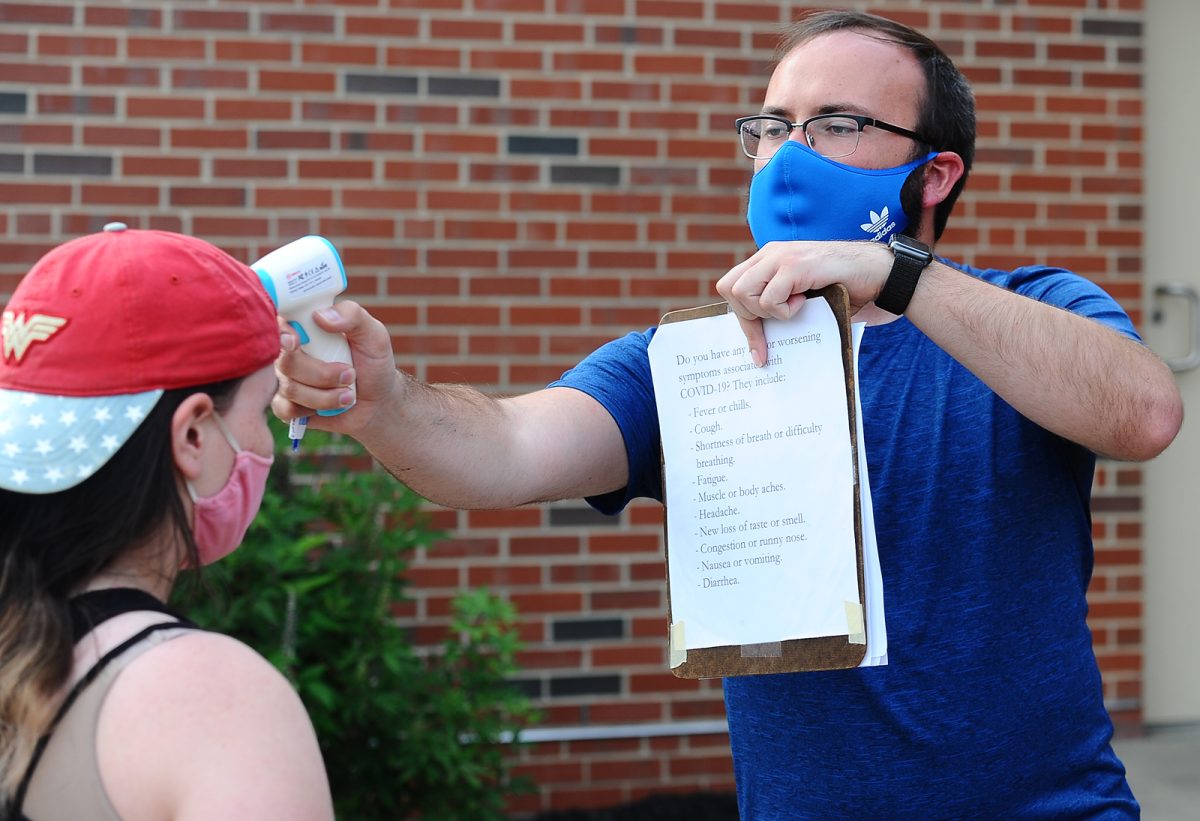
Trinity band director Dan Hilty takes a temperature check while asking required health questions prior to practice.
Eleanor Bailey/The Almanac
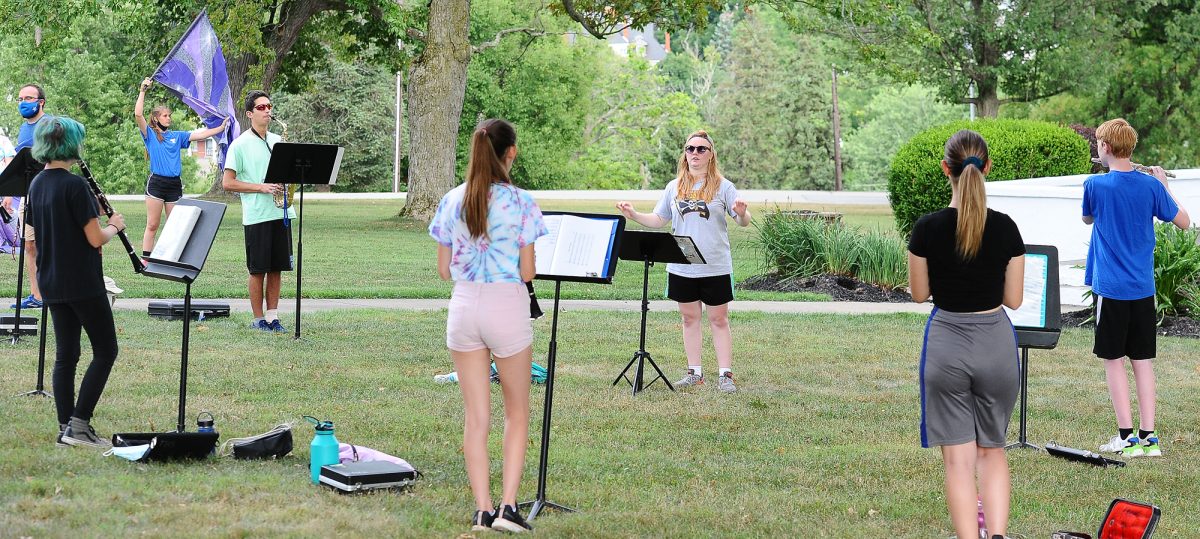
Trinity drum major Elle Rush, center, leads a wind section during band camp while director Dan Hilty (mask) listens and Sydnie Garrett (background) maneuvers her flag.
Eleanor Bailey/The Almanac
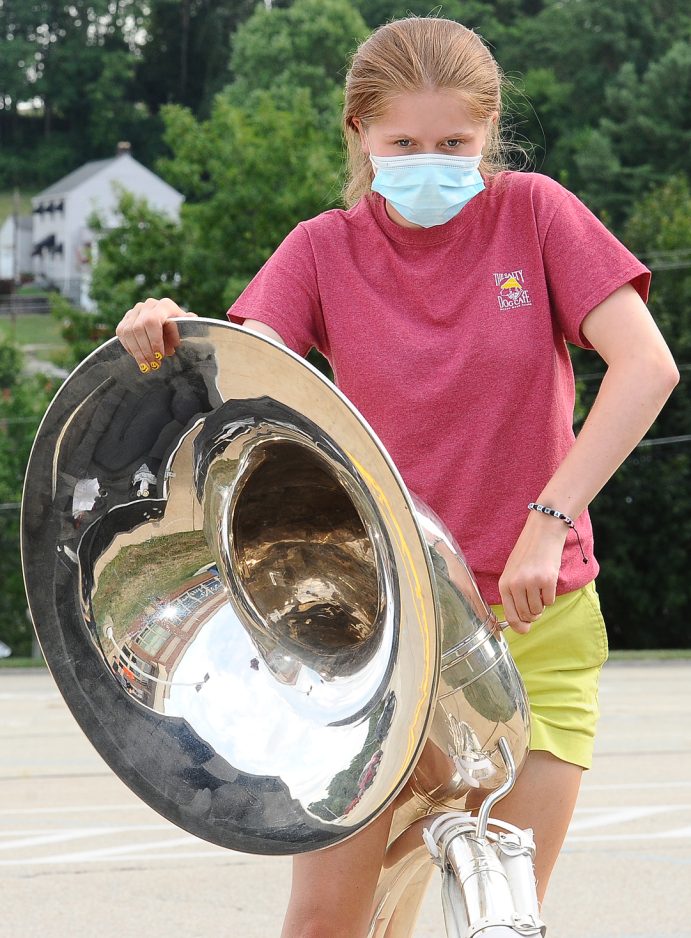
Savannah Ikach adjusts her sousaphone prior to practice at Trinity band camp.
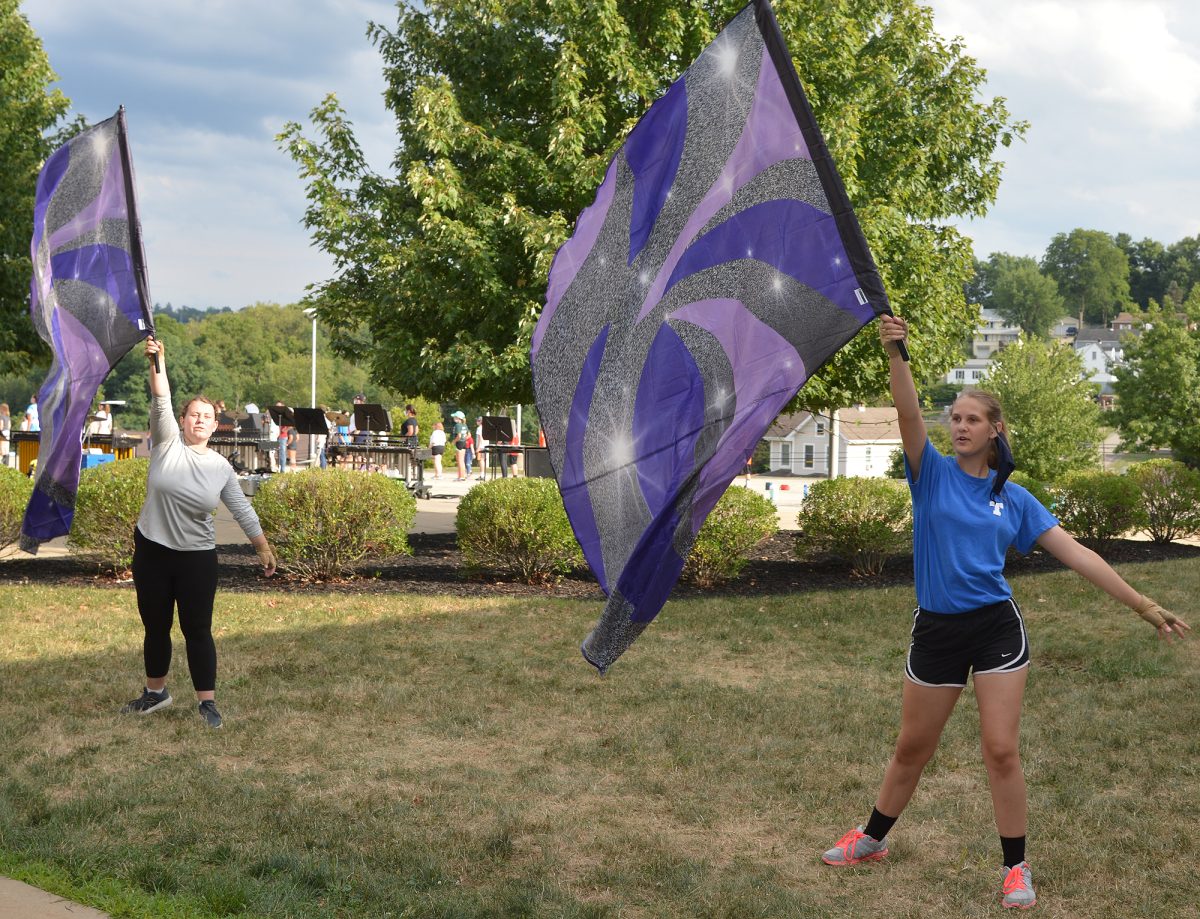
Meredith Bryant and Sydnie Garrett practice their flag twirling at Trinity band camp.
Eleanor Bailey/The Almanac
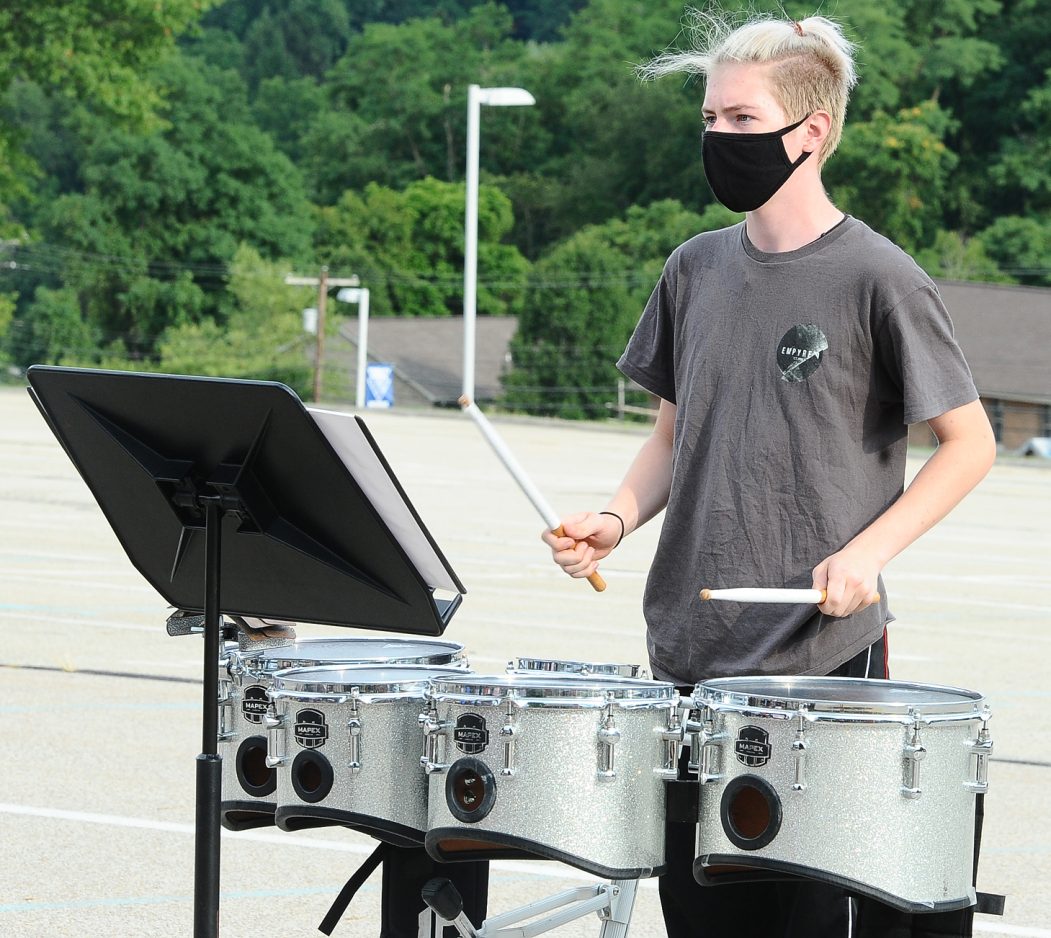
Even Berry practices during band camp.
Eleanor Bailey/The Almanac
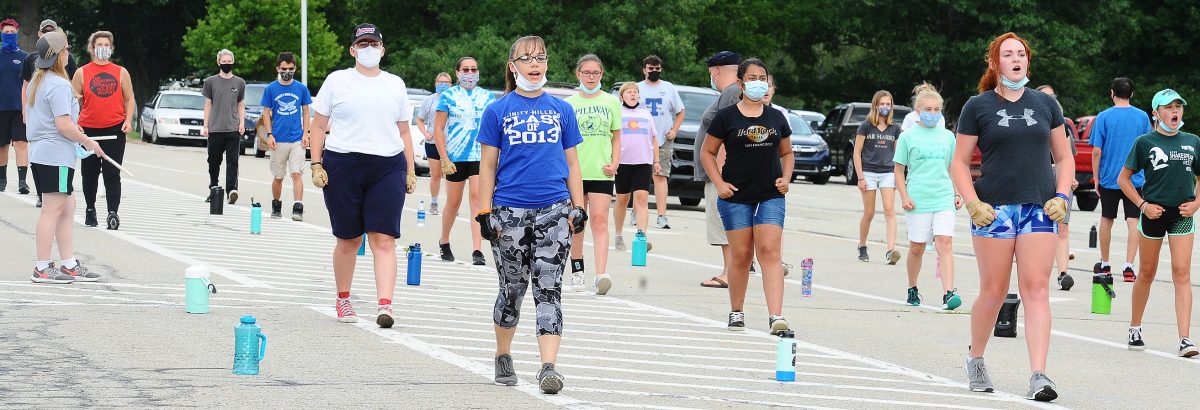
Alyssa Burtoft, front left, leads Trinity band members as they are put through their marching paces by drum major Elle Rush (with drumsticks).
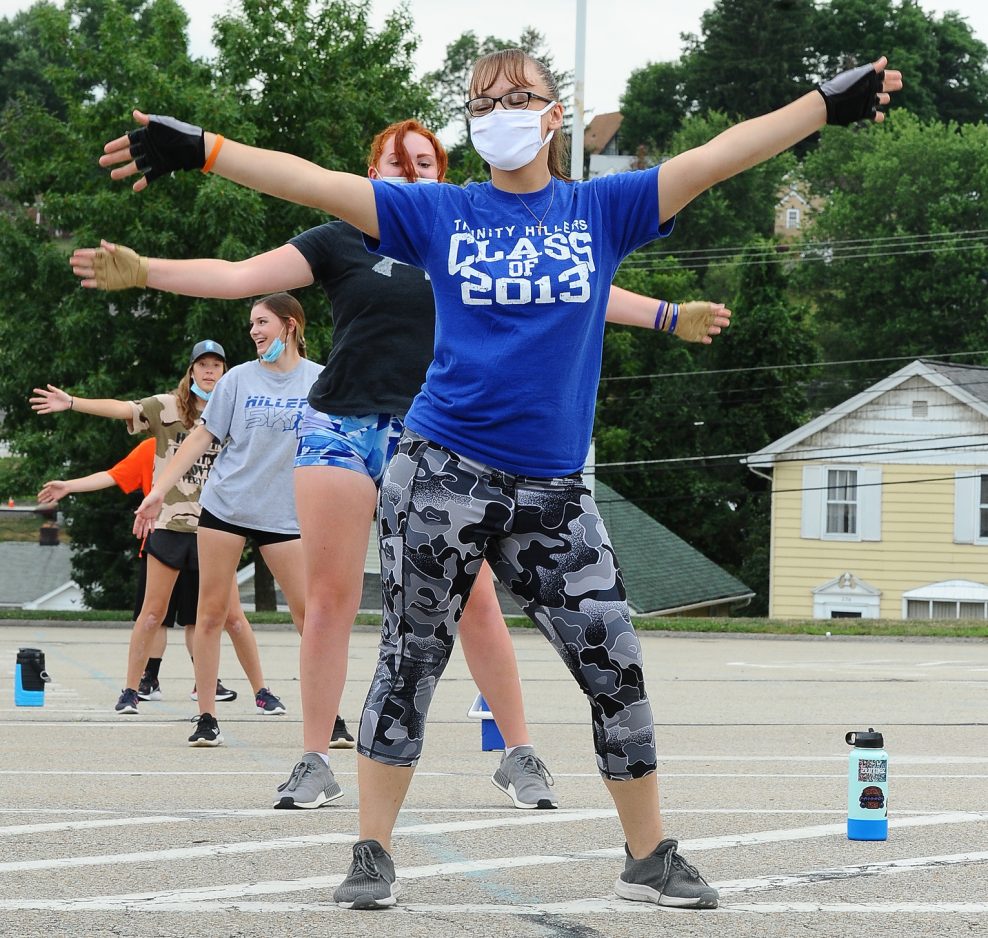
Alyssa Burtoft leads Trinity band members during a warm-up drill at band camp.
Eleanor Bailey/The Almanac
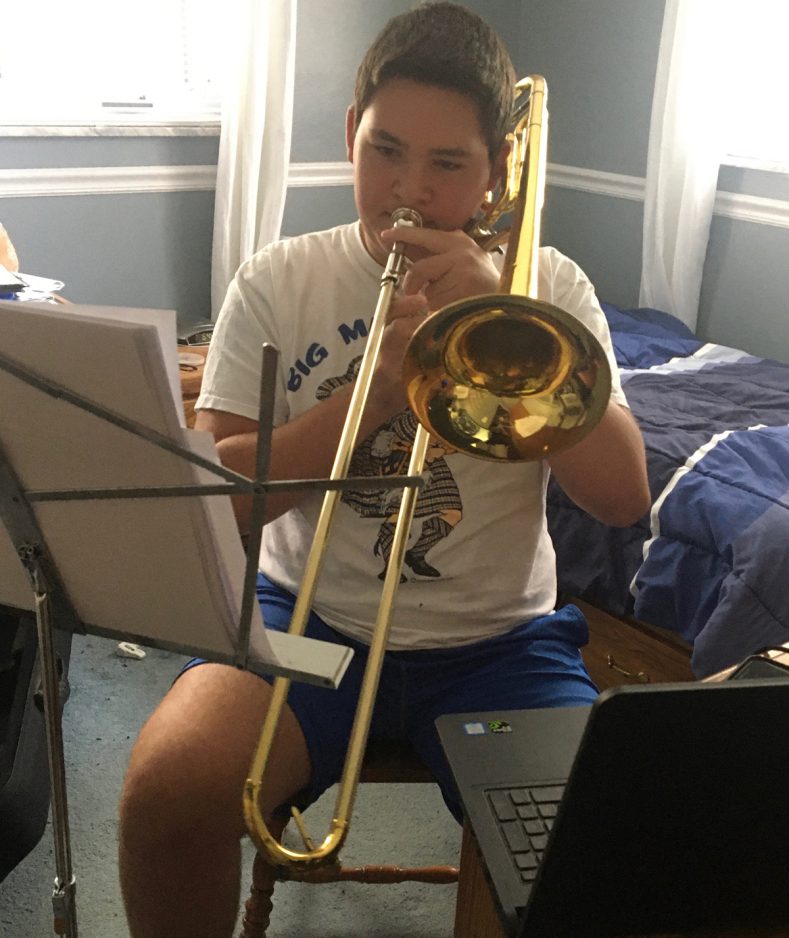
Jacob Street, one of Canon-McMillan’s trombone section leaders, practices his part of “I’m Still Standing” during Zoom band camp. The Big Macs are meeting and training virtually because their numbers exceed the guidelines for gatherings and distancing.
Will high school marching bands get to take the field this football season or will they have to yield to the ever-changing parameters set by government officials during the coronavirus pandemic?
“We are hoping right now,” said Mark Falvo.
The Canon-McMillan High School band director and his musicians are still preparing, although virtually, for halftime performances. In fact, their planned show speaks to their positive outlook as they incorporate songs such as Elton John’s “I’m Still Standing” and Journey’s “Don’t Stop Believin'” into their repertoire.
“Optimism,” said Falvo. “It’s not a theme per se, but the kids came together and decided they wanted to do something uplifting. So all the songs will boost the spirits.”
Those spirits were dashed, however, when area ensembles realized that although the WPIAL and PIAA gave the green light to scholastic athletics to resume this fall, guidelines set forth by Gov. Tom Wolf and the Pennsylvania Department of Health place restrictions on attendance at sporting events.
Issued June 10 and updated July 15, the state Health Department provided guidance for all sports permitted to operate during the COVID-19 disaster emergency. The directive limits gatherings to 250 people at outdoor gatherings and 25 indoors. Sports-related activities are limited to student athletes, coaches, officials and staff. The list did not include bands or cheerleaders.
Until Thursday, that was the “state of affairs,” according to WPIAL executive director Amy Scheuneman. After Wolf’s daily coronavirus press briefing, though, it now seems the entire high school athletic scene could be shuttered until 2021.
“The guidance from us, the recommendation, is that we don’t do any sports until Jan. 1,” Wolf said Thursday in response to a reporter’s question concerning high school sports. The decision regarding sports should be made by elected school boards, the Department of Health and Department of Education said later.
The PIAA Board of Directors met Friday and issued a statement saying it believed it can safely sponsor fall sports. Until the board reconvenes Aug. 21, however, mandatory fall sports activities are paused for the two-week period. Voluntary workouts per the Governor’s Guidance for All Sports and with local approval may continue.
Meanwhile, the WPIAL will meet at 10 a.m. Monday, at which time it will release a statement.
The state’s pronouncement disappointed Trinity Hiller Marching Band members. They have been attending band camp and preparing to provide halftime entertainment for football games that would be live-streamed to fans.
“I was extremely disappointed,” said Emma Liggett. “I was extremely excited for the season because I really like marching band. But, I do understand. The governor just wants the students of PA to be safe.
“I do hope they change their minds because I feel that with all the precautions we have taken we could get by with the season.”
Dan Hilty has complied with all the guidelines. The Trinity band director does temperature checks for all the members. They, in turn, must complete a daily health questionnaire. Additionally, they adhere to physical distancing requirements and break up into smaller groups to practice.
“We have gone through all these hoops and all of a sudden it’s another change,” said Hilty. “It’s frustrating.
“They hit us hard with this one. I was kind of surprised and a little bit let down,” he continued. “I understand where (Wolf) is coming from, but when you put all this planning and work into it, especially when you are so far into the rehearsals and all the time you’ve put into doing it right, it’s frustrating.
“We were hoping that we are able to give these kids a safe, positive experience. That’s my whole thing. I feel like we can’t do too much more at this point.”
All the Hillers and other marching bands can do now is hope.
“I’m honestly not surprised,” said Elle Rush of the state’s recommendation. “It’s for everybody’s safety of course. That’s most important.
“It’s pretty sad,” admitted the senior drum major, “but we are going to get through it. Keep that positive attitude.”
She is thankful that to date she has had some practices before she heads off to college. A trumpet player, she plans to major in music education at a school in Florida.
“At least we have gotten out here and we have had something to do to get out of the house during quarantine,” she said. “That’s really a big plus. At least we have had some of the season.”
While her dreams of leading the marching band may be vanishing, Rush demonstrates a maturity and leadership when she says, “I’m here for everybody and I’m keeping my positive attitude, which is one of the most crucial things. It’s sad, but we will get through this.”
While the Trinity band features 58 members, including 30 musicians who play wind instruments, Canon-McMillan showcases nearly 250 players. Because that is the maximum for gatherings, the Big Macs have had to practice via Zoom meetings.
To orchestrate these virtual practices requires precision. Each student section leader works with the metronome to insure timing and that fellow players are in sync.
“It’s very difficult,” said Falvo, because of the lag time and various internet connections, “but we’ve been able to put it together. The kids are upbeat,” he added. “They have been really happy to see each other because they have been isolated for so long. In fact, we spend our first 45 minutes together just talking because they’d missed that socialization. We’ve all been in the same boat.
“I think though we’ll be all right. The kids will be fine. They are resilient.”
C-M’s sheer numbers present challenges for practicing in person. Because of the aerosols created by wind instruments, distancing is a particular concern.
According to Falvo, the band’s make-up is two-thirds wind and the rest percussion and auxiliary performers, such as color guard and rifles. With 18 trombonists alone, 81 square feet is required because studies have shown a safe distance is nine feet rather than six.
“Our size is our biggest problem,” Falvo said. “For a band our size to meet and play, we’d have to be too far away from each other, and that creates timing issues.”
Should there be a football season, that would be the least of Falvo’s worries. He has created a variety of “scenarios” and is attempting to remain as “flexible as possible.” However, he wants to see his band perform as its own entity.
“That would be the best-case scenario but, if allowed, we may have to figure out how to perform because it can’t be in the traditional sense,” he said, noting that with two football teams, coaches, officials and all the added personnel including medics and ticket takers,that number could approach 250.
“It’s all a numbers game, and a lot of other bands our size are in the same boat. If you take out the fans, the student body, the cheerleaders and bands, it’s not football anymore. Each element is as important.”
Scheuneman agreed. As far as the WPIAL executive director is concerned, bands as well as fans and cheerleaders contribute to the Friday Night Light experience as much as the teams on the field.
“They’re integral,” she said. “They all play into the atmosphere of an event.
“Especially if there are not going to be fans,” she continued, “the bands would provide a better atmosphere for the game. It’s an opportunity for more students to be part of something as well.”
Some hope that political officials and school boards see it that way, too.
Already the marching bands have lost much. There have been no Fourth of July parades, no Fall Fantasy Days at Kennywood Park, no county fairs, no band festivals or competitions, no Octoberfest, no Thanksgiving Day parades. The first scheduled opportunity could be Light-up Night the first weekend in December in Canonsburg.
“We have to find a way. We have to figure it out,” Falvo said.
“It’s very disappointing when my seniors ask, ‘Will we get a homecoming, will we have a senior night?’ Can we give them that and keep them safe? What we want and safe is not the same thing.”