

School bus firms navigating a lot of COVID-related bumps

This plexiglass partition developed by Dale Lyons, vice president of Schweinebraten Bus Co., will not be put into service on school buses as it did not meet state vehicle code.

This plexiglass partition developed by Dale Lyons, vice president of Schweinebraten Bus Co., will not be put into service on school buses as it did not meet state vehicle code.
Observer-Reporter
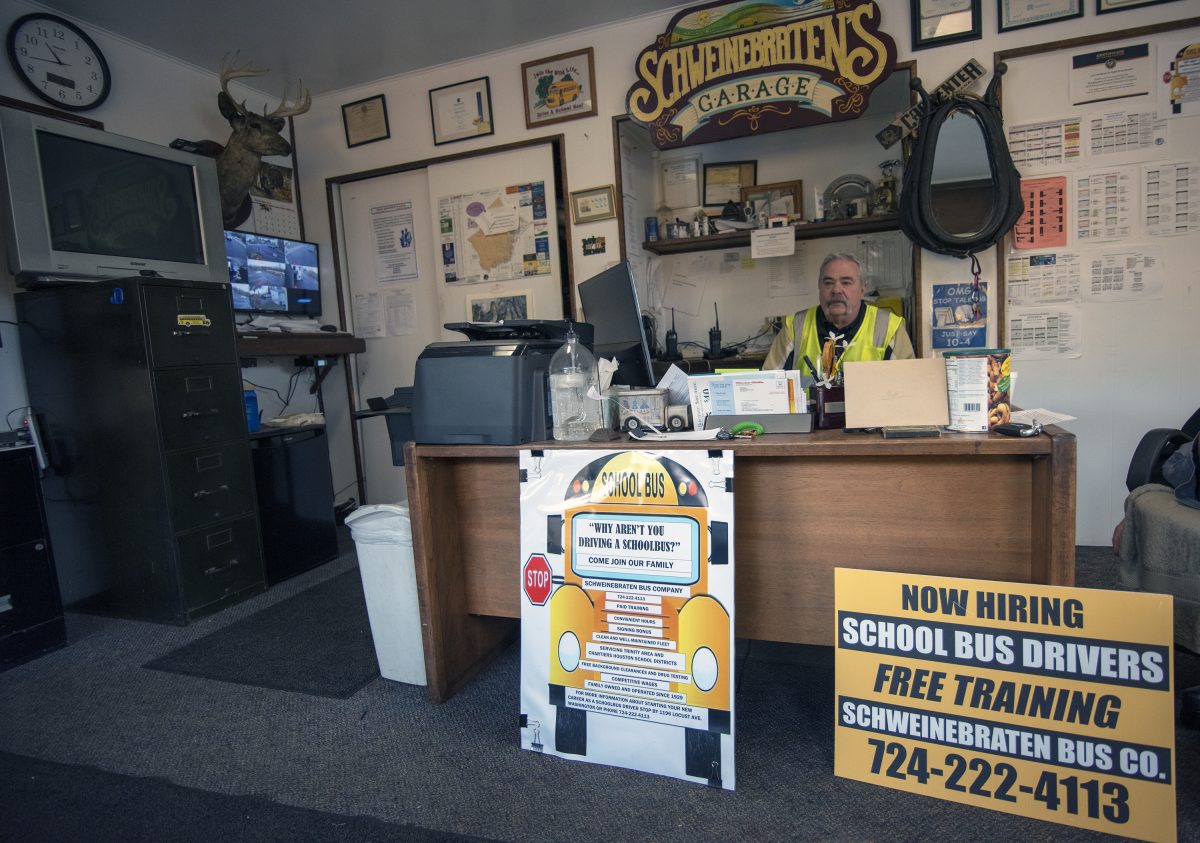
Dale Lyons of Schweinebraten Bus Co. discusses the shortage of bus drivers nationwide in 2018 from inside the offices at the bus garage on Locust Avenue in South Strabane Township.
Dale Lyons thought he had successfully undertaken an extraordinary measure for these extraordinary times.
In an effort to safeguard his drivers against COVID-19, the vice president of Schweinebraten Bus Co. developed plexiglass partitions that would essentially enclose the operator in his/her seating area, away from students they would be transporting. Two pieces would go from floor to roof, one behind the driver, another to the right. Lyons went so far as to get a patent for the device.
“It was basically a big sneeze shield for the driver,” he said. “I didn’t want them wearing masks if I could help it.”
The partitions, however, did not meet state vehicle code, according to Lyons. “It changed the integrity of the bus.”
So now it will be masks or face shields for Schweinebraten drivers, and masks for its student passengers – who will be fewer in number in vehicles than in the past, and seated farther apart.
Extraordinary times, indeed.
To combat the coronavirus, area school districts are largely following Centers for Disease Control and Prevention guidelines for those students who are riding buses or vans to school, and local companies under contract to them are adhering to the guidance. For those being transported to school, that means masks and social distancing as much as possible inside vehicles, with cleanings between trips and thorough sanitizing at the end of the day.
Buses are not expected to be as crowded in districts that are instituting hybrid learning, where some students go to classrooms on Mondays and Tuesdays and their classmates on Thursdays and Fridays. (Wednesdays will be devoted to deep cleaning of buses.)
Safety is paramount during an outbreak that, as of Tuesday, had claimed more than 163,000 lives in the United States. Bus and van drivers, in particular, are at risk. Many in Southwestern Pennsylvania are older, some of them retired from careers, some with pre-existing health conditions that could leave them more susceptible to contracting the disease.
The pandemic is occurring at a time when school transport companies nationwide have been dealing with a severe driver shortage. This has been a quandary in recent years, with the ranks diminishing further during the outbreak. Some older drivers resign out of concern for themselves and their families, and aren’t being replaced by a sufficient number of willing applicants.
“We’re hiring. We’re always recruiting,” said Trudy Skinner, regional vice president for GG&C Busing Co. She said the Washington-based firm needs drivers for school buses, who require a commercial driver’s license, and vans, who don’t.
“A lot of drivers fall into the risk category of COVID-19,” she said. “Most drivers are eager to get back because they’ve been away for so long. But we lose some who say they have a wife or husband who is at risk.”
Lyons, of South Strabane Township-based Schweinebraten, said his company appears to be retaining its complement of drivers. He added, however, that “our biggest fear is one of our drivers getting sick. If one has to quarantine, a bunch may have to quarantine.”
Drivers aren’t the only ones who could be in peril en route to school, though. Young children and teenagers can be infected as well, and concerns about those age ranges have risen in recent weeks.
Skinner said GG&C will strive to separate students, but sticking closely to the CDC guideline “is not doable.” She said that calls for 12 students on a 72-passenger bus, meaning GG&C “would need a tremendous amount of vehicles and drivers.”
She said each school district forms its own plan, which usually leads to loading a bus from back to front, minimizing the number of students each will pass. Family members will sit together.
“Windows will be open as much as possible,” Skinner said. “Even on a rainy day, we want at least one or two inches for air flow.”
Aaron Scott, transportation director for Trinity Area schools, said the district has a fairly large number of cyber students, so “our numbers on the buses will be way down.”
He said the district purchased electrostatic sprayers, for deep cleaning of buses, at a fortuitous time: just before the coronavirus hit Southwestern Pennsylvania in mid-March. All students and drivers, he said, will wear masks.
A representative of Fox Bus Co. in Waynesburg, which serves Central Greene School District, said the fluidity of the situation makes it difficult to determine specifics at this juncture.
“We will do everything we can to keep kids safe and drivers safe,” the representative said. “(Social distancing) on most of our buses won’t be a problem because we have partial loads, a lot of feeder routes. We don’t have full routes.
“I can say we’re heading into our 52nd year and have never seen anything like this.”