

Local hospitals working to maintain PPE amid COVID-19, impending flu season
Courtesy of Washington Health System
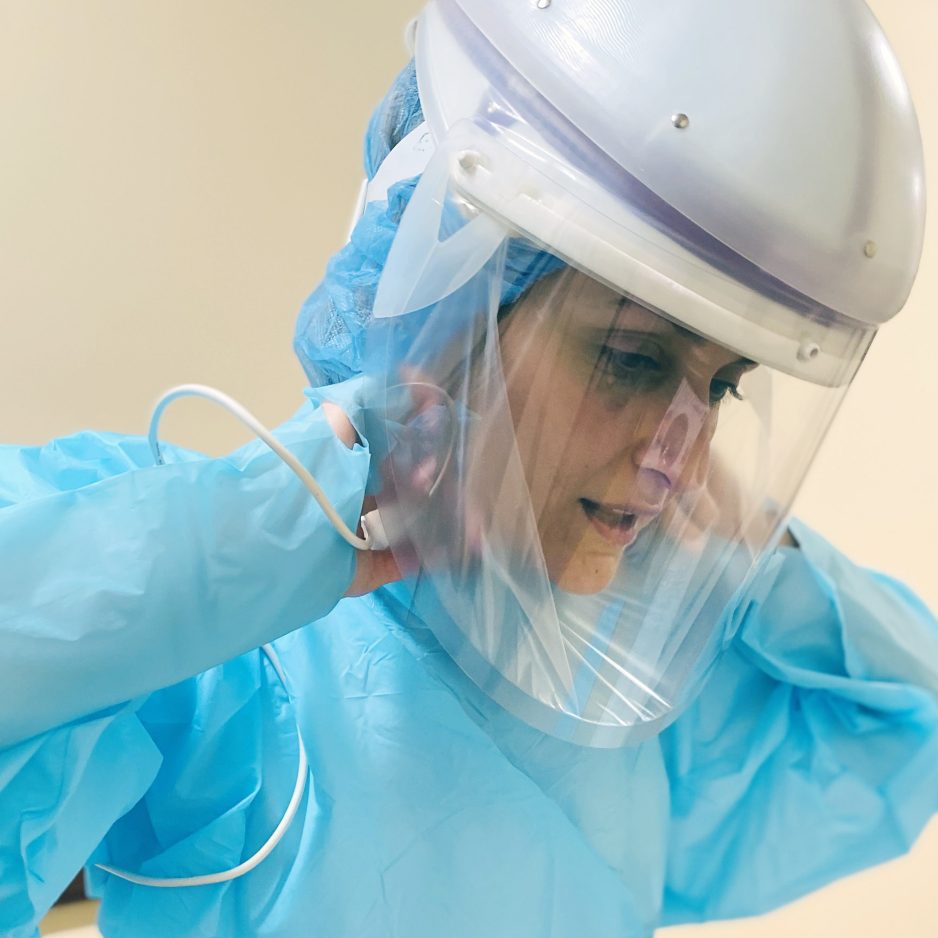
WHS employee Chelsea Lang demonstrates how to put on the MAXAIR helmet. The hospital has been conserving and stockpiling PPE as the COVID-19 pandemic continues.
Courtesy of Washington Hospital
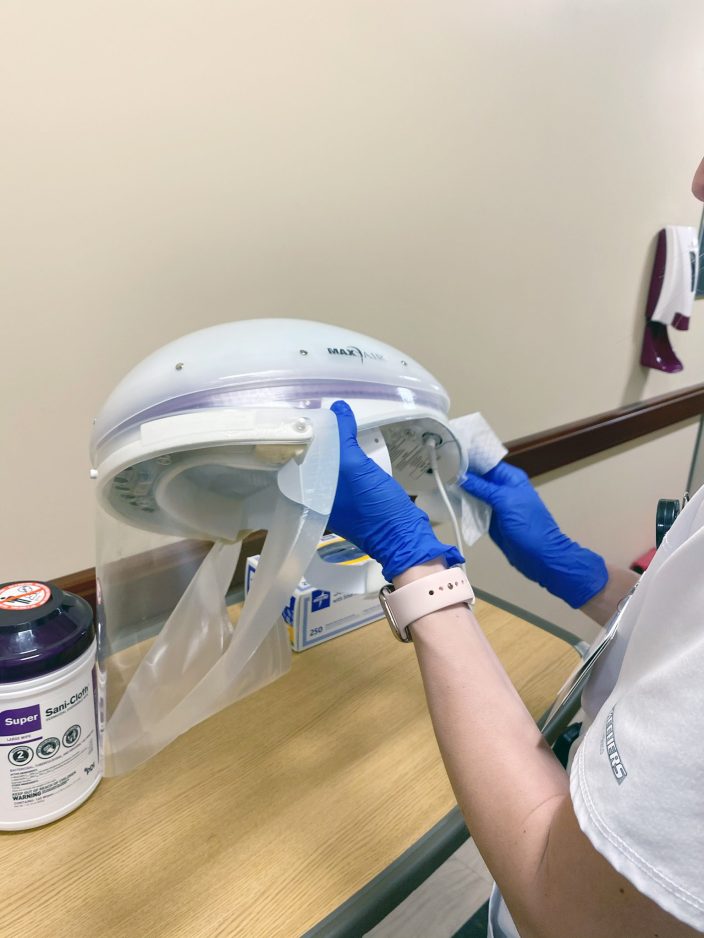
A WHS Washington Hospital employee cleans a MAXAIR helmet, part of the hospital system’s PPE equipment.
As Washington and Greene counties reopen amid novel coronavirus – and as cases in the region continue to rise, hospital officials are mindful the respiratory disease isn’t going away, and that there is no vaccine.
Local hospitals also are looking ahead to flu season, which officials believe will be complicated by the COVID-19 pandemic.
As part of their planning, hospitals have continued the task of stockpiling personal protective equipment (PPE), including masks, face shields and gowns in preparation of a future surge.
At the same time, health care workers continue to conserve PPE because they do not know what the future needs will be.
Dr. Thomas Corkery, chief medical officer at Allegheny Health Network Canonsburg Hospital said hospitals are prepared for the likelihood COVID-19 will persist.
AHN currently has adequate supplies of PPE, and is doing everything it can to ensure its hospitals continue to have enough to protect its health care workers as they provide care to patients.
“I think we’re pretty well prepared. Western Pennsylvania had some lead time, so we have a lot stockpiled, but we still conserve PPE,” said. Dr. Corkery. “Right now, we’re doing fine, but a big concern is that when flu comes we’re going to be using a lot of PPE because we’ll have to discern between flu and other viral diseases. We’ll continue to conserve because we don’t know what to expect. We’ll probably see peaks and valleys.”
The pandemic has strained the worldwide supply of PPE, including masks, face shields and gowns.
In an email, Minnesota-based mask-maker 3M Co. said despite doubling its production of N-95 respirators and working around the clock, global demand caused by the COVID-19 pandemic continues to exceed the ability of suppliers to manufacture it.
Because of the scarcity of disposable respirator masks frontline workers need to work with COVID patients, AHN last month partnered with MSA Safety in Murrysville to procure P100 industrial grade respirators that can be disinfected and reused repeatedly.
“That reduces our need for N-95s because the (P100s) are reusable,” Corkery said.
Some hospitals now are using new technology to disinfect and re-use N-95 masks.
Washington Health System also is confident it currently has an adequate supply of PPE for its health care workers.
Hospital spokesperson Stephanie Wagoner said WHS contracted with a private purchasing company in the spring to acquire PPE, and ended up with an abundance of surgical gowns and other items.
“We were able to assist other local health systems by distributing some of the items we had to facilities in need,” Wagoner said.
The hospital also recently purchased 72 additional MAXAIR helmets for health care workers.
“We have already begun planning and ordering for a potential surge. WHS feels confident that we will be ready, if a surge occurs,” said Wagoner.
According to the Centers for Disease Control and Prevention, more than 72,000 healthcare workers nationwide have tested positive for COVID-19, and more than 380 have died.
More than 5,000 healthcare workers in Pennsylvania have tested positive for the virus, Pennsylvania Association of Staff Nurses and Allied Professionals said.
Since the outbreak, Pennsylvania Department of Health has distributed PPE to hospitals, long-term care facilities, first responders and others who need PPE. Among the supplies it has provided are more than 5.2 million N-95 masks; close to 621,000 gowns; more than 2.5 million procedure masks, more than 4.7 million gloves, more than 1.2 million face shields, more than 892,000 bottles of hand sanitizer and more than 105,000 coveralls.
At the same time, DOH has been working to rebuild its PPE supply to prepare for subsequent waves of COVID-19, and also the potential for other disasters that would require PPE.
Health care facilities are also expected to have their own supply of PPE, and many of them are working to resupply themselves.
The national stockpile was largely depleted, but the federal government has continued to push out PPE to states and also directly to facilities as it can, said DOH spokesman Nate Wardle.
The supply chain is improving, and prices on PPE are falling in comparison to costs six weeks ago, according to Michael Paul of Doctors Business, a PPE distributor in McMurray.
John Zambelli, owner of Zambelli Technology International, said while surgical masks and KN-95 masks are more readily available, the N-95s are harder to come by.
“We believe that there will be enough PPE to protect frontline workers if they need it moving forward,” said Wardle.