

Cal U. professor addresses verbal, nonverbal communication with mask wearing
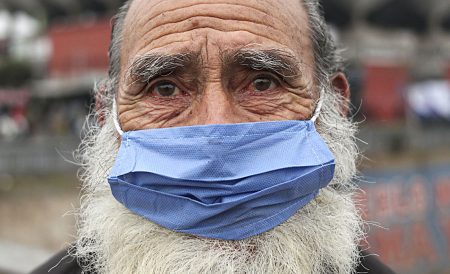
With an order issued last week requiring Pennsylvanians to wear masks any time they leave home, the facial coverings are here to stay.
Dr. Patricia Milford, a communications professor at California University of Pennsylvania, acknowledged that wearing masks might make many feel at a loss for communication – but said our most basic means of conveying how we feel remains intact.
Eye contact is a key component of nonverbal communication, said Milford, and it is something people may rely on even more strongly when half of a person’s face is covered. Making eye contact establishes how a person feels about us, whether they are a threat, and forms a sense of community, she said, even while the act is usually subconscious.
“I think that our nonverbal communication is very important in assessing people, and we pay attention to people’s facial expression to get a cue for how they are feeling toward us,” she said, giving an example of strangers in a grocery store. “It’s to establish a sense of community, of belonging, because these people are, in general, their neighbors.”
While it may seem as though a person can’t tell whether someone is smiling or frowning with a mask on, the eyes still carry these expressions, she said. Some people linger longer with eye contact while wearing masks, beyond a typical quick glance, because the prevalence of masks is new and it takes a bit longer to process, she said.
“You can smile. You can raise your eyebrows to say hi,” she said. “They don’t need to see your mouth to see if you’re frowning.”
People also seem more hesitant to speak when wearing masks, making a local grocery shopping trip a near-silent errand, Milford noted. In part, she said, people think they won’t be heard or understood with a face covering. But part of it is also subconscious. A covered mouth is a universal symbol not to speak.
“I think maybe it sends an unconscious feeling to your brain not to speak or to be quiet. By covering our mouths with the cloth masks, it sends a message to be silent,” she said.
In her experience wearing masks, she finds it uncomfortable to say “hi” to strangers without making eye contact first.
“I think that wearing a mask has established that we need to make eye contact before we feel we have permission to speak,” she said.
Milford noted the irony of deeply ingrained symbols, that a person wearing a mask is a “bandit” or a “bad guy.”
“Now, people who aren’t wearing masks in reality are more threatening than people who are wearing a mask,” she said.
The Centers for Disease Control continues to recommend wearing masks in public to stop the spread of the coronavirus, especially in areas with significant community-based transmission.
On Wednesday, Pennsylvania’s Secretary of Health Dr. Rachel Levine signed an order requiring the nose and mouth coverings be worn when leaving home, in any instance where social distance cannot be maintained.
It is an update to the previous order that required masks be worn by anyone in businesses or restaurants.
The order was issued as some counties, like Allegheny, have seen a significant spike in cases. Officials there stopped in-person service of alcohol in bars and restaurants, hoping that would slow the spread of COVID-19.
Fayette, Washington, Greene and Westmoreland counties have also seen more cases, though nowhere near the triple-digit increases in Allegheny County.
Levine, who issued the order under the Disease Prevention and Control Act, called it “essential” to masks to prevent the spread of COVID-19.
“My mask protects you, and your mask protects me,” she said, echoing her repeated message that wearing a covering can help stop the spread of the virus by someone who does not know they are infected.
“Wearing a mask shows that you care about others, and that you are committed to protecting the lives of those around you,” Levine said.
For those who still feel strange wearing one, Milford said establishing that eye contact with others truly can help mitigate unease.
She teaches her oral communication students to make eye contact with the audience, even though that might make them nervous. Studies show it actually has the opposite effect, she said.
“They’re going to feel less afraid when they make eye contact,” she said.
People glean a huge amount of information about a person or an environment from nonverbal clues, she said.
For example, if you walk into a relative’s home and see that everything is neat and tidy, you assume the person has control over his or her life. If everything is in disarray, you might assume something is wrong.
“This is how humans engage with each other. So much about communication is at an unconscious level, so much. It’s not in the words we say,” she said.
It is possible that people will form new ways of communicating non-verbally, gesture more often or wave more frequently as mask-wearing requirements continue. New gestures could start in one community and remain there, or become a part of broader society, she said.
Milford also said the prevalence of personalized masks allows people to learn more about others, share something about themselves and feel more comfortable during the pandemic. A person’s attire says something about their personality or profession, and masks have become another accessory.
“I think the idea of purchasing your mask is a very important expression, and it’s a way of controlling something in your life,” she said. “It’s a way people feel there is something they can control in an environment that is kind of scary. It gives us a way to control our own lives.”