

WCCED’s micro-loans, Starpointe having large impact
Observer-Reporter
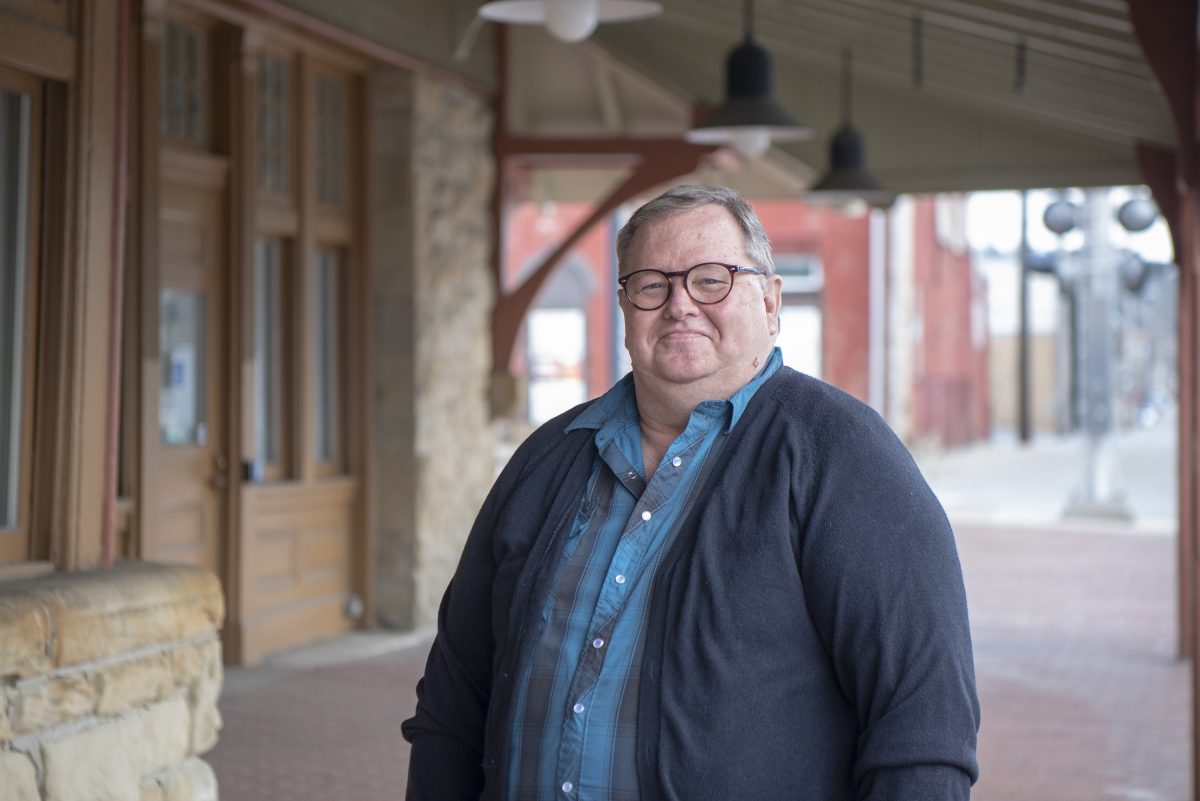
Executive director Dan Reitz, outside his downtown Washington offices, oversees operations of the Washington County Council on Economic Development.
Observer-Reporter
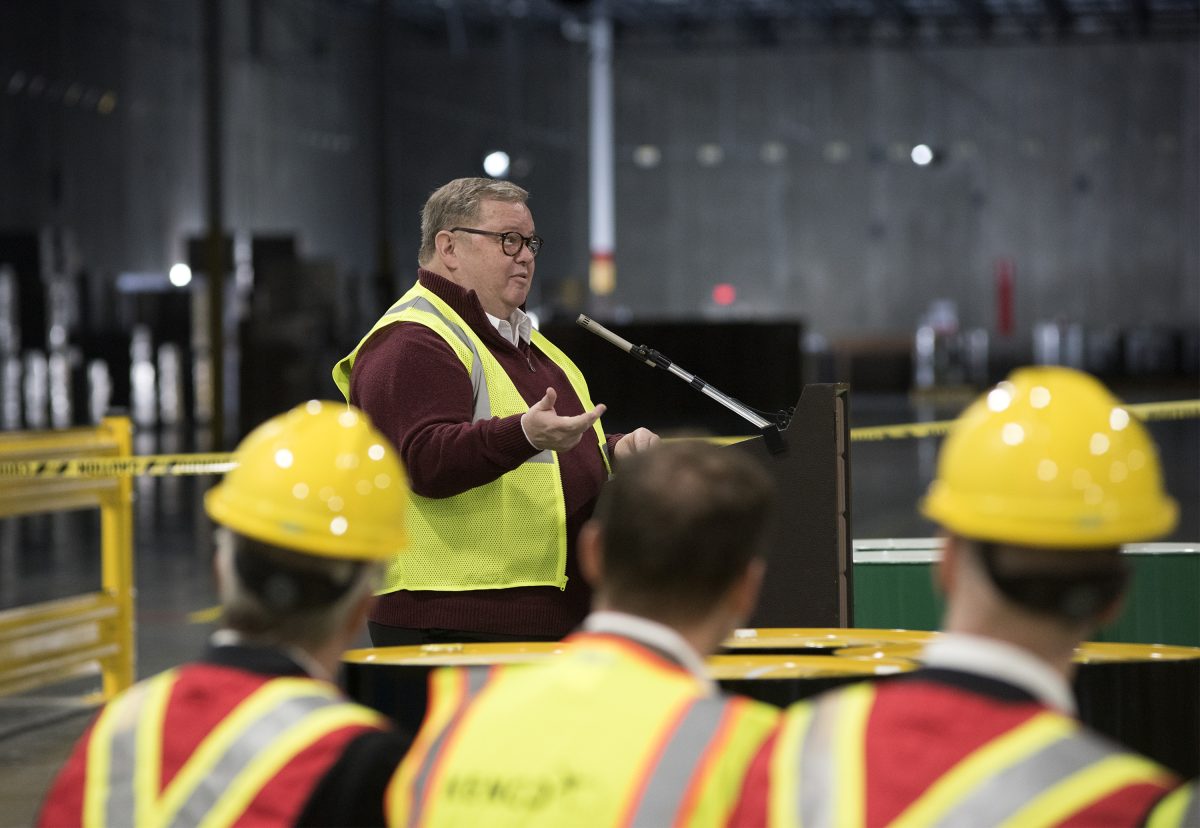
Dan Reitz, executive director of Washington County Council on Economic Development, speaks during the March 2019 ribbon-cutting ceremony at Kenco in Starpointe.
Courtesy of Allen Rich
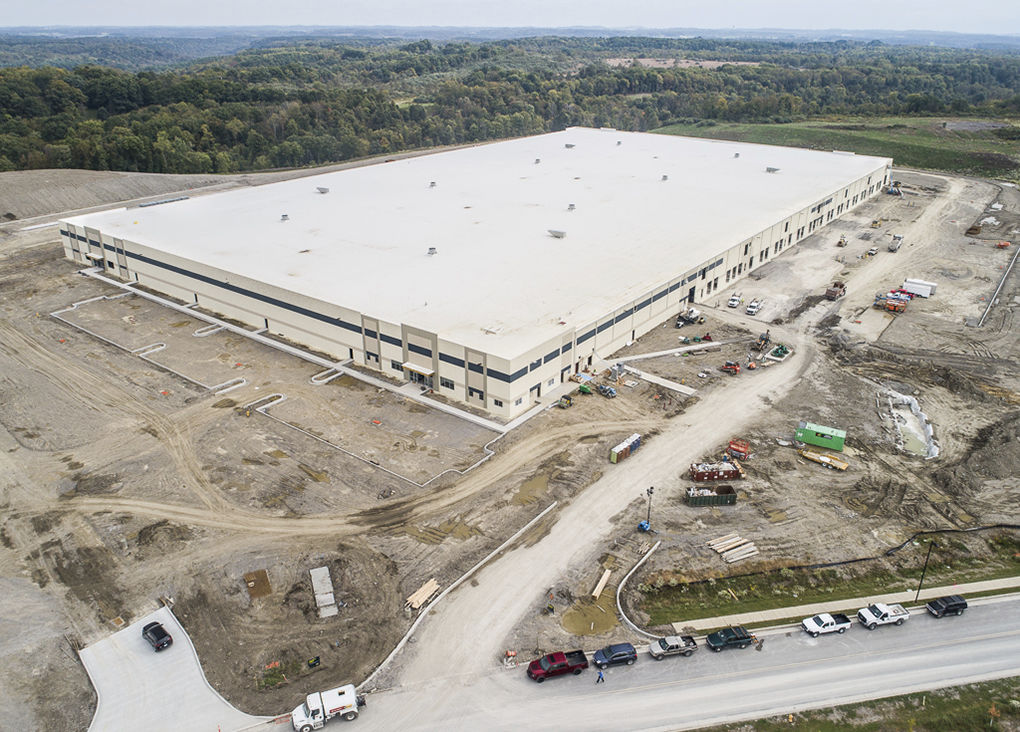
A drone captured this photo of the Kenco building in Starpointe Business Park.
Neither the pandemic nor knee surgery has slowed Dan Reitz. Economic development is his game, and it’s a high-speed one.
Reitz is executive director of Washington County Council on Economic Development, which, among its many initiatives, works to secure loans for businesses, projects and other entities from Donora to Avella, Finleyville to Amwell.
The council recently distributed 16 loans from the county’s Main Street program, for a maximum of $10,000 at 0% interest. The average amount of those loans, he said, was $8,625 at a time when those recipients “really, really needed it.” Among the beneficiaries were a barber shop in Monongahela and a Donora machine shop.
“Chambers in the valley got the word out,” Reitz said. “And I still have more (Main Street) money to lend to other downtowns in the county.”
More than $220,000, the equivalent of at least 23 more loans, is available. Loan recipients, he said, can use the funds to “pay rent, utilities, vendor costs.”
For 31 years, WCCED has reached out to help regional economies succeed. The nonprofit was formed as a public-private partnership in 1989, an organization focused on enhancing a region wracked by industrial decline in the 1980s. The mission of the council essentially remains the same.
WCCED, based at the renovated train station on South Main Street, Washington, focuses mainly on development in Washington County. But its outreach goes well beyond county lines. The council strives to secure micro-loans for six counties in Western Pennsylvania: Washington, Greene, Fayette, Westmoreland, Allegheny and Beaver. It also serves 38 counties in West Virginia and five in Ohio, through satellite offices in Wheeling and Charleston, W.Va., called First Microloan of West Virginia.
The council is – and has been – the largest U.S. Small Business Administration micro-loan lender in those three states. Reitz said when September ends, WCCED will have closed 39 loans totaling $994,100 in those states. He said the figures are off from previous years because of COVID-19.
“We still have nine loans waiting to close for an additional $442,000,” Reitz said. Getting life insurance assignments, he pointed out, has been an issue because so many individuals are working remotely.
Loans, of course, are not the only part of WCCED’s equation. The council is the owner and developer of Starpointe Business Park, a 1,153-acre property in Hanover Township. It is, simply, a brownfield in the northwest corner of the county, much of the property scarred by strip mining from the 1930s through the ’80s.
Then county commissioner Max Morgan started the project in the late ’90s, when he negotiated the purchase of 148 acres. A few years later, following discussions with the state Game Commission, Morgan and the other commissioners acquired the other 1,005 acres.
This has been fruitful reclamation project, where 12 companies have located since ground was broken for the park about 15 years ago. Starpointe is in a strategic location, near the intersection of Routes 18 and 22, a half-hour commute from downtown Pittsburgh, Washington and Weirton, W.Va. Pittsburgh International Airport is nearby, and the Shell cracker plant is going up 19 miles to the north in Beaver County.
Kenco, the most recent tenant to move in – 18 months ago – has the largest structure on the property at 468,000 square feet.
Starpointe is now in the early stages of phase three. Reitz, who has been with WCCED since 1996, is planning to initially develop six or seven level lots – between eight and 40 acres. He said his organization may be close to a deal with a manufacturer on a larger lot, “maybe a month or two.”
Funding is a major factor with WCCED development. That is why Reitz appreciates the support WCCED has gotten from the commissioners and the county’s Local Share Account, which is sustained by gambling revenue generated at The Meadows Racetrack & Casino.
“It takes seven years to raise money to do a phase,” Reitz said. “It’s a brownfield. Without the commissioners’ help, we’d be nowhere near where we are. And I don’t know where we’d be without LSA money.”
With help, and its own diligence, WCCED has gone far.