

Raising knowledge of a tasty tradition
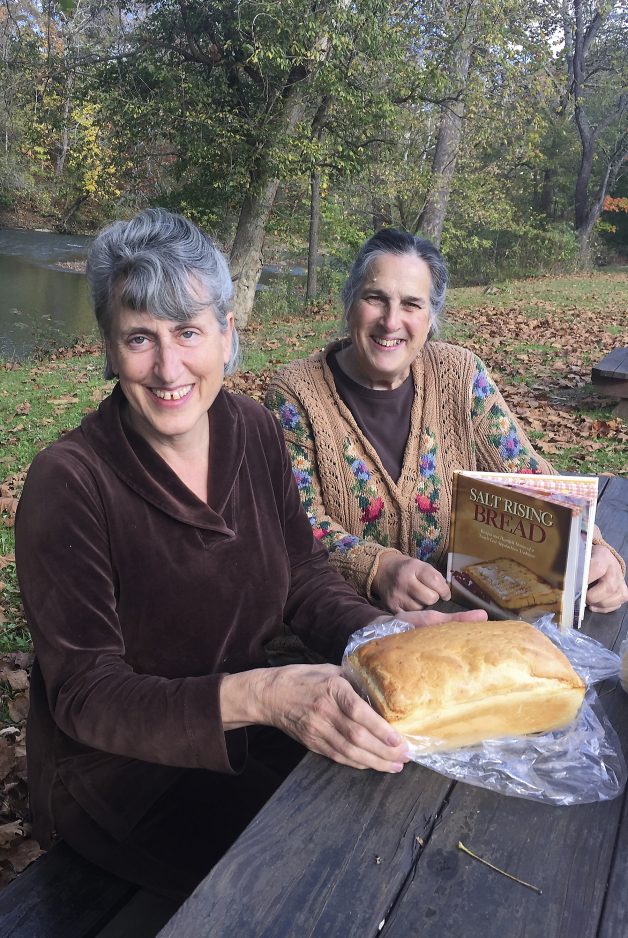
Jenny Bardwell and Susan Ray Brown
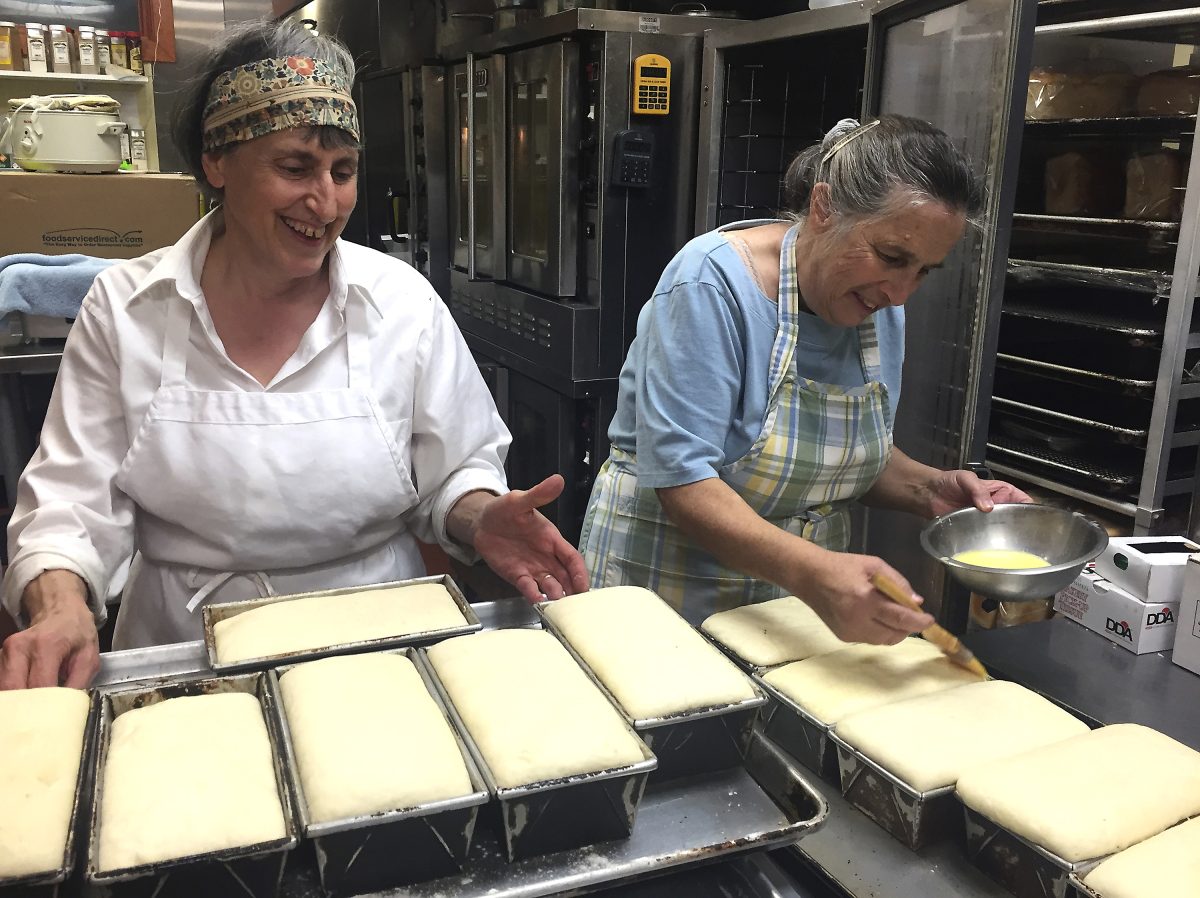
Prepping the dough to bake.
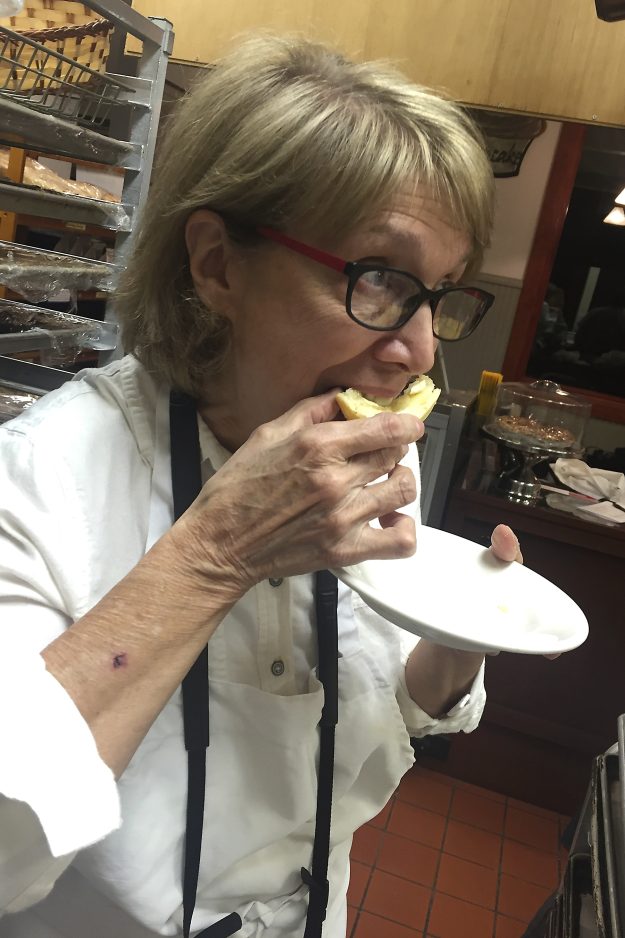
Mary Briggs, a folklorist who is working with Rivers of Steel to document the culture that is part of this industrial heritage area, takes a bite. She’s helping Rising Creek apply for a grant through the PA Council on the Arts and came to a recent class to do research.
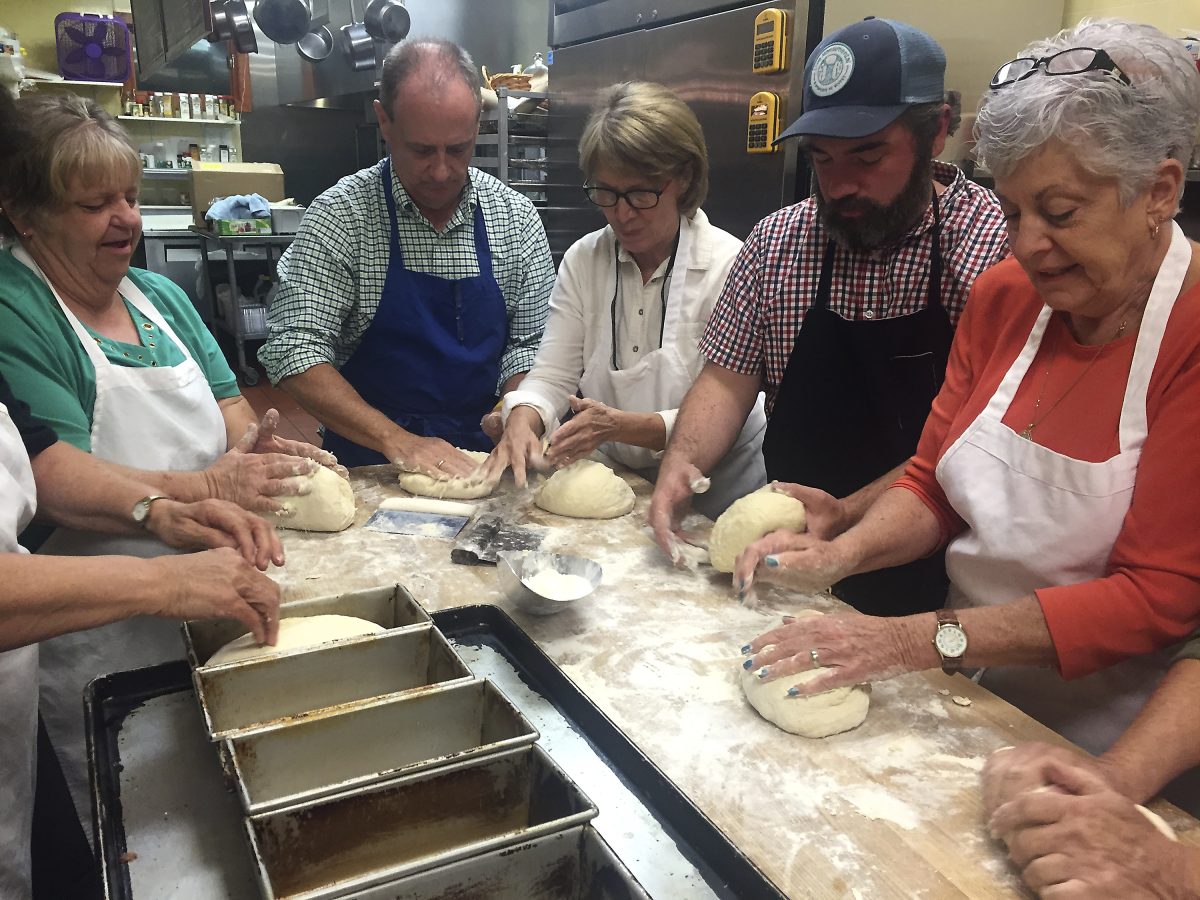
“Students” learn to knead salt rising bread during a recent class.
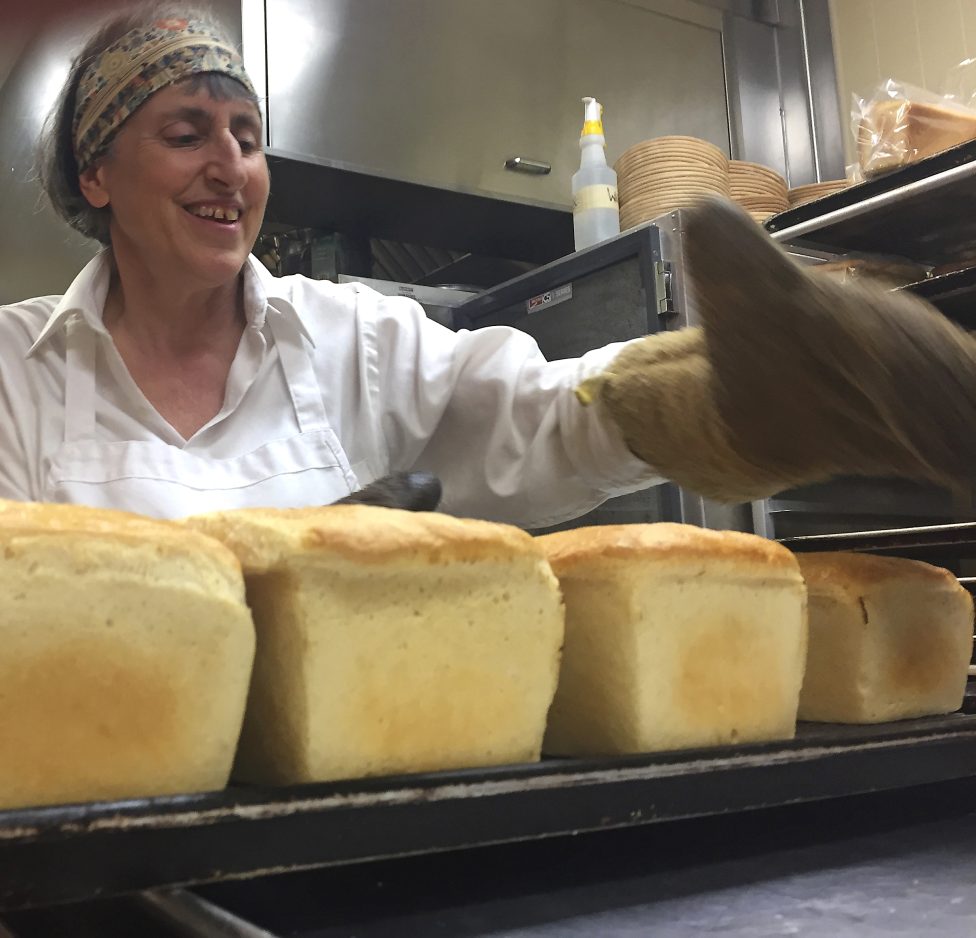
Jenny Bardwell takes the hot loaves from the oven.
Raising knowledge of a tasty tradition
{child_byline}C.R. Nelson{/child_byline}
There is a wonderfully tasty tradition being kept alive at Rising Creek Bakery & Cafe in Mt. Morris. Stop in any morning but Monday and the rich, cheesy smell of salt rising bread being toasted for sandwiches to be eaten at little tables inside or under sycamore trees along nearby Dunkard Creek mingles with the smell of fresh coffee.
This unique bread, leavened by wild microbes rather than yeast, was discovered by pioneer women more than 200 years ago. Recipes were passed by word of mouth through generations of daughters, neighbors and friends. The tradition almost died when commercial bakeries stopped producing salt rising bread in the 1990s and families across the land realized they had forgotten how grandma made it. But now, salt rising – or risin’ – bread is making a comeback, thanks to two women who have devoted more than 20 years to researching the science while collecting family stories and recipes, and teaching others what they have learned.
On a picnic table by Dunkard Creek, the broad stream that gives Genevieve “Jenny” Bardwell’s eatery its name, a fresh-baked loaf of this pioneer staff of life is posing for the camera, held up for viewing by Bardwell herself. Beside her, her partner in microbial sleuthing, Susan Ray Brown, is holding their newly published book, “Salt Rising Bread” – a title that brings memories of home to those who must have it toasted up one more time. The book is full of first-person stories, local histories, science lessons and recipes for making salt rising bread in your own kitchen, including gluten-free versions of the pioneer classic.
“We get orders from all over America – especially now for the holidays. Over the years, we’ve learned so much about how to make this bread but even now it can still be uncertain, because sometimes it just doesn’t rise. You never really know why,” Bardwell says.
This is the crux of why this bread is considered to be the most finicky of breads – you never know if it will rise. Yet, generations of women have made it successfully over campfires or in kitchens, using starters of sliced potatoes and water or corn meal and milk, with table salt, potash or baking soda added to encourage growth. But how did pioneer women first stumble upon the wild microbes?
Perhaps in those early days, the unleavened cornmeal “Johnny cake” batter was left by the fire long enough to begin to rise when the bacteria in the corn began to multiply, and the women tending the fire were happy to knead it and turn it into bread.
They became experts at keeping their starters warm enough to “come” and shared what they knew, in recipes that Bardwell and Brown are still learning to perfect. What they have learned is now preserved in their book. The occasional evening classes at the bakery are another way they are passing it on by doing. Class starts with starters and a sponge already prepared, along with detailed examples of how to keep it warm with heating pads, slow cookers or professional water baths. Students get a whiff of what a successful starter smells like, then help scald and stir them. After kneading, shaping and baking, class ends two hours later with slices of bread right out of the oven and a warm loaf to take home.
Brown grew up in Greenbrier County, W.Va., eating salt rising bread. “My grandmother made it and I loved it,” she says. After graduating from West Virginia University with a degree in anthropology, she became a social worker and eventually settled in Mt. Morris with her family in 1983. But she never forgot the love that her grandmother served her, warm from the oven, with homemade butter and jam.
As a wife and mother, Brown tried unsuccessfully to make the bread of her childhood.
“I’d call my grandmother and she’d try to help, but for years I just couldn’t make it rise.”
As a busy modern woman, Brown was learning the biggest problem is the heat loving wild microbes demand a very warm corner to grow in and someone there to keep that temperature constant.
Brown’s grandmother had a secret ally – a gas hot water heater tucked away in a closet that she set her starter on, and start it did.
“You have to keep it at 105 to 110 degrees for nine to 12 hours and I didn’t have a perfect place for it to rise,” Brown admits. “I didn’t have a pilot light and it’s hard to keep it at the right temperature for that many hours. I threw out a lot of starters.”
And when it finally works, you know it. There’s nothing like the smell of microbes rising. It’s not the familiar yeasty scent of bread dough creating bubbles of carbon dioxide, but wild bacteria processing sugar and starch and releasing hydrogen, a lighter gas that makes the dense crumb texture the bread is known for. This is the same bacterial process that makes the greatest cheeses.
But, as generations of children have declared when walking into their mother’s kitchen in the hills of Appalachia, “It stinks!”
Bardwell moved from Massachusetts to Mt. Morris in 1988 when husband Andrew Liebhold took a job with the United States Forest Service in Morgantown, W.Va. Her degree in plant pathology from the University of Massachusetts gave her a keen curiosity about the behaviors of the invisible world of fungi and microbes. Her degree from the Culinary Institute of America and her experience operating a bakery while living in Massachusetts came in handy when demands for the bread she would finally master led to the opening of Rising Creek Bakery & Cafe in 2010.
Bardwell tasted her first pungent slice while visiting neighbor Pearl Haines, who was making soap in an iron kettle in the backyard. She stopped to learn and was invited into the kitchen afterward for a bite to eat. She fell in love with the flavor, the texture and the mystery of the bread Haines served.
“I was intrigued. Bread without yeast?” Later, Bardwell would find a partner who would help her find the answer and preserve the past.
“I met Susan at a Halloween party at my house when the children were younger and we started talking about it. What makes it rise? We really wanted to know.”
The hunt was on. Bardwell began writing to experts in the sciences and companies that still made the bread commercially. The bacteria, Clostridium perfringens, is found everywhere in nature – in tree bark, in cornmeal and in the human digestive tract. The women took loaves to the University of Pittsburgh to be cultured by microbiologist Dr. Bruce McClain’s lab. The samples came back with a clean bill of digestive health.
“It’s part of our micro flora, which might explain why some people say it calms their stomach,” Bardwell says.
Salt rising bread became a staple of the frontier and traveled westward as Americans migrated to the Pacific. In the early 20th century the microbes were gathered, dried and turned into batches of Khoman’s Salt Rising Yeast, much to the delight of bakeries that had customers with a taste for it. The patent was sold several times then, mysteriously, the product stopped being manufactured in the 1990s and loaves were soon gone from bakery shelves.
People were still yearning for it in 1995 when Brown started her website devoted to making salt rising bread the old fashioned way, with recipes and memories sent in by readers. Working with Patty Kisner of West Virginia University Extension Services, women across the state were contacted for recipes and family stories. Many were in their 90s and happy to pass on what it had taken them a lifetime to learn to these inquisitive newcomers. Bardwell and Brown slowly got themselves into the almost mystical groove of enticing their salt rising bread to rise – almost every time.
“We began conducting classes through the extension office,” Brown remembers. “We wanted to keep the tradition alive.”
When Rising Creek Bakery opened, classes continued and still happen whenever enough people contact the bakery to sign up for the next one.
“I’m back for a refresher course,” longtime bread maker Sue Chisler of Fairview, W.Va., joked at a recent class that gathered in the bakery kitchen. Some, like her, were there to relearn the secrets of a finicky microbe. Newbie Mike Costello of Lost Creek Farm came to learn to make a bread to sell at his Pop Up Kitchen featuring traditional foods. Emily Hillard from the West Virginia Humanities Council and folklorist Mary Briggs, working with the Rivers of Steel Industrial Heritage project, were there to roll up their sleeves and document first hand the process of making what is now recognized as a heritage bread of Appalachia.
Class was in session as questions were answered, secrets were shared and loaves took shape. There was flour on every hand.
Oh, that troublesome starter! What do you do when it doesn’t start?
Chisler laughs. “Do what my neighbor does. When it don’t rise, make fry bread!”