

Have You Met … Pastor John Dorean?
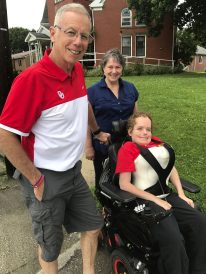
Pastor John Dorean and his wife, Merry, have called the Colonial town of Jefferson home for more than 30 years. They and their youngest daughter, Bethany, 31, live in the parsonage beside the Baptist Church on Pine Street. It is a neighborhood of shady sidewalks and friendly faces – a perfect fit for Bethany’s motorized wheel chair.
Dorean’s easy smile is an ever-present feature and it softens the edges of his next words. “I plan to retire in May 2018. The church is doing extremely well – we have four missions and I will continue to work with the person we pick to replace me. But I don’t want to stay 10 years past the time I should have left. I’ve seen that happen. Besides,” he nods towards Bethany, “we’re one bad lift away from another life change. Merry and I aren’t getting any younger, and our other daughters want us to live near one of them so they can continue to care for Beth. We’re not sure where we’ll go once we leave the parsonage but … it’s in the Lord’s hands. We’ll see.”
Dorean laughs as he remembers the first time he preached at Jefferson Baptist in 1982 as a substitute “supply” preacher. He was young, bearded and tan from doing what Jesus once did – carpentry. “I was wearing work boots and an old suit. And I wasn’t quite sure what a Baptist was. I was raised Presbyterian. “
It’s the kind of tale that calls for a trip to the church basement, where opioid support groups have met, kids have learned rocketry and Dorean escaped to when it was time to write books about murder in Greene County or raising an exceptional child who was not expected to live more than six months – Bethany was born with one-tenth the muscle tissue of a normal person due to what is classified as a rare motor neuron disease.
The walls are lined with shelves and scrapbooks that will come in handy to unravel the story of a man whose father, Professor Bennett Rich of Rutgers University, moved his family from New Jersey to Waynesburg in 1963 to become president of Waynesburg College.
When did young John Rich, who went to Dickenson College in 1970 to study political science, get the inclination to become a man of spirit – and eventually change his surname to Dorean?
Let’s go back to 1972, when a college course led to an urban project in Harrisburg with the Center for Peace and Justice. Dorean remembers his emotions over the injustices he witnessed and then a professor asking him: “Do the things you’re doing for peace and justice have a place in the Christian tradition or is this a passion that will come and go as a political and social revolutionary?”
“It made me think and it made me start to study religion,” Dorean says. “I was in my sophomore year. I went from a straight B student to straight As.”
Tall and athletic, he was also hungry for physical work to complement his understanding of the Christian tradition of community building. “I wanted to use my hands to do good work. One of my religion professors worked weekends on the house of an impoverished lady and I started helping him do dry wall and plumbing. When we graduated, he presented those who worked with him with a bent nail on a scarlet ribbon.”
In his junior year, he and some like-minded college buddies began traveling the East Coast, visiting Christian communities that practiced peace, racial equality and simple living. That year, Dorean found a community in Americus, Ga., that had been founded at a time when racial reconciliation could, and sometimes did, get you killed.
Baptist preacher, Greek scholar and self-made farmer Clarence Jordan was ahead of his time in 1942 when he and a handful of Christian families started a community called Koinonia – Greek for “fellowship.” The community treated blacks as equals and were against war – dangerous views for that era. But Koinonia persevered and was there to show the way when idealistic students like Dorean came to visit and stayed to make a new life for themselves.
“When 99 carloads of Klu Klux Klan showed up at their farm telling Clarence he needed a safer place north of the Mason Dixon Line, he told them, ‘I believe God is more real in the universe than the KKK’ and they left,” Dorean remembers. “I visited for the first time in 1973, went back for four months in 1975 and in 1976, stayed six and a half years.”
Habitat for Humanity founder Millard Fuller, who gave his fortune to improve the lives of others, was also impressed with the houses that Koinonia was building. Seeing the need for housing for the poor of the world, Fuller held the first organizational meeting for Habitat for Humanity in 1976 – and Dorean was there.
So was a girl from Philadelphia named Merry Posey. Something clicked between them, Dorean recalls with another big smile.
“Meeting Merry was a transformative moment. We were working to have our lives shaped by the reality of Christ, so we both took the name Dorean (Greek for ‘freely given – a gift from God’) when we married because this love was a gift to the both of us. Some of the family were upset, but my dad was good with it.”
Two daughters, Emily and Carrie were born, but family ties were pulling them home to Pennsylvania to be close to their parents.
The newly-minted Doreans loaded up their belongings and left Georgia with “two and a half kids” – Merry was pregnant with Hannah in January of 1982. The family settled into an upstairs apartment next door to the Presbyterian Church in Waynesburg, with free rent in exchange for Dorean’s carpentry skills.
“I worked for Keith Davin and Dave Pollock when they redid the Jury Box (on Washington Street, Waynesburg) with old barn siding,” Dorean recalls. Later, as director of Greene County Habitat for Humanity, it would be Dorean who hired Davin to manage the construction side of the organization that “builds houses for God’s children in need.”
Dorean added his name to the list of substitute preachers and soon found himself ministering regularly at Jefferson Baptist Church, which was looking for a new pastor. His sermons were a promise of things to come and the congregation was warming to his roll “up your sleeves and do good work” spiritual message. Within the year, they invited him to be their full-time pastor.
“I had a call to the ministry, but never lost my passion to build,” Dorean admits.
In 1984, he joined former President Jimmy Carter to work on the first Habitat for Humanity building project in New York City and continued fundraising through his church for Habitat projects in Haiti and Uganda. But, “When a parishioner came to me and said, ‘We need to build houses here,’ I got together with Chuck Baily and Bob Bishop to get it going. We invited Millard Fuller to Waynesburg to speak at a luncheon of 20 pastors, and then later that evening to the public.”
Greene County Habitat for Humanity was up and running in 1984, with Dorean as its first president.
Things changed forever on July 13, 1986, when Bethany was born. Her condition added countless trips to Children’s Hospital, round-the-clock care and many sleepless nights to the family dynamics.
Dorean’s latest book, “Our Girl,” chronicles the impact Bethany’s fragile existence had on his spiritual understanding of God. Guided by Merry’s calendars of daily happenings, the book is full of intimate detail, from the first frantic months to the present. The reader meets exceptional doctors, neighbors and friends, along with the support services that have been a blessing, especially the motorized chair that gives Bethany her independence.
Through it all, the family learned to live with uncertainty and use love and faith to carry on. “When I was writing the book I was reading Merry’s journals, and the details of our lives were in there day to day. It amazes me is how much we were able to do along with all of that,” Dorean says.
Thanks to Dorean’s commitment to affordable housing, Greene County Habitat for Humanity has constructed and refurbished 60 houses since 1984 and families who qualify do “sweat equity” alongside Habitat volunteers from churches, colleges and the community at large. The no-interest loans are based on biblical teachings and the organization holds the mortgages until paid off, with payments going back into the pot to create more homes.
When the county reactivated its Redevelopment Authority in 2009, Dorean’s expertise did not go unnoticed. There was a critical housing shortage exacerbated by an influx of out-of-state workers that came with the shale gas boom to be dealt with. Luckily, the state’s gas extraction fee made funds available and Dorean was appointed to serve on the board. Habitat president David Calverio became the executive director of the authority in 2015 with Dorean’s blessing.
“Habitat welcomes everyone and anyone and uses no government money. The cool thing about the Redevelopment Authority is that powerful things can be done when working through the government,” Dorean says.
The authority helps low to moderate-income families qualify for a mortgage by offering land contracts. Since 2013, 12 homes have been rehabilitated, three new ones built, seven land contracts granted and five homes have been sold outright in nine county municipalities and boroughs.
“Providing folks with a decent house is a way to show them the love of Jesus, day after day after day,” Dorean says. “A house can make such a huge difference, not just in physical comfort, but in building self-esteem and economic security in a way few things in life can do. Everyone deserves a decent place to live.”
It’s not hard to guess what Dorean will be doing after he retires. “Jimmy Carter is 93 and still hammering, and I wouldn’t mind following his lead. There are Habitat projects all over the world, so wherever we end up, Merry and I be involved.”