

Paving the way
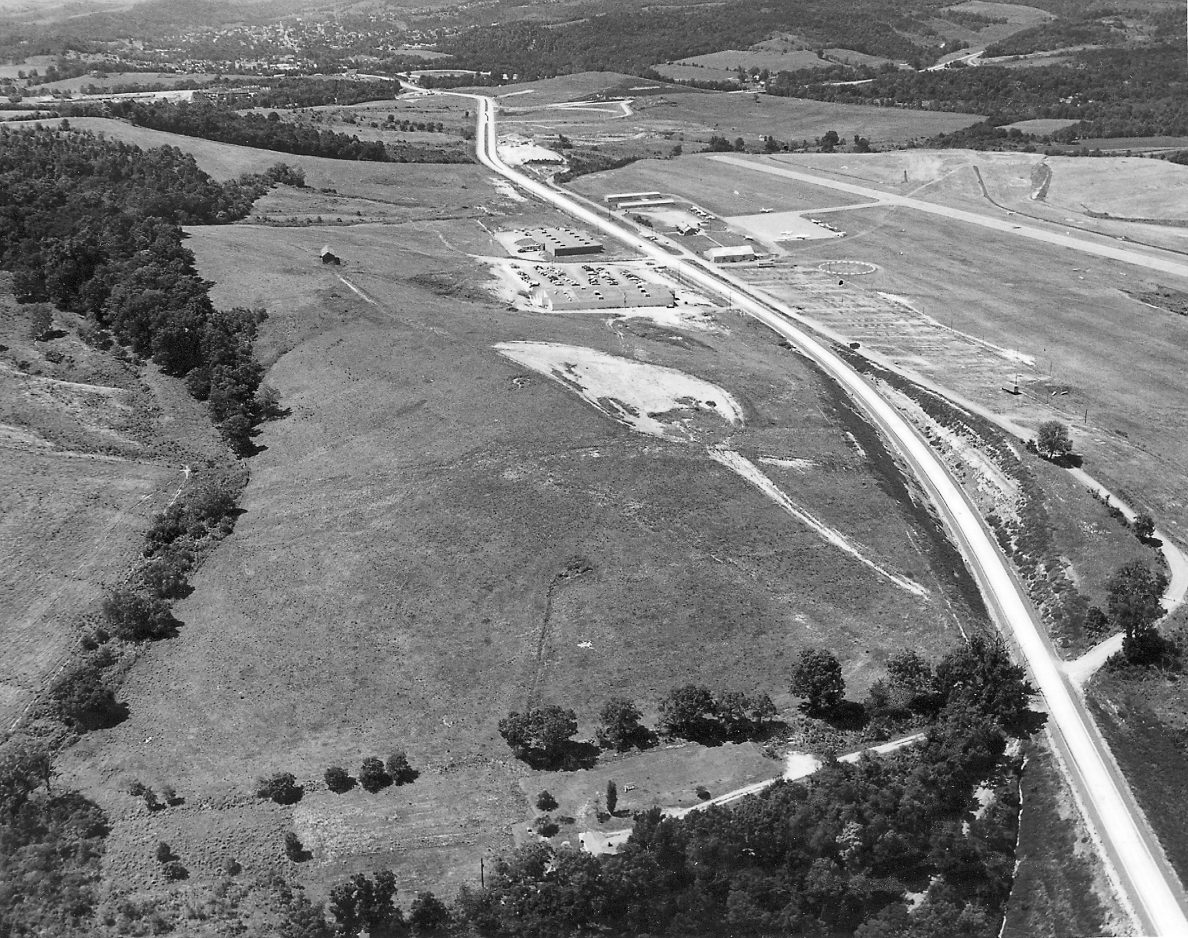
An aerial photo provided by Greene County Industrial Developments Inc. of the Greene County Airport and the new Route 21. The expansion of the road and its extension to the east over Loves Hill was completed in the mid- to late 1960s, according to G. Wayne Smith in his book “The History of Greene County Pennsylvania.”
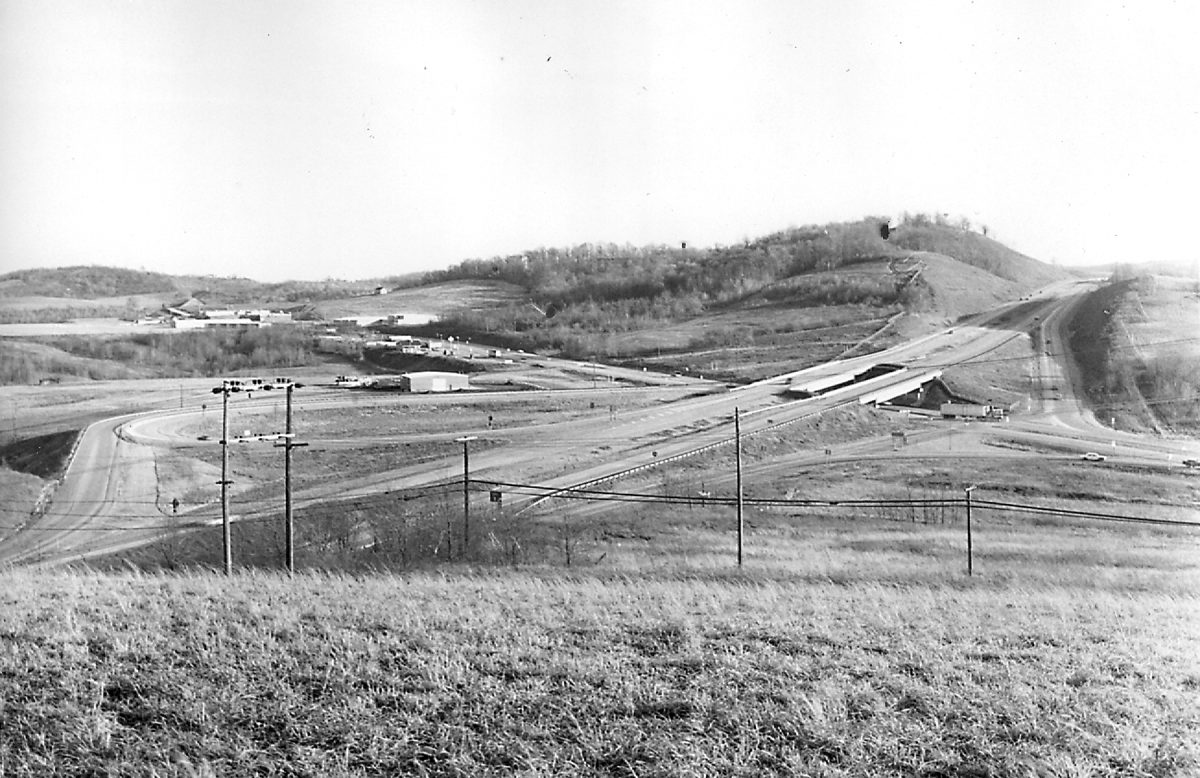
An undated shot from the Observer-Reporter archives of the Waynesburg interchange before any commercial development.
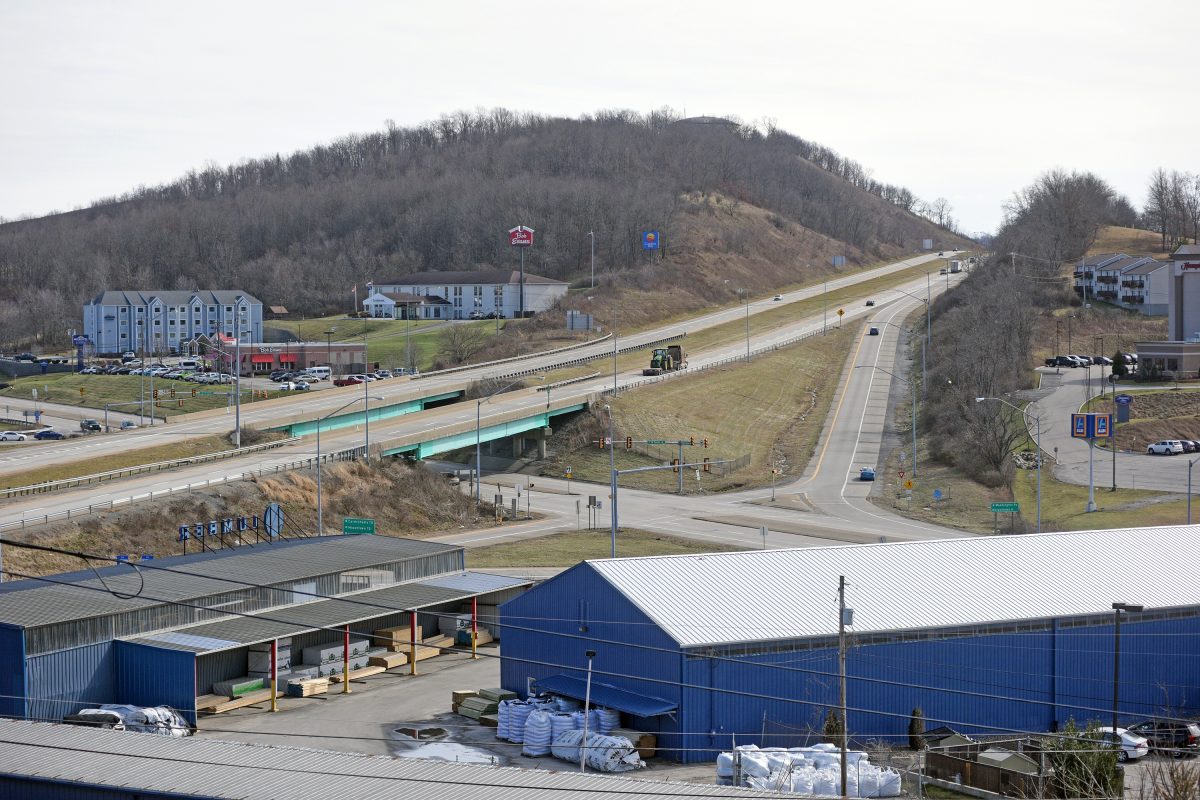
The Waynesburg interchange as it looks today.
Before Interstate 79 was constructed in the 1960s and 70s, the main road through Greene County, north to south, was Route 19, a winding, two-lane highway.
Don Chappel remembers coming to Waynesburg from South Fayette Township in Allegheny County to attend Waynesburg College in late 1968, when I-79 was only partially completed.
“It was quite a trek. We had to get off at Lone Pine and take Route 19 into the college,” he says. Travel could be impeded by slow moving traffic and an inability to pass. It certainly was not ideal, he recalls.
And at night, “it was a dark, windy road.”
When construction of a major north-south highway from Erie to Mt. Morris was first discussed in the mid-1950s, it was viewed by local leaders as important to the growth and prosperity of Greene County.
“An interstate is a tremendous resource for any community,” says Chappel, executive director of Greene County Industrial Developments Inc., which works to promote economic development in the county. It was important then and it remains important today. “In today’s economy, business and industry are looking to locate as close as possible to an interstate, a four-lane highway or an airport.”
The effort to construct a north-south highway from Erie to Mt. Morris began in the mid-1950s, according to Observer-Reporter newspaper files, which are incomplete and contain many gaps in the history of the highway’s development.
The project was first considered as part of what was called the southwest turnpike extension, an extension of the Pennsylvania Turnpike that would run south from an area west of Pittsburgh through Washington and Greene counties. A newspaper article from 1955 said the road would connect with any section of the West Virginia Turnpike that might be built later.
The effort, initially planned by a group called the Erie-Pittsburgh-West Virginia Turnpike Association, took a slightly different path in 1956 when Congress enacted the Federal Aid Highway Act, creating the interstate highway system.
The following year, then-Pennsylvania Gov. George Leader ordered a study be conducted on building the north-south highway to include in the federal interstate system.
Within a short time, the U.S. Bureau of Roads approved the highway for inclusion in the interstate system, but only as far south as Washington. The section from Washington to the West Virginia line was assigned to the federal aid primary system.
The difference was important, an article explains. The federal government provided 90 percent funding for interstate highways, but only 50 percent funding for the primary system roads. The state still planned to build the Washington to Mt. Morris section, but only as finances permitted.
A break came in 1960 when West Virginia began work to continue its north-south highway. As a result, the federal government in 1961 agreed to include the section from Washington to the West Virginia line in the interstate system.
In a letter in 1961 to the state Secretary of Highways Park Martin, Greene County commissioners A.R. Varner, John B. Carter and Herman Gigliotta spoke of the highway’s importance.
“Greene County is a distressed area. This road is greatly needed in order to encourage new industry to settle in Greene County,” they wrote. “Any delay at this time may make it difficult, if not impossible, to alleviate the existing economic condition by providing new employment for our people in the near future.”
Greene County had experienced an economic slump in the 1950s and 1960s because of changes in the coal mining industry, according to an employment analysis completed in 1977 for the Greene County Planning Commission.
In 1953, coal mining jobs accounted for 71 percent of all jobs covered by unemployment compensation, the study said. “As the mining process became mechanized in the 1950s and 60s, mining employment fell off sharply and as a result, the entire economy was severely impacted,” the report said.
The first major development came in August 1963 when a construction contract was awarded for the first section of the highway in Greene County, a 2.2-mile section between Ruff Creek and Waynesburg, but including neither intersection.
A ground-breaking ceremony was held in October 1963 to mark the event. John M. Cowan, a Waynesburg businessman, speaking for the Waynesburg Chamber of Commerce, said the new highway would be “the greatest, single contributing factor” to help alleviate the county’s economic plight.
In a lighter vein, Cowan said he had been asked why all the fuss was being made over a highway. “This is Greene County,” Cowan said. “We have not constructed a four-lane highway since the Pilgrims landed at Plymouth Rock in 1620; in fact, we could say with equal accuracy, since the birth of Christ.”
None of the available articles discussed factors that went into deciding where the road was to be built. It can be assume politics played a role in the alignment but also geography, the location of connecting highways and the nearness to population centers.
Much discussion took place in the early 1960s about where to build the interchange to serve Waynesburg. The plan was to build the interchange at what was then known as Airport Road, a two-lane road that went from Morrisville east past the county fairgrounds and swimming pool and ended at the airport. The road is now Route 21. The other options were to build the interchange at Route 188 or at the original Route 21, which is now part of Rolling Meadows Road. The airport road was favored, one article said, because it would be closer than Route 21 to Waynesburg and would better serve the airport and nearby properties slated for industrial development.
This plan also entailed the relocation and expansion of Route 21 to four lanes from Morrisville to the interstate as a “feeder road.” That work was completed in the mid- to late-1960s, while the interstate was under construction.
Following the awarding of the first contract, work proceeded during the next five years on construction of the road between Washington and Waynesburg and on Nov. 1, 1968, a ribbon cutting ceremony was held on the Washington-Greene county line to mark the opening of the highway north of the Waynesburg interchange.
Before that time, motorists had been able to use the road as far south as Lone Pine and for some six weeks prior to the ribbon cutting, the highway was open from Waynesburg to Ruff Creek.
Wayne Hart of Waynesburg said many people in the late 1960s would get on the new interstate at Ruff Creek and drive to Washington to shop.
“There was a Kmart there, that was a big thing, a Kmart and a McDonalds,” he says. Waynesburg didn’t get a McDonald’s restaurant until 1974. “And you can’t forget the S&H Green Stamp Store in Washington. We always went there.”
Hart says he also remembers many local youth used to sneak on the interstate before it officially opened to race their cars.
“There were an awful lot of people who used to drag race on it. We were not a select few,” he says. “I believe at the time there was a fine if they caught you; some people they caught, some they didn’t.” Hart says he was one of the ones they didn’t catch.
Construction contracts for the sections between Waynesburg and Mt. Morris were let in 1971. It was the last part of the road to reach the building stage, except for sections near Pittsburgh.
The work wrapped up in 1975. A ribbon cutting ceremony for the highway from Waynesburg to the West Virginia line was held July 25, 1975, near the Waynesburg interchange.
It was a big event. Newspaper accounts indicated 400 to 500 people were in attendance. Music was provided by the Waynesburg Central High School Band and a cannon volley by the Independent Battery E, 3rd Pennsylvania Volunteers, a Civil War memorial organization.
It was big deal because the highway was viewed as being important to the county’s economy, says Ralph Sommers Jr., who is chairman of the board of Community Bank and who gave the welcoming address at the ribbon cutting. At the time, he was president of the chamber of commerce.
“Without a doubt, it was probably the most significant event to open up Greene County to commerce and travel,” Sommers says. “Prior to that, Route 19 was the only road north and south and it stifled any economic development.”
The late Greene County historian G. Wayne Smith in his book “The History of Greene County Pennsylvania,” published in 1996, gave a summation of the highway’s importance to the county. He wrote:
“It is difficult to measure all of the impact of Interstate 79 on the economic and social life of the county. In many instances, farms were divided by the interstate and some historic homes were lost …On the other hand, the interstate ended the relative isolation of Greene County.”
Businesses began to develop at the interchanges to take advantage of the highway access, particularly in Waynesburg and Mt. Morris, Smith wrote. In addition:
“Ease of commuting and the accessibility of shopping centers in Washington and Pittsburgh on the north and Morgantown, West Virginia, on the south changed the lives of Greene County’s residents.”