

Greene County Historical Society & Museum’s “Stone to Steel: Native American Heritage Weekend” brought history alive
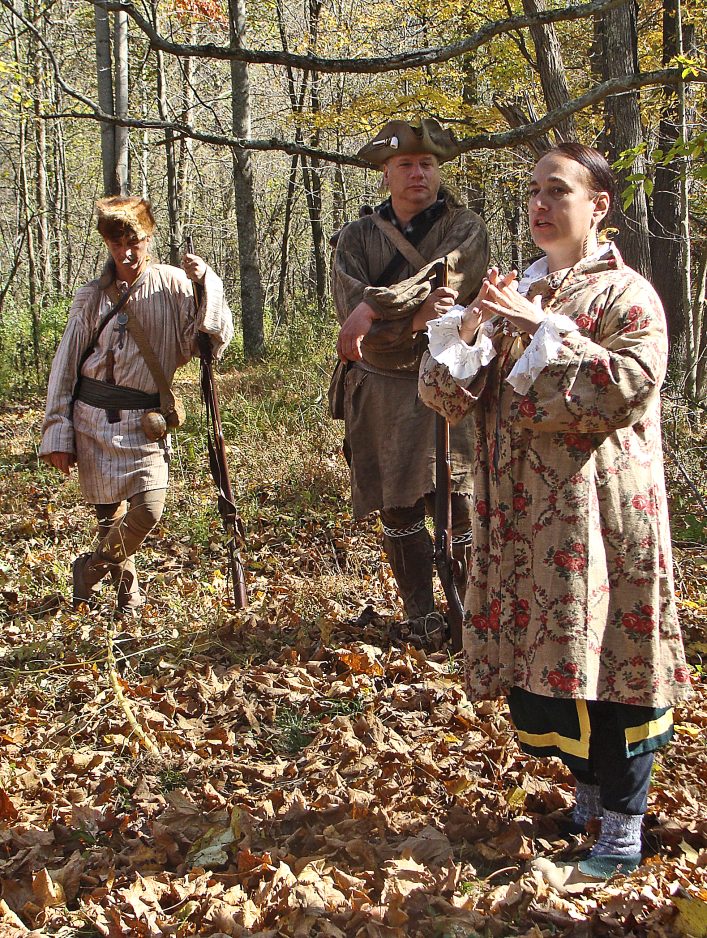
Doug Wood, Ed Robey and Dianne Anestis at Mason-Dixon Park
Beeswax and bear grease, buckskin and linen – what better way to understand the past than by living it?
This western corner of Pennsylvania into West Virginia and Ohio has a frontier history filled with pioneers and indigenous tribes struggling over access to the land. More than two centuries later, their history has been preserved, hands on, by people who adore the outdoors and are happy to jump back in time to recreate life as it was when everything needed to survive could be found in the virgin forests of America.
The Mason Dixon Historical Park near Core, W.Va., and Mt. Morris is home to the end of the line that was drawn by British surveyors Charles Mason and Jeremiah Dixon in 1767. Hikers and historians gather every October to walk the hardwood forested path along Dunkard Creek to the “third crossing,” then up Browns Hill to the last marker the survey team placed before surrendering to the turmoil of the times – the French and Indian War was raging on the frontier – and then heading back east to the safety of more settled lands. And every year, re-enactors slip out of the forest to tell more of the everyday story of those times. As time shifts in the telling, a richer understanding of life as it really was on the frontier begins to take shape.
Doug Wood and his wife, Dianne Anestis, of Nitro, W.Va., have been jumping centuries since 1986 when they met while working on the Mary Engle Draper Trail Blazers project through the West Virginia Scenic Trails Association. The goal was to create a hiking trail along some of the rugged, 450-mile route taken by 23-year-old Mary Draper Ingles and an elderly German woman after they escaped from their Shawnee captors at Big Bone Lick Kentucky in 1755. With only memory as her guide, Mary and her companion followed the rivers for 40 days, surviving on nuts and berries to get back to her home near present day Blacksburg, Va.
“The more we worked on the history, the more we realized the best way to tell it would be to demonstrate it,” Anestis says. She and Wood soon found themselves doing just that, drawn ever more deeply into the adventure of telling the tale of the wilderness through the lives of the indigenous people who were here before settlers and European territorial wars took the lands that had been their home for untold centuries.
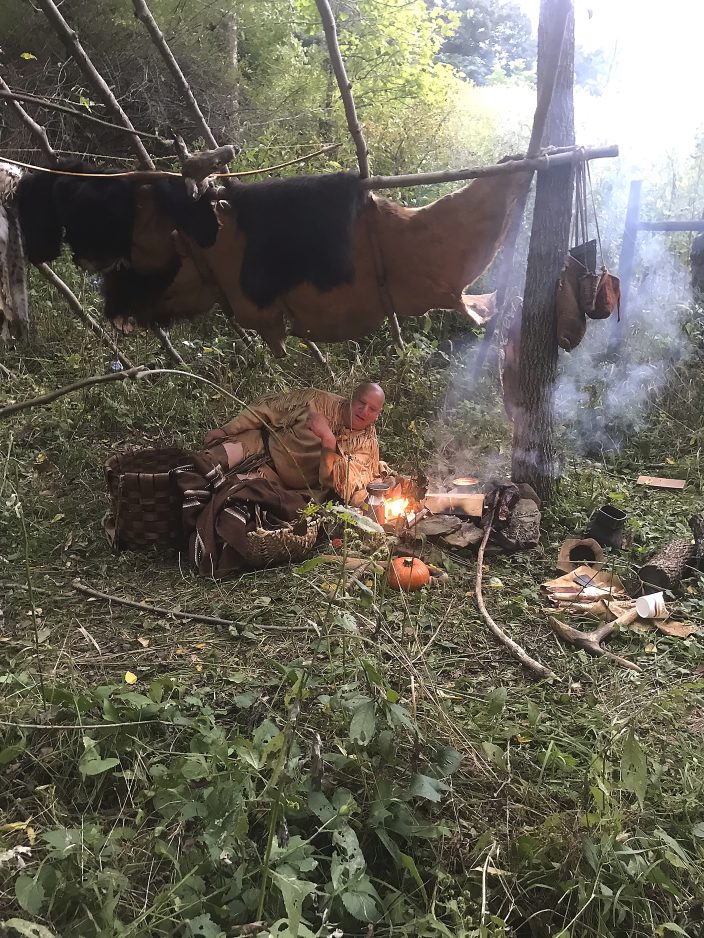
Ed Robey living as a pioneer during “Stone to Steel: Native American Heritage Weekend”
The American Bicentennial of 1976 started a trend of cinematic storytelling of those times, and some of the people recruited to play the part for movies and documentaries went on to become re-enactors. Wood and Anestis found their historic niche a decade later and became part of the act at annual re-enactment events such as the Battle of Bushy Run in Westmoreland County.
Almost every year they are joined at Mason Dixon Park by fellow historian Edward Robey, who spends his 21st century life in Morgantown crunching data, but is much more inclined to hunt, camp and live the life of a 17th century survivalist in any season these forests have to offer.
While Wood assumes the historic persona of Ostenaco, (c. 1730-1780) a Cherokee chieftain diplomat who sometimes carried messages between tribes and European treaty makers and spoke multiple languages, including French and English. Anestis describes the many roles women played in tribal politics and village life, and Robey takes a free hand with his characterizations, sometimes appearing as a frontier woodsman, sometimes as Chief Catfish of Catfish Camp, now the city of Washington, who came to visit the survey party of 1767 when they crossed the Monongahela River at Cheat Lake.
Robey’s roots in Greene County history run deep.
His mother’s uncle, Frank B. Jones (1879-1951) of Pine Bank, spent 17 years collecting amazing specimens while roaming “the seven seas” as a Navy headmaster and avid archaeologist and naturalist. A veteran of the Spanish-American War, Jones returned to Greene County in 1906 and joined forces with Muddy Creek native A.J. Waychoff (1849-1927), a professor at Waynesburg College with a formidable thirst for geology, anthropology and local history. Waychoff and nephew Paul R. “Prexy” Stewart, who went on to become head of the college’s geology department, traveled to Ohio to explore the indigenous mounds, and dug and documented ancient cultures on farmland all over this area. They identified the first segment of the Warrior Trail near Nettle Hill, and as the county’s passion for the past grew, Waychoff and Jones helped form the Greene County Historical Society, which would be both a library and a museum. It opened in the basement of the newly constructed Long Building in Waynesburg in 1925 with a membership of more than 200. Jones was the co-curator and had on display, along with all those indigenous artifacts, his “18 foot jawbone from a whale killed off Greenland and shipped to Waynesburg by a Norwegian whaler he had met during his travels.” Later, the museum would move to the county “poor farm” in 1970 and continue celebrating the past with an October festival, complete with pioneer and indigenous re-enactors.
“I spent a lot of time at the museum as a kid during the Harvest Festival,” Robey says during Stone to Steel, the museum’s newest venture into hands-on history in the steep ravine where the creek runs at the edge of museum property. His encampment is back in the day to the “clovis point era” of 1,000 years ago, and his lean-to is draped with bear skins, much to the delight of kids who can’t wait to try one on, then shoot a sinew-strung bow and attempt to slay a stuffed opossum with a log suspended above a hidden snare.
Further upstream, Anestis operates a tribal kitchen, complete with expertly arranged rocks that heat, simmer and bake; along with racks to cook and smoke fish, rabbit, otter and crayfish; and baskets of foodstuff from the forest – seeds, nuts, berries, roots and even a squash crock pot, simmering with a woodland stew inside. Her background in science – she’s a researcher at Marshal University School of Medicine – gives her insight into the foods and earth-based medicines that native people depended on to survive for thousands of years, and she shares this knowledge as a savvy indigenous cook.
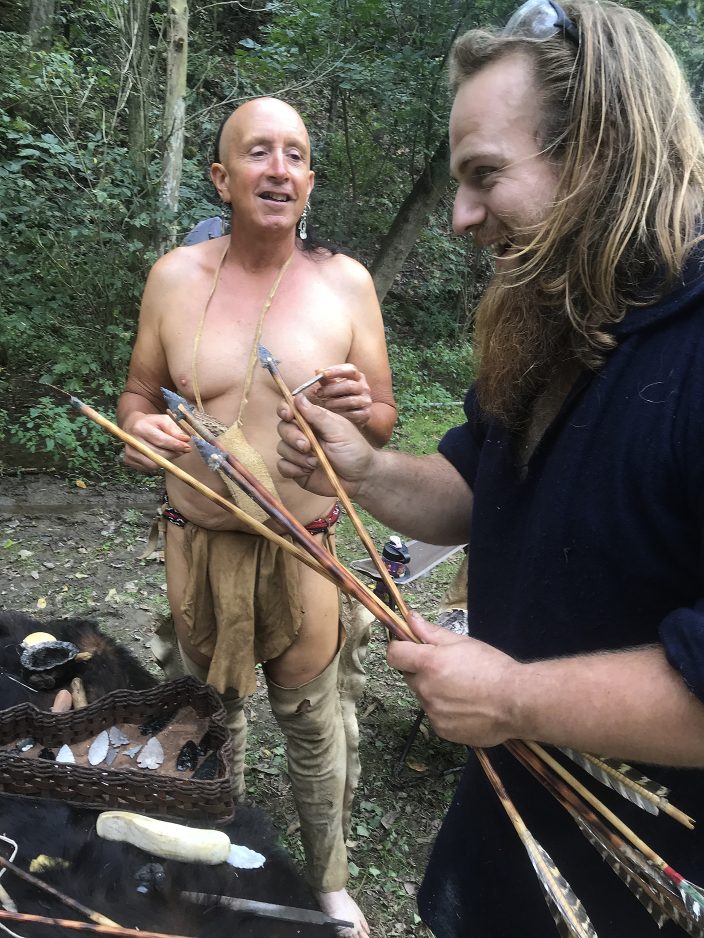
Todd Johnson along with another re-enactor, a flint knapper, during “Stone to Steel: Native American Heritage Weekend”
Kids line up to have Wood wade into the stream to retrieve the spears they throw at that once-alive fish tethered in the waters, as they learn to gauge the light fracture that stands between them and the fish, learn to balance the spear and use their body mass to propel it. Clad in a loincloth and wearing a feather through his nose, it’s easy to forget that Doug spent a career doing water pollution research for West Virginia.
Other re-enactors with multiple century lives are encamped up and down the riparian edge, knapping flint, making pottery, weaving natural fibers, skinning wildlife, rendering fat, drilling holes, starting fires with friction, all living the life of a people about to make first contact with the age of steel that will change their culture forever.
“Culture has very little to do with bloodlines. It’s about human involvement,” Wood points out with a grin before wading back to retrieve more spears.
“I want to thank the historical society for always making us feel welcome,” Todd Johnson of McKeesport says as he skins out a bear that was supplied by the Pennsylvania Wildlife Commission from its stash of frozen road kill and illegally taken game animals, saved for just such events each year.
“Ghost in the Head” is the persona Johnson adopted as a teenager when he began exploring his own native roots and earned the nickname because of his love of the past and his traditional archery skills that won him national awards. “My grandfather was Huron. He moved from Michigan to Donora to find work, and I grew up in a multi-ethnic town, with Irish, Italians, Slavs. They all had their family traditions, and I have mine. My first event was at Bushy Run in 1998 – it re-enacts Pontiac’s rebellion of 1763. That’s where I met Doug and Dianne.”
Johnson has been setting up camp at the museum’s Harvest Festival since 2001, with a Woodlands Indian shelter, a well-equipped campfire and wearing moccasins and gear he makes himself. He spends the weekend living that life and inviting festival-goers to reach out and get a better feel for the times that have come before, back when nature was our Walmart and humanity had to be wily enough to shop there.
Public interest has made these blasts from the past something to look forward to, so keep an eye out for them next fall.
They’ll be back.