

Have you met … Bettie Stammerjohn?
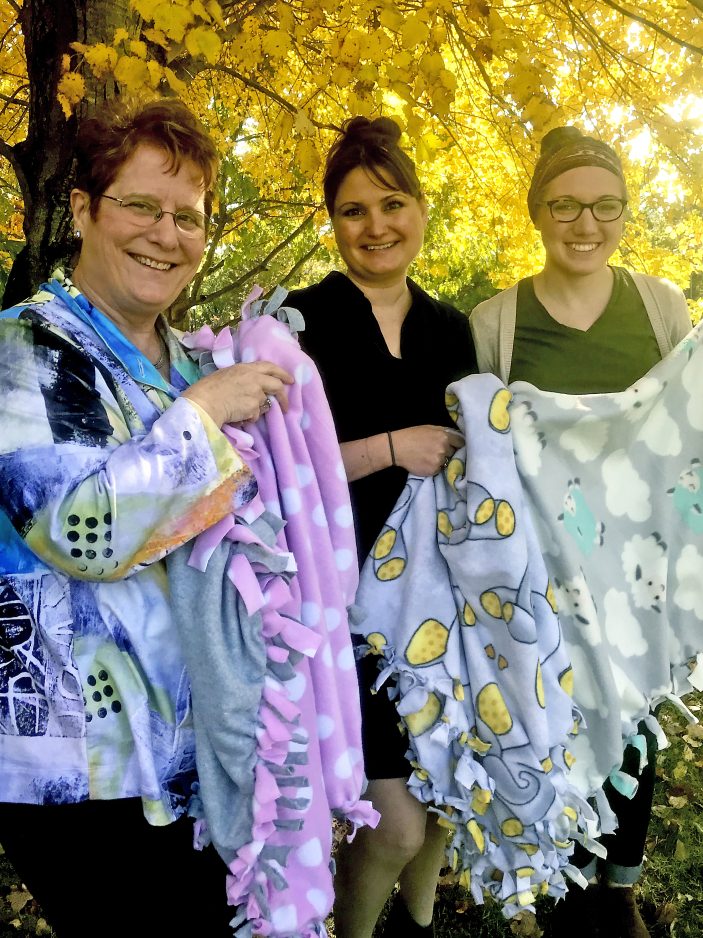
Bettie Stammerjohn, Kellie Hardie and Waynesburg University student Sara Byler
The blankets are super soft and adorable – polka dots, fleecy elephants, dancing sheep – made by Waynesburg University students in their spare time between classes and in evening get-togethers. It’s a fine late fall afternoon, and Bettie Banks Stammerjohn has stopped by the university to drop off a donation of material to make more, to visit with assistant dean of students Kelley Hardie to see how Project Linus is doing and to be photographed for this story.
Have you met Bettie Stammerjohn? If you made an endowment in the name of a loved one or your family, or have been the recipient of a Community Foundation of Greene County grant to support your library, church, school, fire department, food pantry, scholarship fund, or great new idea to help others, you have.
A $500 grant from Community Foundation of Greene County helped get this national blanket-making project for children in physical or emotional need rolling this year, and “Blanket Parties” are now being held across the county and cash donations to support it are a sure sign that this program has legs.
It’s just this kind of little grant that Bettie loves to make – one that plants the seed of a new project that takes roots and grows in the community, far beyond what it took to get it started.
Sometimes the right job for the right person is waiting when that person comes along, and Bettie’s career that led her to be the executive director of CFGC is a case in point.
“I’m not from Greene County but …” she says with a smile, sitting at her Waynesburg office, surrounded by paperwork, adorned with local art on the wall and a handy bag of chips nearby. “I truly love working here.”
I’ve known Bettie ever since I was a VISTA Volunteer in the 1990s, helping Washington-Greene Community Action, now Blueprints, identify needs in this very rural and under-served county.
The book she gave me when I stopped to interview her for this story told a story that I was delighted to read. Her father, Dr. Jay Banks, practiced medicine in the even more rural reaches of Virginia in the 1950s and wrote “House Calls in the Hills – Memoirs of a Country Doctor,” that tells of his first years as a general practitioner following in his father’s footsteps in Beaver, W.Va. Written with dry, compassionate wit, it is a series of tales about a doctor making house calls and coming of age as he learns the ancient art of survival from granny midwives, desperately poor but resourceful mountain people and children who thrive and make a place for themselves in the world despite all odds. These families had seen better days before the lumbering jobs that drove the local economy at the turn of the 20th century disappeared. The modern world had hardly begun to arrive to homes in the steep valleys and rocky ridges that Dr. Banks drove to in the six years he practiced there. When he left with his young family for a residency in orthopedic surgery at the Veterans Administration Hospital in Richmond, Va., in 1958, Bettie, the fourth of five siblings, was going into second grade. One fact lingers from those early years that sums up the spirit of those times: “My father ended up delivering me because the regular OB didn’t show up in time!”
When the family settled in Hagerstown, Md., in the mid-1960s, Bettie’s country roots were firmly planted. Their home sat at the edge of cornfields and cattle pastures, and the Antietam battlefield was five country miles away. Bettie went to Shippensburg State College, took liberal arts and studied to be a secondary social studies teacher. But one day of student teaching told her this was not her path to follow.
“My adviser warned me I’d have to get a master’s degree,” so Bettie took the challenge and went back to school to major in community planning with a focus on land use and soil and water conservation. “I grew up in farm country, and I realize now that all the work I did in college was leading toward real projects.”
She did surveys in downtowns, studied transportation patterns and learned to work with government agencies and city planners. A greenway plan for waterways became her thesis, and fellow student David Stammerjohn became the love of her life while she was doing graduate work at the University of North Carolina in Charlotte. The Stammerjohns married in 1977 and moved to Pittsburgh two years later when David started seminary school and “the Pirates won the World Series!”
Bettie became a pastor’s wife when First Presbyterian Church in Masontown recruited David in 1982. “I was the church receptionist – we had a Lily Tomlin switchboard that had wires to plug in.” She also found herself doing contract work collecting data for the Redstone Presbytery – “I was a data junkie, anyway!” – and went to libraries and courthouses doing research to see where new ministries might be started. When David took on a new church in Laboratory in 1986, their kids, Joe and Sarah, were in school, and Bettie decided, “I need to get a job.”
As if on cue, Washington-Greene Community Action advertised for an assistant planner.
“Richard Rinehart hired me in 1987, and when he left his position the next year, I became planning coordinator with human services.” Although her office was in Washington, Greene County was a big part of her beat as she administered grants for human services funding and was a liaison for the Human Service Advisory Commission. Greene County was looking to set up its own county human services department, and Bettie was working almost full time to make those plans happen. Richard Rinehart became the first human services director in 1991, and Bettie cheerfully admits she had worked herself out of a job. She then became director of planning at Community Action, overseeing all the funding that would go to Greene County for Head Start, literacy programs and housing and homeless services, directing federal and state grants, getting to know the programs and the people they served.
“Greene is one-fourth the size of Washington, population-wise,” and Bettie was using statistics and mapping software to show where the needs were. “In 1990, Greene County had the highest level of poverty of any county in Pennsylvania. But block groups and census data don’t work here.”
However, fair housing surveys did, and so did hands-on data gathering. “I rode the transportation vans, talked to the senior center people, the families with children. I got to know the people.”
Identifying needs through the work Bettie did – and the door-to-door surveys I did as a VISTA volunteer for Community Action – was the proof needed to get funding for new services like the much-needed preschool Even Start program at New Freeport Elementary School.
By 2001, Bettie was ready for a change of pace and took a job at Bethany College as assistant director of development, doing fundraising, grant writing and writing appeal letters for funding. “Looking back, I realize this was just the kind of training I needed for what I’m doing now.”
Bethany cut its staff in 2005, and Bettie found herself out of a job. But it wasn’t long before Community Action took her on as a consultant for a strategic plan to garner grants for programs like Head Start, and she found herself serving the people of Greene County once more.
Something was missing that Bettie couldn’t quite put her finger on until fellow Presbyterian Janet Brown gave her a call in 2006 and said, “Bettie, I have the perfect job for you!”
CFGC was founded in 2000 by residents like Baptist minister Dick Vissar and business leaders who cared for their community and wanted a place where that community could give back to meet needs as they arose. As a private nonprofit organization, it could accept money and endowments that might not be able to be given directly, to support churches and schools, libraries and community services. In addition, organizations like the Humane Society that depend on sustainable income to be available as needed for new ideas that need seed money to get started, like Project Linus, also benefit.
“The thing I really like is, we’re not just raising money, we’re building relationships. We’re helping meet the needs and develop those skills needed to build the capacity of the community to do good. The endowments we set up aren’t short-term – the money will be here, going out year after year. In the 12 years I’ve been here, our assets have grown steadily. As of June, we have $5.2 million in assets.”
Sitting in her office, Bettie reflects on the path her career has taken and smiles again. Her daily commute from Martins Ferry, Ohio, where David became pastor of the First Presbyterian Church in 2010, is less than an hour and, “I’ve only missed two days because of weather. You might not want to write a spiritual story, but I believe God has led me to this place, step by step. I couldn’t do what I do without those 13 years at Community Action and what I learned at my other jobs. I used to laugh at the students in college studying human services jobs. I think this is God’s sense of humor to lead me to where I didn’t think I wanted to go!”