

After 46 years, Leigh Shields finally sees his agave plant flower
By Text and photos by C.R. Nelson
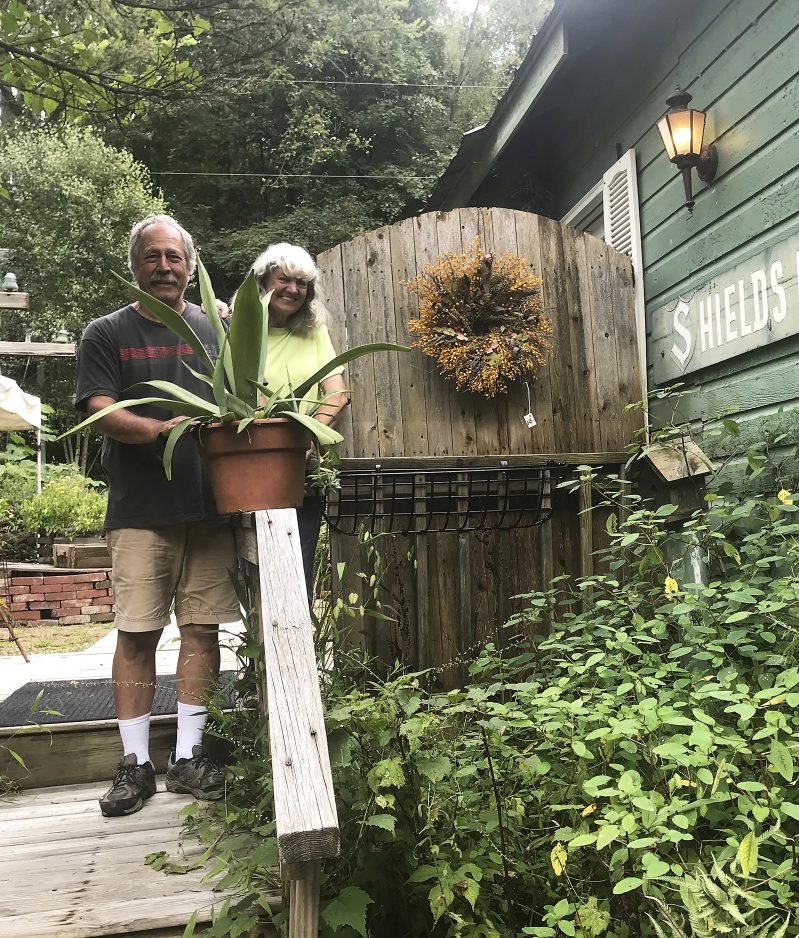
Leigh and Liki Shields
Imagine a freshly minted Waynesburg College biology graduate in 1972 checking out an impressive agave plant growing in a garden in Palm Beach, Fla. The huge succulent is fully mature, with a 30-foot tall spike about to bloom. At its base is a tiny offspring, growing from the mother plant.
“Agaves are also called century plants – they live for decades, but once they bloom they die.” Leigh Shields leans back in his chair, settling into the tale that neatly bookends his years as owner and tireless operator of Shields Greenhouse and Melomil Winery between Spraggs and the West Virginia state line. It’s an early August afternoon and I’m there to get a plant or two, then sit with Leigh in the gift shop to hear the story only he, with a huge grin, can tell. “I stole that pup, put it in my pocket and brought it here.”
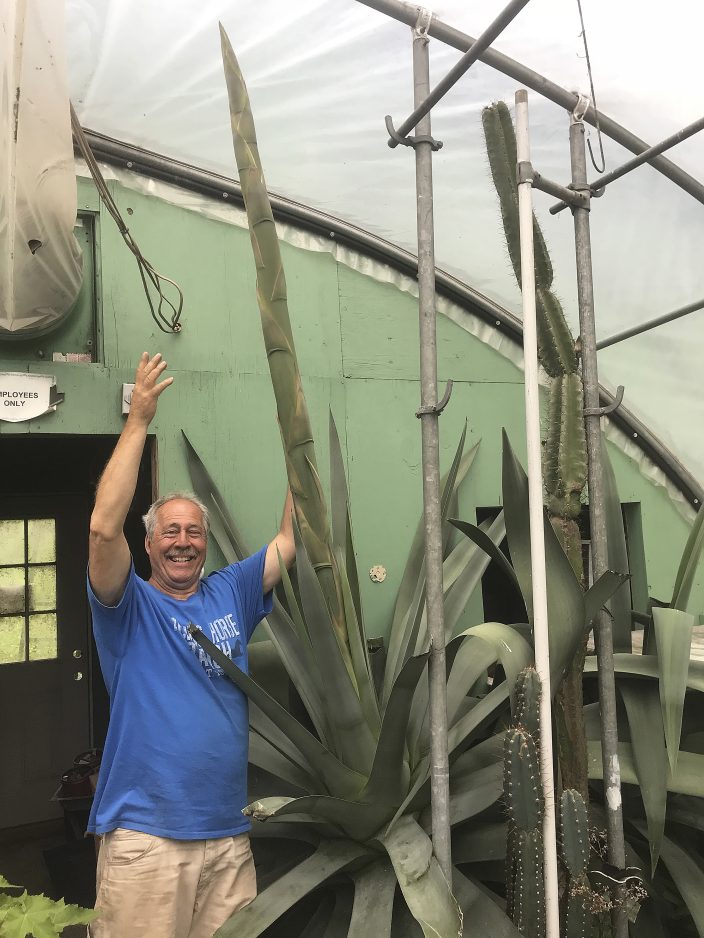
Leigh Shields with his agave plant in May
Now, 46 years later, that pup is ready to bloom.
We’re sitting on antique metal bistro chairs in one dim, air-conditioned corner of the shop with its attached wine tasting room, surrounded by twinkling lights, wife Liki’s dried flowers hanging from the ceiling and rustic collectibles in every nook and cranny. Outside was a humid, summer-drenched maze of pathways between greenhouses, flowerbeds and tables of countless varieties of flowers, herbs, fruits and vegetables. Out of the torn plastic roof of one of those greenhouses is a 30-foot spike of green towers, studded with branches, bending under the weight of buds about to open.
Friends and longtime customers had been coming by since May to watch the growth of the big plant that gives tequila and mescal their unique taste, that rooted itself into the soil under its pot in 1987 and hasn’t budged since.
“That’s why I ended up heating that greenhouse year-round,” Leigh says with another 1,000-watt smile. Growing a business based on plants is a matter of working with what happens when nature takes its course. Leigh summed up his business plan in one truncated sentence: “Baby steps all the way – with a plan that you don’t know is a plan.”
When the little agave arrived in Spraggs, Leigh was already living on the land that would one day become what you visit today to buy Greene County hardy plants and honey-infused fruit wine that he learned to make from Hungarian refugee Ferenc Androczi, who settled in West Virginia after World War II.
The kid from New Jersey came to Waynesburg College in 1969, following in the footsteps of older sisters Elyn and Diane. Buying a rundown farm in Spraggs seemed better than paying for a dorm room, so Leigh set down his first tentative roots and settled into college life.
“I wanted to live on the land ever since I was 2 years old.” The Shields family had relatives with a three-acre parcel some 20 miles from their home in the outskirts of Newark, and Leigh was the kid who demanded to go there every summer. “They had chickens and a garden and a cow, and I loved it.”
Waynesburg College also had something he loved – a world-class geology and biology department, taught by professors who were experts in their fields. “I checked them out the year before I graduated high school and I knew I wanted to learn from them.”
College life in the early 1970s was freewheeling, and Leigh was a happy participant. There were keg parties, adventures and roommates who never paid rent, but things got fixed, things worked out and Leigh graduated in time to help put his aunt’s house in Palm Beach on the market. He came back to the farm with his agave, ready to settle down and grow.
Unbeknownst to him and most of his neighbors, the coal industry was on the move and the coal reserves were about to be extracted from the lands around Spraggs. This would kick off years of undermining claims, road access issues and water rights challenges – a big deal for any business trying to raise plants commercially. But in those early years, Leigh was focused on learning his craft and fixing up his old farmhouse that had a German log cabin, circa 1840, buried beneath generations of sidings and additions.
“After graduation, I worked at Fishers Big Wheel, which gave me the money to do what I wanted.”
One of the things he got to do was buy his first greenhouse – a vintage 1919 Lord and Burnam 50-by-12-foot redwood glass greenhouse rescued from Mahle’s Greenhouse on Route 218, partially destroyed, with a tree growing through one end.
Leigh hauled it home in his station wagon and stored it in the barn. When reassembled in 1979, it connected to the house. He now had a year-round bit of the garden of Eden to call his own, but still wasn’t sure what or how to grow. This was the year that serendipity came calling.
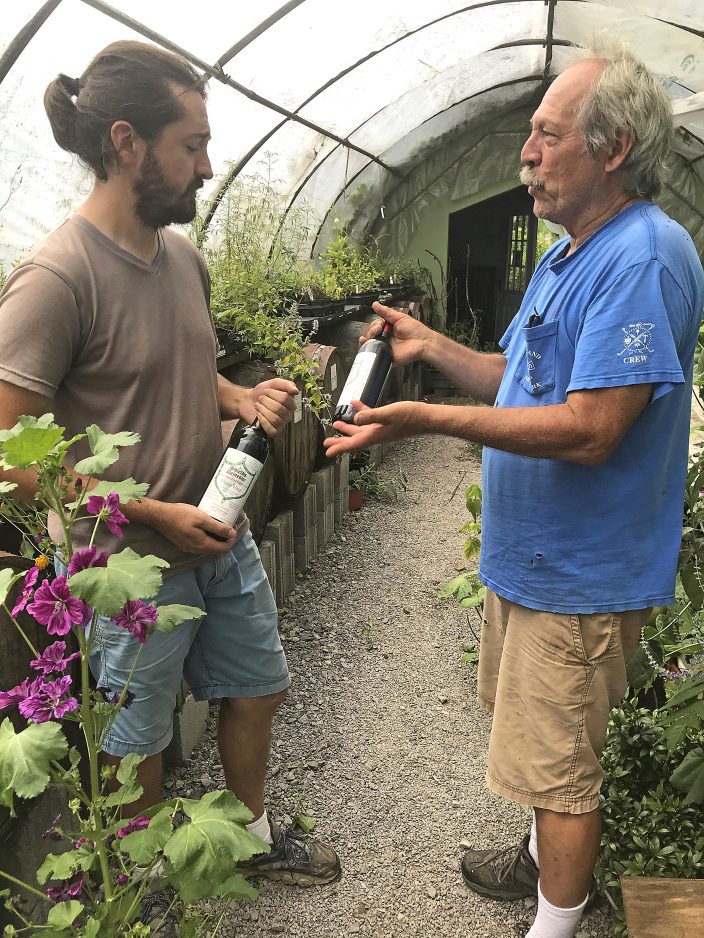
Alex and Leigh Shields
Alex Shields with his dad, Leigh Shields, in the family’s Spraggs greenhouse in this file photo. In addition to the greenhouse, the family has the Shields Demesne Winery.
“I was on a train to San Francisco when I read a little ad about a new agricultural program at the University of California, Santa Cruz.” The Farm and Garden project was rooted in the work started in 1967 by famed English gardener Alan Chadwick. He took five steep, graveled acres that were once a road in the middle of campus and turned it into organic terraced gardens, using only shovels, hoes, forks, picks and eager student labor. When Leigh was accepted into the program and fell under the spell of Chadwick’s expertise, it had expanded to 19 acres of organic learning in the midst of a redwood forest. “We had donkeys and workhorses, slept in teepees, grew our own food with no pesticides.”
Solar panels, hand tools and natural fertilizers were great teachers for this new generation of farmers ready to get back to the land and grow healthier food. “It pretty much taught me everything I needed to know.”
After graduation, Leigh was off for a year abroad as a migrant farm worker, learning traditional gardening and agricultural practices in England, France, Greece and Italy and then on to Israel and Egypt. These farmers had been organic for thousands of years. Leigh worked alongside them, slept in the fields and learned.
Once back in Spraggs, “I bought a Jersey cow for an alarm clock – it meant I had to get up early to milk!” Leigh tackled his own steep hillsides. A few seasons of clearing, plowing and planting, first herbs, then the vegetables his neighbors wanted to buy, got the greenhouse going. He also planted some dried flowers, “but I didn’t really know what to do with them.”
Serendipity heard the call – on a visit to the family in New Jersey, Leigh met Ljiljana “Liki” Miladinovic from Yugoslavia, who came to visit her own relatives and stayed to become his wife. Her degree in fabric and interior design turned those dried flowers into a beautiful outpouring of wreathes, swags, bouquets and other decoratives that went from local craft and gift shows to nationwide distribution.
Son Alex was born in 1987 and Victor in 1994. It was now a family business, the family farm that Leigh had always dreamed of.
The dried flower craze lasted more than a decade before changing with the times, but the greenhouse business, with its hardy, homegrown botanicals, continues to thrive. By the early 1990s Leigh had met Ferenc – “everyone called him Frank” – and by 2000 was using his techniques to make honey wine, melomel, a favorite of those who like a flavor reminiscent of sherry or port. In 2008, Shields Greenhouse had the licenses to add winery to its name and now offers more than two dozen varieties based on the fruits and herbs used to make each oak barrel-aged batch.
Alex has become the family wine guru, tending to the distillation, bottling and marketing of the family’s unique product. Victor, a recent West Virginia University grad, recently landed a job with the Smithsonian, and Leigh and Liki are hard at work every business day, which is every day someone is home.
A couple of weeks later, I’m back, ready to witness the agave in full bloom and hopefully, get a fine photo ending for my story. Leigh meets me with the kind of news that only someone who understands nature can deliver with a grin. The 30-foot stalk of buds was broken by a burst of wind between thunderstorms last week and now lies nearly invisible, caught between two greenhouses. Squinting I can see a halo of gold peeking above the roofline, the glow of countless long stamens growing out of the countless stylus pods, now ready for bees to pollinate the seed ovules within them.
“The base is dying back fast, but the stem isn’t severed, so it still has turgor. The seeds should germinate and grow,” Leigh informs me. “I think I’m going to leave it like that and see what happens. When Alex and Victor get back from Europe, we’ll clear out the space between those greenhouses and get a good look. It should be something to see!”