

Bee skeps a sweet idea as a decoration
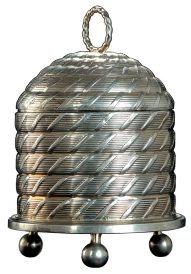
Honey has a history dating to 2100 B.C. It is mentioned in some Babylonian writings. It was used for sweetening food, for medicine, for religious ceremonies and even as a form of money. In the 18th and 19th centuries, a special serving dish and usually a special serving fork or spoon were devoted to each type of food, so it’s not surprising to find special antique honey pots. The wealthy used silver serving pieces, and honey pots might be shaped like bee skeps or have a sculpted or engraved bee as decoration.
Skeps were made of woven straw and were portable. If a skep was not destroyed to get honey out, another swarm of bees could inhabit a skep the next season. Old skeps sell today for about $50 to $100 as decorations. It is illegal to raise bees with a skep today. Beekeepers must be able to open hives today so mite medicine can be applied. Old and new honey pots can be found made of glass and pottery. If you plan to use a sterling- or silver-plated pot, it must have a glass liner. Honey encourages silver tarnish, and tarnish destroys some of honey’s nutrients.
Q. I have an original program from the Candlestick Park Dedication Dinner held at the Garden Court of the Sheraton-Palace Hotel in San Francisco on April 11, 1960. It’s autographed by a few baseball players and by some of the people who spoke at the dedication, including Vice President Richard Nixon, Major League Baseball Commissioner Ford Frick, Giants owner Horace Stoneham and Giants manager Bill Rigney. What is it worth?
A. The San Francisco Giants played at Seals Stadium for two seasons before Candlestick Park opened in 1960. The team played there for 40 years, until its new ballpark on San Francisco Bay (now called AT&T Park) opened in 2000. Your program would interest collectors of baseball memorabilia, but the Nixon signature means it also might appeal to people who want political collectibles. If you want to sell, contact an auction that specializes in sports collectibles. The program could sell for $100, but it might also bring $500 or more, depending on the program’s condition and the fame of everyone who autographed it.
Q. I still have my Alice Marble wooden tennis racket my parents gave me when I was about 10 years old. It was made by Wilson and reads “Court Queen” on the handle. Is this of any value, or is it just a piece of tennis history?
A. Tennis player Alice Marble (1913-1990) was ranked No. 1 in the world in 1939. She broke world records when she won the singles, doubles and mixed doubles titles at both Wimbledon and the U.S. Open that year. During World War II, she was a spy for the United States and was wounded when trying to get some Nazi financial information.
Wilson made more than one model of Alice Marble tennis rackets. The Court Queen model was introduced in about 1938. Old wooden rackets aren’t particularly valuable today. Rackets like yours sell for under $40. They are hung on the wall as decoration, not used to play tennis.
•
Tip: Help your family by always identifying who’s pictured in your family photographs. Include their names and ages, the year the photo was taken and where it was taken. Write on the back near the edge using the kind of permanent marker sold at photo supply stores.
Do not use a ballpoint pen. It will leave a dent in the paper.
Current prices are recorded from antiques shows, flea markets, sales and auctions throughout the United States. Prices vary in different locations because of local economic conditions.
• Postal telegraph badge, “All America Cables,” globe, blue-and- white cloisonne, triangular, 2 1/8 x 1 7/8 inches, $45.
• Wallace Nutting print, “The Quilting Party,” signed, framed, 10 x 12 inches, $50.
• Yellow Kid paperweight, metal, figural, “Say, ain’t I a heavyweight,” R.F. Outcault, 7 x 3 inches, $130.
• Walking stick cane, antler handle, black trim, nickel silver cap, c. 1885, 36 inches, $185.
• Barber shop sign, globe, hand lettered, white, 16 1/2 inches, $210.
• Edwardian chair, domed slatted back, medallion, feathers, down- swept arms, square legs, c. 1900, 36 inches, $430.
• Pier table, mahogany, cove-molded frieze, scrolls, columns, serpentine shelf, c. 1835, 37 x 39 inches, $985.
• Reverse-painted lamp, autumn landscape shade, metal base, Moe Bridges, c. 1920, 24 x 18 inches, $1,180.
• Lalique Verone vase, flared sides, frosted birds, scrolls, ring foot, 1980s, 7 1/2 x 11 inches, $1,230.
• Tea caddy, George III, fruitwood, pear shape, c. 1810, 6 1/4 inches, $2,360.
Write to Kovels, Observer-Reporter, King Features Syndicate, 300 W. 57th St., New York, NY 10019.