

HBO’s ‘Phil Spector’ a tour de force for cast, director
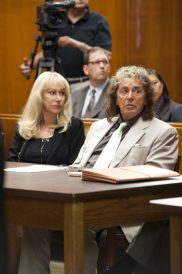
The question of whether famed music producer Phil Spector killed struggling actress Lana Clarkson is secondary in HBO’s “Phil Spector.” The film, written and directed by David Mamet, is only about a murder trial the way “Glengarry Glen Ross” is only about real estate.
Mamet is very much on his game in “Phil Spector,” airing at 9 tonight, but so is every member of his cast, including Al Pacino as Spector and Helen Mirren as attorney Linda Kenny Baden. One of the reasons “Phil Spector” is so thoroughly engaging is the chance to watch these two acting titans work to the full extent of their considerable powers.
HBO insists the film is not a dramatization of Spector’s first trial for the 2003 death of actress Lana Clarkson, but, rather, that actual events and people “inspired” the film.
That’s Mamet’s way of buying a permissive license to interpret and, frankly, to create characterizations that explore much more than whether Clarkson put a gun in her mouth that night at Spector’s home and pulled the trigger, or whether Spector did the deed.
Suffering from an ever-worsening cold, Kenney Baden arrives at the sparsely furnished temporary offices set up in Los Angeles by attorney Bruce Cutler (Jeffrey Tambor) as defense headquarters for Spector’s first trial. At best, she thinks Spector’s crazy but tries to remain agnostic about his guilt or innocence in Clarkson’s death. Summoned to Spector’s house, she goes alone in the rain through the barbed-wire gates and into a labyrinth of rooms and hallways. Each overstuffed room seems to have a theme – one room is devoted to Lincoln memorabilia, another set up like a carnival with an assortment of swords and knives, yet another contains a jail cell and a wall decorated with silhouettes of the guns removed by the cops after Clarkson’s death.
Finally, she finds herself standing in front of three doors. The left one opens inward, the right one opens outward, and the one in the middle is closed and may be trompe l’oeil. The whole place is a cross between a haunted mansion and a set designed by Magritte.
All of this is more than just a suggestion of Spector’s rich professional past and eccentricity. Like the landing of the airliner carrying Benjamin Braddock back to Los Angeles at the start of “The Graduate,” Mirren’s walk through the partially lighted rooms represents the film’s thematic descent into Spector’s mind. Whatever she thinks about him at the beginning will necessarily change as she goes deeper into what makes him tick, however arrhythmically.
As Mirren’s character moves from room to room, we anticipate that moment when she and Pacino will be in the same scene together. When it happens, it’s almost comic at first, this small, doddering and rambling man with a Ken doll blond wig, seeming at first to confirm that he’s clearly a nut case who must have killed Clarkson.
Addressing him as “Phillip” (as his late mother did, he says), Kenney Baden assesses the enormity of her task: How to get the jury to find Spector something other than a freak. With Cutler often away to work on other cases, Kenney Baden assumes more and more control of the defense, setting up focus groups to gauge potential juror reaction to taped testimony from other women to whom Spector was allegedly violent, including ex-wife Ronnie Spector, and trying to find a plausible alternative scenario for the night of Clarkson’s death.
Many viewers will know the outcome of the trial, others will only know that Spector is in prison today, but although Mamet structures “Phil Spector” like a legal thriller, with the compelling look and feel of Raymond Chandler and old Hollywood, the film isn’t about guilt or innocence. As Kenney Baden tries to find a way to get a jury to like the bewigged creator of the fabled Wall of Sound, we are forced to reconsider whatever opinions we might have about Spector’s culpability. We do so not because of the effectiveness of re-enactments to determine blood spatter patterns, but because our minds have been opened by Mamet’s deeper purpose of exploring the nature of prejudice, of superficial yet often immovable opinions based on minimal information about a person.
Mamet often explores the psychological space between our inner selves and the personae we don, like, well, Spector’s shrub-size fright wig. We all have a version of the person we want to project to the outside world. Some of it may be an accurate reflection of our internal selves, but even the truth of our nature is necessarily refracted by the lens of the image we want the world to see. When the person is a public figure, that image can be indelibly shaped by the media.
The more we get to know Pacino’s Spector, the more transparent his exterior braggadocio becomes. He almost sounds desperate when he bellows, “I invented the music business.” He may believe it, but we get that he is also trying to reassure himself as much as Kenney Baden, and that behind his own personal Wall of Sound, he is frightened, increasingly vulnerable and, most of all, human.
There is an ever-present Greek chorus in “Phil Spector” to enforce Mamet’s theme – the throng of reporters and photographers camped outside the courthouse and Spector’s mansion, and the even noisier gaggle of looky-loos who wait daily for Spector’s arrival to wave their signs calling for a guilty plea or scream at him like frenzied audience members in a Roman arena.
Mamet’s script and direction are spot-on and richly detailed, from the crisply naturalistic dialogue, to the details of Spector’s reclusive life, including his obsession with T.E. Lawrence, the diminutive (5-foot-5) Briton whose life was mythologized by journalist Lowell Thomas.
Although Pacino gets to gnaw ravenously on every bit of scenery, he has met an equal in Mirren, who holds our attention by speaking in measured tones, prompting us figuratively to lean in closer to her character.
Until Clarkson’s death, Spector was pretty much an unknown to many contemporary music fans, and the passage of time presents an enormous challenge to Kenney Baden – at the start of the film, she asks a younger colleague to identify a small black disc with a large hole in the center. The young man has never seen a 45 rpm record before. But Spector’s glory days were largely in the past before Lana Clarkson’s death, an event which ironically not only gave Clarkson, however momentarily, the fame she’d sought while she was alive, but also brought Spector back into public consciousness.
Today, the minotaur is back in another cave, to use an operative metaphor from Mamet’s script, burdened perhaps forever with an entirely different persona in the public’s mind. If they think of him at all, it won’t be as the pioneering music producer, but as the man who killed that actress they’d never heard of before. It’s a public image that’s even harder to counter than the one Kenney Baden faced trying to keep him out of jail.