

Halloween items make bewitching collectibles
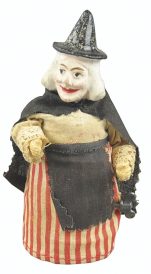
Jack-o’-lanterns, ghosts, witches and trick or treating are all part of Halloween. But how did it start? There were similar celebrations dating back to ancient times but the modern holiday started about 1910. There was a Halloween Carnival party and a king and queen were chosen in 1904.
The Dennison Co. started selling costumes, crepe paper and instructions for Halloween decorations by 1910. About 1920 paper lanterns and paper pumpkins turned into jack-o’-lanterns became popular. The same type of stiff paper was used in Germany to make Halloween candy containers.
The 1920s also saw the idea of trick or treating come into fashion. To get a treat of candy, the costumed visitors had to perform. Some of the 1930s jack-o’-lanterns were made of celluloid. And by the 1940s, hard plastic had arrived. Witches seem to have been added to the holiday by the 1930s and the black dress, pointed hat and flying broom were important. The green face was probably inspired by the wicked witch in “The Wizard of Oz” movie, but witches are getting nicer and better looking at today’s celebrations. Could that be because nice witches starred in TV shows like “Bewitched”? And trick or treat bags didn’t appear before about 1948. Before that any plain paper bag or cloth sack was fine.
Since 1900, toy makers have added to the holiday fun with games and toys using all the popular symbols. Save the trick-or-treat bags this year. They are becoming popular collectibles.
Q. I bought a Smith Corona “Classic 12” manual typewriter from the SCM factory in Groton, New York, in 1965. It came in the Trimline carrying case. I have the original booklet and warranty that came with it. I bought a new ribbon for it in 2004 and it’s still in excellent condition. What is the value?
A. Smith Corona was formed by the merger of two typewriter manufacturers, L.C. Smith & Brothers Typewriter Co. and Corona. The companies merged in 1926 and the name was changed to Smith Corona, Inc., in 1949. The Classic 12 was made in the 1960s. Smith Corona stopped making typewriters in 1998 but sold typewriters made in South Korea until 2009. The company is still in business, selling pressure sensitive labels and thermal transfer ribbons. Your typewriter could sell to someone who wants to use it. Value of your typewriter, about $30 to $50 for most, about $100 for mint in the case. Most are bought to use.
Q. Can I use boiled linseed oil on my woven oak splint baskets? My dad’s aunt made them in the early 1900s. Some of the splints are starting to dry out and crack. How can I keep them from splitting more?
A. Don’t use linseed oil or any other kind of oil, it can get sticky and will make the splints harder and darker. For routine care, dust the baskets with a feather duster or use the vacuum cleaner, but first wrap an old nylon stocking around the nozzle. You can clean the splints by blotting with a damp white cotton cloth. Let your baskets share the bathroom with you when you take a shower. The hot, moist air is good for the basket. Splint baskets benefit from a light shower or misting once or twice a year, but don’t soak the splint. Let the basket dry completely in a spot away from direct sunlight. Some sources recommend soaking the baskets in cool water for 30 minutes, but that can cause the splints to warp. Keep baskets away from direct sunlight, heating vents, the fireplace and any other heat sources that will dry out the splint.
Q. What is a fore-edge book?
A. The fore edge of a book is the edge opposite the spine. In a fore-edge book, the edges of the pages are painted or gilded to make a picture when the book is closed. Fore-edge paintings may have been done as early as the 10th century. In the 17th century, artists began painting slightly inside the outside edge of the page so the picture was only visible when the pages were fanned out. Double fore-edge paintings also were done so two different pictures were visible depending on which way the pages were fanned. A lot of fore-edge paintings found today are later additions to old books. Fore-edge books sell for a few hundred dollars or more.
Tip: A monogram can be removed from an old piece of silver by a competent jeweler or silversmith. But it is easier to tell friends that the strange initials on the platter are those of a great-great aunt.
Current prices are recorded from antiques shows, flea markets, sales and auctions throughout the United States. Prices vary in different locations because of local economic conditions.
• Advertising sign, Blue Diamond Brand, Hood River Apples, glass front, frame, 12 x 22 inches, $30.
• Victorian pin, memento mori, memorial scene, blue glass, mother-of-pearl urn, plinth, 1 1/2 x 1 inches, $55.
• Candy container, witch, black dress and bonnet, holding sack, Halloween, cardboard, 8 inches, $90.
• Pharmacy Scale, balance, wood and glass case, footed, hinged lid, Henry Troemner, 9 x 13 inches, $180.
• Plant stand, porcelain, tripod, hanging cauldron, flowers, brass trim, chain, England, 57 inches, $480.
• Silver page turner, eagle head, ivorine blade, monogram, Germany, c. 1900, 11 3/4 inches, $590.
• Halloween, Jack-O’-Lantern set, papier-mache, wire handles, graduated sizes 4 to 7 inches, 4 pieces, $1,890 • Movie viewer, “Horrorscope,” Werewolf, Frankenstein, Dracula, box, 1964, 20 x 12 inches, $2,280.
• Glass sculpture, Pulcino bird, green, millefiori eyes, copper feet, c. 1960, 12 inches, $4,750.
• Butler’s chest, Regency style, mahogany, drawers, human foot shape feet, velvet slippers, 61 x 21 inches, $5,190.
Write to Kovels, Observer-Reporter, King Features Syndicate, 300 W. 57th St., New York, NY 10019.