

Baseboards, from bland to boastful
Baseboards might not be the most important element in a room, but they serve a practical purpose and, in some old homes, a decorative and architectural purpose, while neatly covering the space where the wall meets the floor. They are also there to protect the wall from mops and vacuum cleaners. Sadly, today in newer homes most of the beautiful high baseboards have been replaced with a 3-inch version that is best painted the same color as the walls. However, there are simple ways to embellish the boards that will give your room character and a sense of importance. They can make a decorative statement as large or as small as you choose.
I have always been fascinated by baseboards. They frame a room and announce the walls around them. When I was in my 20s, I lived in a tiny flat in London that had 12-inch baseboards, or skirting boards, as we called them in the U.K. I spent weeks on my knees stripping off layers of paint to reveal the original pine underneath. It was the fashion of the times, and looked amazing. Of course, trends change, and 10 years later everyone was painting their wood baseboards white.
In Italy, rather than using wood moldings, baseboards – called battiscopa – are generally painted onto the lower wall. The lower part of the painted walls takes a beating when the floors are mopped, and a darker color hides the marks. (Another translation of battiscopa is “mopboard”.) The baseboards could be a simple band of paint, a foot or more high seen mostly in farmhouses, but in grander villas they grow higher with differing shades of paint and trompe l’oeil techniques. Using shading, these sections could be transformed into the look of fancy moldings, richly textured and even gilded.
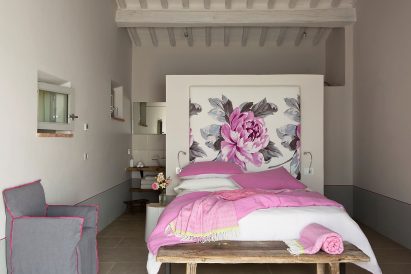
In one of my Tuscan guest rooms, I painted the battiscopa about 22 inches high in medium gray and topped it with a line of fuchsia. These shades were drawn from the stunning Tricia Guild peony fabric that dresses the headboard. The upholstered chair is also trimmed in fuchsia. While the biggest impact is gleaned from the giant peony, the eye is drawn to the other elements in the room that complement the flower.
If you would like to add some pizzazz to your baseboards, there are plenty of options. Moldings in wood and plastic are available in many styles and widths. Build up an architecturally interesting design by piecing together different widths and shapes. Fill in any spaces or gaps with pre-mixed plaster filler, prime and paint for a cohesive finish.
You can use paint alone or add a paint detail to the top of an existing molding. Your room’s style and mood can dictate how you proceed. Victorian rooms call for high baseboards and ornate details. They can be painted all white, or pull a color or two from your furniture fabrics. A contemporary design is more minimal, but a high band of bold color will also work. In rooms with high ceilings, use a high baseboard to bring the space into a more comfortable human scale. Transition style allows for a mix of old and new. Keep the baseboard about 8 or 9 inches high, and try a combination of paint and moldings.
Baseboards are a fascinating decorative detail that is often overlooked. Have some fun; experiment on a single wall and see what a delightful impact it has on the mood of your room.
Email your questions to house2home@debbietravis.com.