

Modern designs of George Nelson clocks ahead of their time
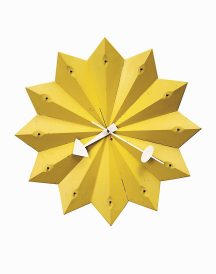
Some of the most popular clocks made after 1944 in the mid-century modern style were designed by an architect and journalist. George Nelson (1908-1986) graduated with a degree in architecture in 1931. He went Europe and wrote magazine articles praising the famous designers and introducing their ideas and his to the U.S. He suggested the open-plan house, storage walls, and family rooms, which all are popular today. Herman Miller, the furniture maker, asked him to become the design director of his company. And that was the beginning of his many still-collected designs, like the “Marshmallow” sofa, “Coconut” chair and the “Ball” clock.
Howard Miller Clock Co. produced over 30 different wall clocks based on his idea of an almost-round face with geometric additions or subtractions and simple hands. Some were just a group of sticks with colored balls at the end that radiated from the center to form a circle. There was no frame, no glass and no numbers. Each design for a clock was made in many different colors. The “Fan” clock was designed in about 1954. It looks like a folded star-shaped cutout. A yellow Fan clock sold for $3,625 at the Los Angeles Modern auction in Van Nuys, Calif., in May 2016. A black version sold at the same auction brought only $2,250. The original clocks ran on electricity, but you can substitute a battery so no cord will show. Save and replace the old parts before you sell the clock or the value will be less.
Q. I have an ornate silver and glass pitcher with a silver lid attached by a chain. The glass is engraved with a boat leaving one country and arriving in another to a church or building. It spins in the silver base so you can read it. The silver is marked “800” and the marks seem to indicate it was made by Schleissner & Sohne Hanau. Can you tell me something about the maker and give this a value?
A. Schleissner & Son made silver in Hanau, Germany, in the late 1800s. Johann Daniel Christian Schleissner started in business about 1817. After his son, Daniel Philipp August Schleissner, joined the business they began making “antique-style” silver copied from older pieces and with marks similar to antique marks. Most pieces were made for export to the U.S. and England. The company is still in business, now as W.K. Schleissner Silver with headquarters in Grundau, Germany. The number “800” is the standard for silver in Germany. The value of your pitcher is about $800.
Q. My grandfather kept wooden matches in a strange vase near his pipe. One side of the colorful vase was a molded version of the mask for Comedy, the other side was the Tragedy mask. It is marked “Wedgwood,” but it doesn’t look like the blue and white pieces with the raised designs I usually see. It has ridges on the bottom. What can you tell me about it?
A. Your grandfather had a Wedgwood majolica match holder, also called a match striker. The ridges were used to strike and light the match. Today’s wooden kitchen matches probably would not light on this striker because they are safety matches, made to be less likely to light from accidental friction. Collectors sometimes confuse match holders with match safes. That name is for a small closed container, usually metal, that held the matches in a pocket or purse. Your majolica match holder was made in the 19th century of majolica. It could sell for $150.
Q. Are cereal boxes still a popular collectible? I remember reading about them in the 1960s and seeing a display of flattened boxes for sale at an antiques show.
A. Advertising collectors have been buying round oatmeal boxes since the 1940s. About 1910 to 1930, Kellogg put games and stories to be cut out on the back of boxes. But the rectangular boxes did not attract much attention until Wheaties began picturing athletes on boxes in 1935. It was the “Breakfast of Champions,” and there was a premium that could be cut from the box. By the 1940s, small pin-back buttons picturing comic characters were included with the cereal. Soon, other toys were included and were pictured and mentioned on the box. But it was the 1960s that pushed cereal-box collecting, and soon there were books about it and boxes were sold at most antiques flea markets. Many were destroyed when the Mickey Mouse mask or other toy was cut out. The most expensive today are the full flattened boxes of the 1950s and 1960s. Some sell for over $100.
Tip: “Liquid silver” jewelry can be cleaned with a soft cotton cloth or rubbed with dry baking powder. Do not use dips.
Current prices are recorded from antiques shows, flea markets, sales and auctions throughout the United States. Prices vary in different locations because of local economic conditions.
• Pin, pearlized acorns, rhinestones, goldtone leaves, c-clasp, marked, Coro jewelry, 1 3/4 inches, $20.
• Doorstop, mouse, sitting up, cast iron, painted, shaped base, bottom lined with felt, c. 1905, 4 inches, $60.
• Delft birdcage, white ground with blue flowers and green leaves, scrolling, footed, dome top with bell finial, 26 inches, $125.
• Mechanical bank, owl, perched on stump, turns head, glass eyes, cast iron, painted, 1880, 8 x 4 inches, $240.
• Orrefors vase, clear with etched green fish and sea plants, teardrop shape, c. 1950, 8 x 5 inches, $295.
• Ride-on toy, St. Bernard, hard plastic, painted steel frame and wheels, handle bar, England, c. 1905, 19 x 24 inches, $325.
• Golf sign, hand carved wood, The golfers arms, golfer on course, arched top, multicolored paint, 1950s, 40 x 27 inches, $400.
• Mirror, carved wood and gilt gesso, openwork scroll design, leaves, chevron border, 25 x 28 inches, $500.
• Lunchbox, Howdy Doody, Howdy holding frying pan, girl with dinner bell, chuck wagon, tin lithograph, 1954, $675.
• Silver figurine, pheasant, etched feathers, one bird wings spread and one bird wings down, c. 1900, 21 inches, pair, $2,750.
Write to Kovels, Observer-Reporter, King Features Syndicate, 300 W. 57th St., New York, NY 10019.