

Duck before you get soaked by a vintage garden sprinkler
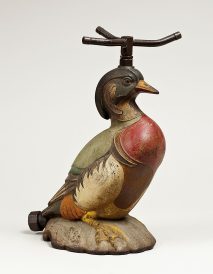
Unusual vintage figural garden sprinklers have become expensive objects wanted by technology and gardening enthusiasts. The first sprinklers were invented after the 1870s. Water was saved in a large rooftop water tank and could be delivered to a fire with the pressure created by letting the water fall down into the hose. At first sprinklers and hoses were only available for public buildings, then farms, then public landscaping. About 1900 lawn sprinklers were available in fanciful shapes. Many of the iron sprinklers were made by the same companies that made doorstops, hardware, bookends or even fountains. By the 1950s colorful plastic sprinklers were popular. Today there are many types of sprinklers from the plain disc that sprays in all directions to the tall pole with a pinwheel at the top to spray patterns of water.
Early painted iron sprinklers shaped like a mermaid, frog, monkey, turtle, alligator, squirrel, rancher with a lasso or a duck in excellent condition can sell for over $1,000. During the past five years, an iron monkey sprinkler auctioned for $9,000 and the Mermaid for $8,000. A 13-inch-high English wood duck painted in original colors and marked “Nuydea, Patent D-8 3091” is for sale at Frank & Barbara Pollack’s American Antiques & Art store in Highland Park, Ill. Prices have come down a little but those with original paint are expensive – unless it is a lucky find at a garage sale.
Q. I have had a cookie jar shaped like W.C. Fields for about 35 years. There are no markings on the bottom, so I don’t know who made it. It’s never been used and is like brand new. The cookie jar is about 11 inches to the top of the cover and 7 inches wide. I’d like to know what it’s worth.
A. Your cookie jar was made by McCoy Pottery in Roseville, Ohio. The company made cookie jars from about 1940 until the pottery closed in 1990. Its W.C. Fields cookie jar was made from 1972 to 1974. The company called it a “snack” jar. Most McCoy cookie jars are marked, but some, like yours, are not. Cookie jar collecting became enormously popular in the late 1980s after Andy Warhol’s collection of 175 cookie jars sold at Sotheby’s in 1988 for more than $240,000. Many vintage jars that sold for hundreds of dollars during the 1990s can now be had for a fraction of their former price. In the late 1990s, W.C. Fields cookie jars sold from $700 to $950. Now, while pre-sale estimates may be as much as $350, they sell for under $100.
Q. I have an old 32-ounce silver-plated coffee pot with the TWA logo etched on the side. The name International Silver Co. is marked on the bottom. After seeing the movie “Aviator” about Howard Hughes and his connection to the airline, I was wondering what its value is as a collectible.
A. TWA was in business from 1925 until 2001. It became TWA in 1930 when Transcontinental Air Transport and Western Air Express merged. Howard Hughes held controlling interest in the airline from 1939 until 1965. The company filed for bankruptcy in 2001 and was bought by American Airlines. There are collectors who specialize in airline collectibles. Coffee pots like this are listed for sale online for $25 to $50.
Q. How much is a Raggedy Ann doll in the original box worth? Printed on the box is “Knickerbocker’s Original Raggedy Ann Doll, Style No. 0001” and “Character created by Johnny Gruelle, Knickerbocker Toy Co., Middlesex, NJ, Made in Taiwan.” The box isn’t in perfect condition but the doll appears to be in good shape with the original clothes.
A. Raggedy Ann dolls, based on stories by Johnny Gruelle (1880-1938), have been made for almost 100 years. Gruelle received a design patent for Raggedy Ann in 1915. The Knickerbocker Toy Co. made the dolls from 1963 to 1982. The company started in Albany, New York, and moved to Middlesex, N.J., in 1968. The box proves your doll is not very old, because it mentions New Jersey and Taiwan. The original dolls were made in the USA. A 15-inch tall No. 0001 sold recently online for $70.
Q. We have a 1950s Kodak Brownie 8 mm movie projector. Is there any value to it? Does anyone collect projectors?
A. Kodak invented the Standard 8 film format in 1932. It ushered in the era of “home movies” for amateur filmmakers. Both 8 mm cameras and projectors were affordable and widespread by the 1950s. The Brownie 8 mm Movie Camera was introduced in 1951, and the Brownie 8 Movie Projector was added in 1952. It was compact, lightweight and fully automatic, and it had about a 200-foot reel capacity for 15 minutes of viewing. It sold for about $55. Collectors of vintage cameras and projectors can be found online. But Kodak Brownie projectors were made in large quantities and don’t sell for more than about $45 to $75.
Tip: Remove stains from plastic dishes with paste silver polish.
Current prices are recorded from antiques shows, flea markets, sales and auctions throughout the United States. Prices vary in different locations because of local economic conditions.
• Toy, mechanical elephant, tin lithograph, red and green, windup, Lindstrom, 6 x 5 inches, $75.
• Match safe, silver plate, river boat, American flag, riverfront town scene, scrollwork, c. 1875, 2 5/8 inches, $175.
• Bookends, panther reclining on book, looking down, green over tan glaze, 1937, 6 inches, $290.
• Cut glass vase, hobstars, diapered triangles, goblet shape, zigzag rim, footed, c. 1900, 13 inches, $305.
• Baccarat glass shark figurine, fins, pointy nose, clear, swimming, rocky base, 1900s, 19 inches, $500.
• Bohemian glass vase, cylindrical, clear textured, violet overlay Egyptian scene, c. 1930, 10 inches, $570.
• Saloon sign, Colorado Bakery, Victorian woman portrait, c. 1890, 18 x 14 inches, $775.
• Linen press, mahogany, molded cornice, two doors, arched panel, bun feet, c. 1865, 92 x 55 inches, $1,355.
• Silver figurine, ostrich, standing, gilt legs, feather detail, Mubati, Italy, c. 1968, 14 1/4 inches, $3,635.
Write to Kovels, Observer-Reporter, King Features Syndicate, 300 W. 57th St., New York, NY 10019.