

‘Heart and Crown’ chairs bring high price at auction
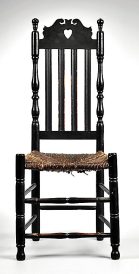
Several rare “Heart and Crown” side chairs were sold at a 2016 Skinner auction in Massachusetts. The high-back chair with molded bannisters, turned legs and a rush seat are part of an old tradition. Furniture makers in Connecticut created this style and used it from about 1740 to 1770. It was an interpretation of the expensive Philadelphia and Boston chairs made at the time.
The top of the back, made with a cut-out heart and a crown-shaped crest, was instead of the curved crest of the formal city chairs. Almost all of the Heart and Crown chairs were painted black or dark brown, and all had the rush seat. An auctioned chair, 44 3/4 inches high and attributed to Andrew Durand of Milford, Connecticut, is painted black and has the characteristic banisters and turnings.
It auctioned for $9,000, which was three times the estimate.
Q. My aunt gave me a set of dishes that were a wedding present to her. She died about five years ago at the age of 90, so I think this set must be 70 to 75 years old. They are marked “Lifetime China Co., semi-vitreous, Alliance, Ohio, Jade Rose.” They also are stamped “Nautilus, Made in U.S.A.” What could I expect to get if I sold this set?’
A. Your aunt’s dishes aren’t as old as you think. The name “Lifetime China Co.” was used from 1953 to 1968 by a distributor associated with Cunningham and Pickett and Associated Companies in Alliance, Ohio. It sold products made by other companies. These Jade Rose dishes were made by Homer Laughlin on the Nautilus shape. Dinnerware sets are hard to sell and some consignment shops won’t even take them. Plates sell online for as little as $5. A platter could cost $35.
Q. I’d like the name of a reputable person who possibly could review a card and signature by Laura I. Wilder and provide a Certificate of Authenticity.
A. The value of an autograph depends on the fame of the person and rarity. It is also determined by how it is written. If it’s part of a handwritten letter, it’s usually worth more than the same person’s autograph on a card or scrap of paper. In 2014, a note on the back of a Christmas card written and signed by Laura Ingalls Wilder, the author of “Little House on the Prairie” books, sold at auction for $1,875. Two of her books with her handwritten signature sold in one lot for over $3,000 in 2012. She usually wrote out “Ingalls” and didn’t use just an initial. If the autograph you have is just an initial, it may not be authentic. You can find places that authenticate autographs online, or you can contact an expert at an auction house that sells autographs.
Q. I heard the Princess Diana Beanie Baby is worth a lot of money. I have one of the purple bears with the heart-shape swing tag that reads “Princess.” It also has a poem commemorating Princess Diana. It’s in perfect condition. What is it worth?
A. Ty Warner started making stuffed toys in 1991. The first Beanie Babies were made in 1993. The “Princess” Beanie Baby was introduced in October 1997, two months after Princess Diana was killed in a car crash. Profits from the sale were donated to the Diana, Princess of Wales Memorial Fund. Retailers received shipments of the bears from Ty in limited quantities, driving up demand, and prices rose on the secondary market. There are slight differences in the tags and stuffing in different editions of the bear. Early editions were stuffed with polyvinyl chloride (PVC) pellets. The company began using polyethylene pellets in 1998. The tag on the bear’s tush tells which stuffing was used. Most editions of this bear sell for $10 to about $30. Don’t look to online sellers to establish value. Remember, a seller can ask whatever he wants, looking for a gullible buyer. Check listings that have sold after several bids to get a more realistic idea of the bear’s value. Although you may see a “first-edition”
Princess Beanie Baby advertised for sale online for as much as $500,000, it won’t sell for that. Most first-edition Princess Beanie Babies sell for less than $50.
Tip: Don’t put a decorative runner or vase on your wooden table if it is in sunlight. Eventually the finish will fade around the ornaments and leave a shadow of the items on the wood.
Current prices are recorded from antiques shows, flea markets, sales and auctions throughout the United States. Prices vary in different locations because of local economic conditions.
• Doll, troll, orange hair, brown eyes, wearing black mask with orange-and-black cape, Halloween costume, stamped, Russ, 1980s, $10.
• Egg beater, tin and steel, wood handle, side gear drive, teeth and crimp, Holt’s, 1899, 10 3/4 x 3 inches, $75.
• Lunch box and thermos, Chitty Chitty Bang Bang, metal, top handle and latch, flying car and characters image, 1960s, $125.
• Glass brandy decanter set, six cordial glasses, black amethyst, dimpled design, mushroom stopper, Italy, 7 1/2 and 2 inches, 7 pieces, $140.
• Halloween figurine, grinning black cat, holding frightened pumpkin head, bat ears, composition, paint, springy tail, c. 1910, 5 x 4 inches, $235.
• Cookie jar, Jack-o’-lantern, scalloped lid, leaf handle, cream and brown glaze, marked, Abington pottery, 1950s, 8 x 7 inches, $350.
• Stand, casket, Victorian, wood, folding, slip joint hinge, turned legs, spindle stretchers, brass hardware, 1800s, 23 x 19 inches, pair, $400.
• Dress, beaded sequin, black, flapper, art deco-style pattern, sleeveless, scoopneck, 1920s, size medium, 35 inch waist, $535.
• Sterling silver, spoon rest, Salem witch figure with broom at top, heart-shape caddy, c. 1895, 3 1/2 x 2 inches, $1,075.
• Cane, walking stick, ivory pique handle, Malacca shaft, silver band, marked, Brigg, 1898, 38 inches, $4,900.
Write to Kovels, Observer-Reporter, King Features Syndicate, 300 W. 57th St., New York, NY 10019.