

Game on Video gaming course generating interest at Trinity
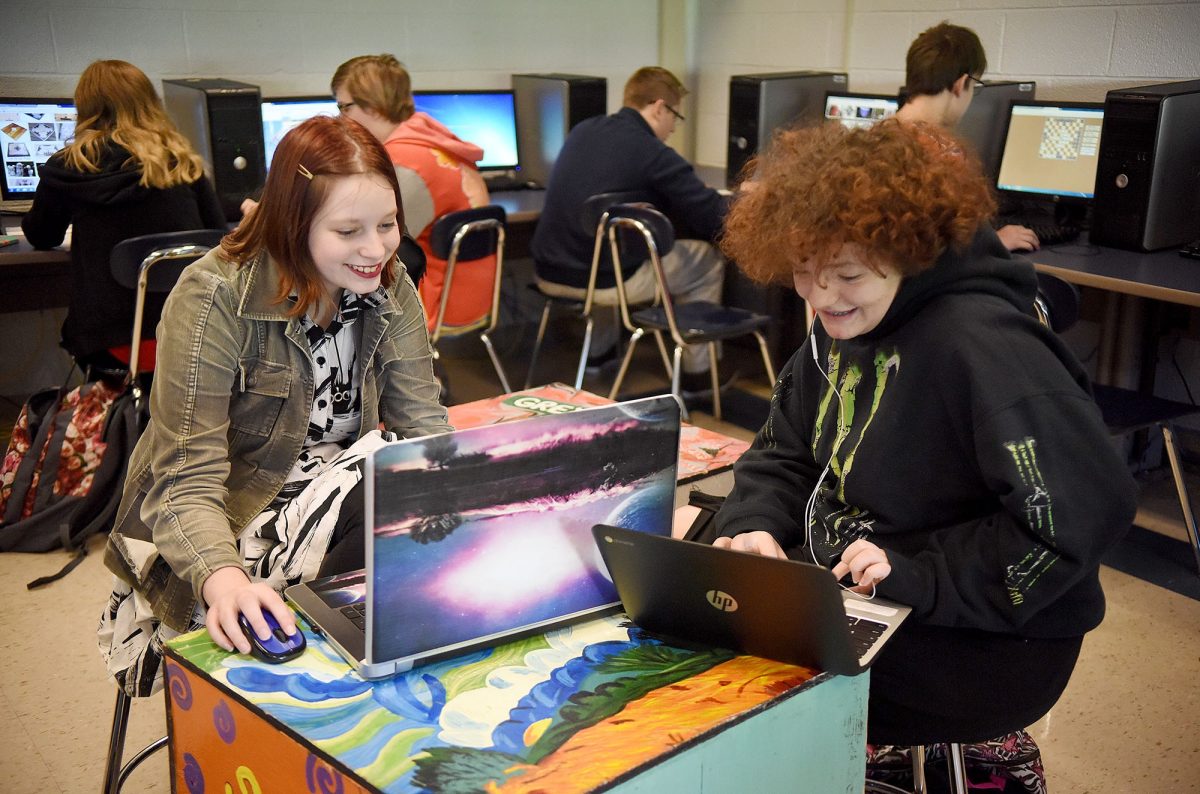
Trinity senior Kelsey Evans, left, and freshman Bonnie Jeblonski work on game pieces for the game Hnefatafl. They are among the first students at Trinity to take Zumala, a video-gaming curriculum that is composed of 11 courses.

Trinity senior Blake Pahler works on his Hnefatafl game board. Students in the introductory Foundation of Game Design class are encouraged to use technology – including their phones, laptops and tablets – to research and help create their board games.

Trinity junior Jesse Diamond researches information on the game Hnefatafl, while junior John Popielarcheck works on measuring and marking the board game. The class uses a Zumala curriculum that was designed at Carnegie Mellon University.

Trinity teacher Ryan Coyle helps seniors Andrew Barnhart, left, and Tanner Lolley with their Hnefatafl board game. The students learn the theory behind gaming and create board games.
Trinity High School students are earning credits for playing board games.
But it’s not as easy as it sounds.
Trinity Area School District has introduced Zulama, a high school video gaming curriculum created by educators in the Entertainment Technology Center at Carnegie Mellon University that engages teens in programming and STEM subjects through game design.
Trinity implemented Zulama as a pilot program this semester, and 24 students are enrolled in the introductory course, Foundation of Game Design.
Students complete a variety of project-based learning activities to improve their problem-solving skills and develop an understanding of the theory behind gaming.
Zulama CEO Nikki Navta said the curriculum aims to equip students with skills and creativity needed in the 21st-century workplace and prepare them for careers in software development, game design and other sought-after jobs.
“There are a lot of options for students today, and Trinity offers a ton of options for those who are interested in specific things, such as vo-ag or art,” teacher Ryan Coyle said. “There are different avenues for students to find their path in life. One thing we didn’t have was a way to reach students interested in gaming. There’s a large group of high school students today who are passionate about this, and when you talk about game design, mobile app design, Zulama prepares them for that, while teaching them problem-solving and communication skills, analytical thinking and teamwork.”
In Foundation of Game Design, Coyle and his students study ancient cultures and their games, and how they designed games using available technology and resources. Students also make and play board and digital games.
During a recent class, students were making a game board for a game called Hnefatafl, also known as the Viking game and a precursor to chess, in which a king must find his way to one of four safe spots without being captured by enemy soldiers.
Coyle and his students recently wrapped up a study of Egypt and the game of Senet, where players move their pieces around a board and avoid hazards in an attempt to get all their pieces off the board in order to pass into the afterlife.
Coyle said the high school will offer a GameMaker Programming course, whereby students will build two-dimensional games using GameMaker software in the college-level programming 101 class, during the second semester of the 2016-17 school year.
Next year, the Foundation of Game Design will be introduced to middle school students, and additional Zulama courses – there are 11 in all – will be offered at the high school.
“There are a lot of good things going on in this class,” said Coyle, noting that demand for the Zulama course has been very high, and the student cap was raised to permit more students to take the class. “Every single student is engaged in doing something with their teams. Whatever they end up doing in the future, this class provides them skills they’ll need for life.”