

Valentine’s cards have evolved through the years
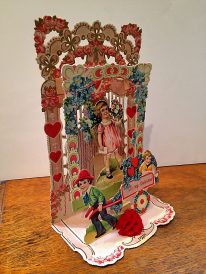
Valentine’s day is a holiday that has its roots in ancient times. But it was celebrated with gifts until the first cards appeared about 1760. Since then, valentines have changed with the fashions and technology, and they are a popular collectible. Cards were made at home, with drawings, poems, cutouts and other ways of expressing love. In 1848, Esther Howland of Worcester, Massachusetts, started making valentines from pieces of fancy paper lace and printed pictures with handwritten messages of affection. Soon, she was selling valentines to friends, and started a business that lasted until 1880.
The style of the valentine can help tell its age. Mechanical cards with parts that could move so a pictured girl could wave her arm were the newest type in the 1890s. Embossing also was popular. In the early 1900s to 1920s, postcards were used. Postage was one cent. Die-cut cards that could be punched out of a single sheet of stiff paper were developed in about 1900. These often came as a set with 25 cards for students and one for the teacher. Folded cards were in style by the 1930s and these, plus photographs and digital cards, are still sent today.
Vintage homemade lacy cards made from paper lace, “scraps” and small shaped and printed pictures, sell today for $10 to $100 or more. Age, condition and beauty determine the value. Save the cards you get each year and look for older examples saved by family members.
Q. My mother recently passed away, and I received her collection of Pennsbury Pottery she’d been collecting for 40 years. I would like to sell the pieces, as I have no room for them. Suggestions?
A. Pennsbury Pottery was founded by Henry and Lee Below in Morrisville, Pennsylvania, in 1950. The pottery was named after nearby Pennsbury Manor, the home of William Penn. The pottery was in business until 1971. Dinnerware and decorative items were made. You can try to sell the collection to a resale shop that handles pottery, to an online matching service like Replacements.com or at an auction that sells Pennsbury. Some pieces sell for $12-$35. Pennsbury cookie jars sell online for about $85.
Q. I have a matching set of two High Point Bending & Chair Co. office-style walnut chairs labeled “Pattern No. 6711.” They are in good original condition. How do I determine their value?
A. This company started as Siler City Bending Co. in Siler City, N.C., in 1901. It made bentwood parts for carriages. In 1904, it was reorganized by Captain Malvola Jackson Boling and renamed High Point Bending & Chair Co., after a nearby city. The company made bentwood chairs and other furniture. It became Boling Chair Co. in 1956. It remained open until at least 1999. Your chairs, with swivel seats and rolling casters, are called banker’s chairs. The price of your chairs is only about $15. They are not in a style that is popular today, and old office chairs are not wanted. Wooden chairs are not as comfortable as the new padded or mesh chairs.
Q. I inherited a 1916 Edison Diamond Disc Official Laboratory Model Phonograph, No. C-19. It is an upright dark oak cabinet that is 4 feet 3 inches high. There are 80 excellent thick records. How can I sell these? The player is windup and in perfect condition.
A. Edison’s Model C-250 Chippendale was introduced in December 1915 and originally sold for $285, which was expensive at the time. Cabinets were made in oak or mahogany, and later in walnut. The Diamond Disc phonograph had a diamond stylus that lasted longer than an ordinary stylus and could only play the records especially made for it. The quarter-inch thick records couldn’t be played on other phonograph machines and were more expensive than other records. The words “Official Laboratory Model” were trademarked in 1920 but had been in use since at least 1918. Chippendale Model C-250 became Model C-19 beginning in April 1919, so your phonograph must have been made after that. The value of the phonograph is about $200-$300. The records sell for about $3-$10 each.
Tip: Do not store paper collectibles in photograph albums with black pages. The acidic paper will cause damage.
Current prices are recorded from antiques shows, flea markets, sales and auctions throughout the United States. Prices vary in different locations because of local economic conditions.
• Cake pan, Oscar the Grouch, Sesame Street Muppets, garbage-can shape, Oscar peeping out, tin, Wilton, 1977, 16 inches, $15.
• Limoges tooth fairy box, kitten and text, Premiere Dents, “first teeth,” teddy bear hinge, blue border with gold dots, 1930s, 2 inches, $60.
• Cane, walking stick, black shaft, dog head handle, white greyhound, carved resin, golden eyes, brass collar, Art Deco, 36 inches, $110.
• Boy Scout Troop Pennant, Patrol 3, Troop 117, Pontiac Indian, arrow, red, yellow and silver canvas, 2-sided, 1940s,40 x 40 inches, $195.
• Advertising sign, Ever Ready Sold Here, India’s Best Batteries, blue enamel, white and orange, 1930s, 18 x 12 inches, $300.
• Porcelain night light, figural polar bear, sulfur eyes, fragrance lamp, stamped, Bohne & Soehne, c. 1925, 10 x 7 inches, $410.
• Mailbox, cast iron, embossed, Pull Down, Letters, red, white and blue, side door opening, lock and key, 1908, 20 x 13 inches, $725.
• Cellarette, mahogany, shaped lift top, square knob, beaded edges, carved, brass handles, splay feet, 1800s, 22 x 27 inches, $2,000.
• Locket, heart shape, blue enamel, guilloche rays, diamonds, 18-karat gold and silver, two compartments, gold frames, scrolls, 1800s, 3 x 3 inches, $4,575.
Write to Kovels, Observer-Reporter, King Features Syndicate, 300 W. 57th St., New York, NY 10019.