

Getting our kicks: O-R editor hits the road for cross-country trip

Mallory Rogers/For the Observer-Reporter
Liz Rogers “gets her kicks” on Route 66 in Shramrock, Texas.

Liz Rogers/Observer-Reporter
The booth where Elvis Presley dined at U-Drop Inn in Shamrock, Texas

Mallory Rogers/For the Observer-Reporter
The from South Kaibab Trail in the Grand Canyon

I didn’t set out to see the world’s largest rocking chair, have my picture taken in the middle of a deserted stretch of historic Route 66, or sit in the booth where the King himself – Elvis Presley – dined.
It all just happened, unplanned and serendipitously, thanks to my daughter, whose career aspirations – and a waiting job interview in California – led us on an epic cross-country odyssey reminiscent of a Cannonball Run.
Truth be told – and kitschy photo ops aside – I’d always wanted to take a coast-to-coast road trip. What better way to experience America and its people than by automobile? My vision, however, didn’t include relocating one of my kids and driving nearly 3,000 miles in five days in a car crammed inside and out with all of her possessions.
With the image of Clark Griswold fixed in my memory, we departed westward, not in a metallic pea Family Truckster but a silver Honda CRV. It was Tuesday, and our goal was to arrive in Los Angeles no later than Sunday, the day before her interview.
We chose a southerly route westward, relying on mobile map apps on our cellphones to guide us, starting on Interstate 70 before picking up I-44 and later I-40, which parallels remnants of the legendary Route 66, one of the country’s oldest and most iconic highways.
We had a rough idea of how far we needed to drive each day but were deliberate in the decision not to stick to an itinerary. Instead, we took a free-spirited approach to the journey, driving as far as we wanted, stopping where we wanted and booking hotels on the fly.
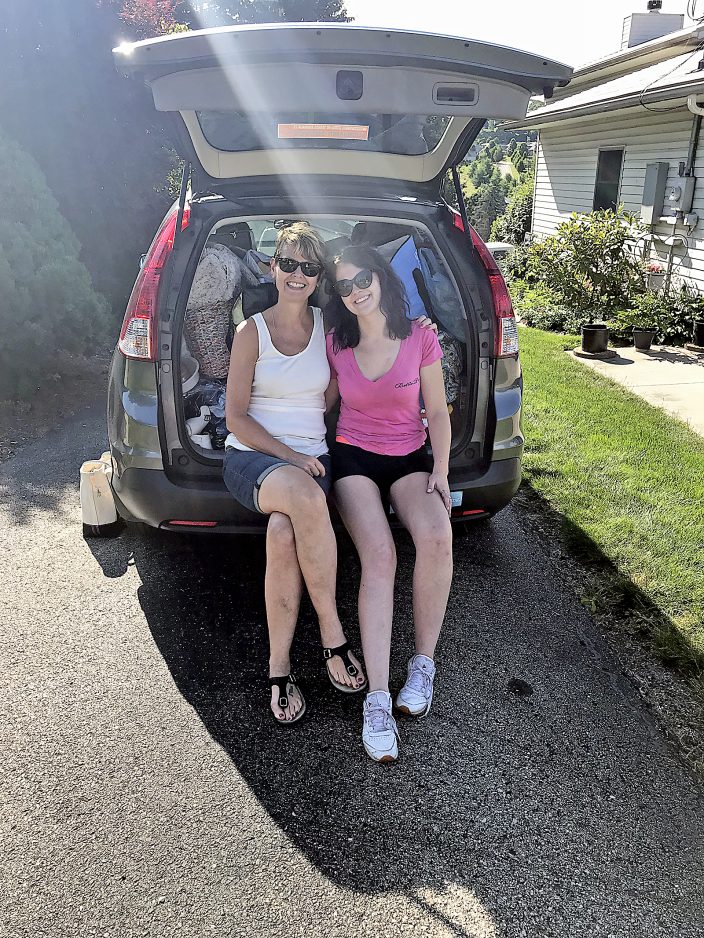
Liz and Mallory Rogers get ready to depart for their cross-country road trip.
As it turned out, our spur-of-the-moment departures from the highway led us to some of the most delightful slices of Americana that our country has to offer along with a lifetime of memories.
Incidentally, she got the job!
Little town, big things
The sign along Interstate 70 about an hour outside of Indianapolis was irresistible. “This exit, world’s largest rocking chair.”
Our first stop at Casey, Ill., rewarded us with not just the world’s largest rocking chair but also the largest mailbox, golf tee, knitting needles, crochet hook, wooden shoes, wind chimes and pitchfork – all certified by the Guinness Book of World Records. There’s a host of other “big” things, too, not yet receiving the Guinness designation in this charming town of 2,700 but worth seeing, including an ear of corn, saguaro cactus, bird cage, yard stick and pencil.
America’s Main Street
Established in 1926, Route 66 connected travelers from Chicago with the West Coast, stretching 2,451 miles through towns large and small in eight states, ending in California. Replaced by interstate highway in the late 1950s and decommissioned in 1985, sections of Route 66 remain, drawing visitors eager to experience the nostalgia of the old road and its many attractions both quirky and historic.
Among them is Meramec Caverns, near Stanton, Mo. Lured by billboards touting the largest commercial cave in Missouri, we soon learned the underground spot was outlaw Jesse James’ hideout in the 1870s. That explains the nearby Jesse James Wax Museum. At the very least, the stop proved to be refreshing on a 90-degree day, given the temperature inside the caverns is a constant 58 degrees.
’Mother of the Mother Road'
Lucille’s Service Station, near Hydro, Okla., is one of just two upper-story, out-thrust porch service stations remaining on Oklahoma’s span of Route 66 and was placed on the National Register of Historic Places in 1997. Lucille Hamons ran the business, assisting Route 66 motorists for 60 years, earning her the nickname, “Mother of the Mother Road.”
Caught up in the nostalgia of Lucille’s, we’d given little attention to our own gas gauge until the low-fuel indicator flashed. While service stations are typically located right off exits, they are relatively scarce in the rather remote section of interstate where we made our discovery. I consulted the gas app on my phone to find that the nearest service station was 10 miles away – in the opposite direction.
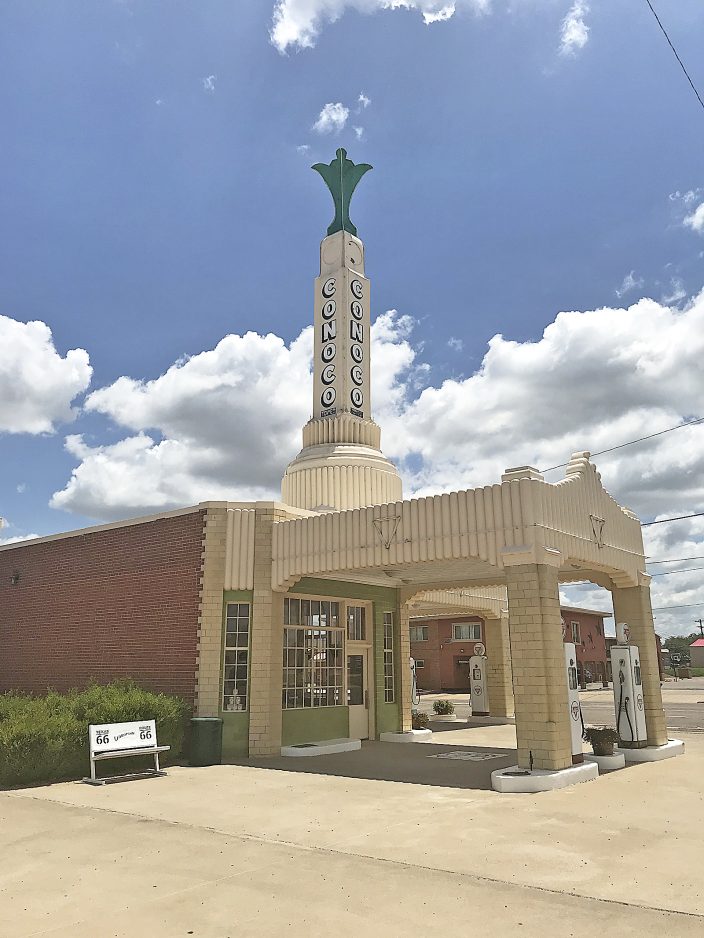
We left the highway and found ourselves on what we thought was a service road. As we crested a knoll, the road widened and we realized we had been driving on old Route 66, just outside of Shamrock, Texas. My daughter recognized the art deco landmark at the top of the next hill as the Tower Conoco Station – inspiration for Ramone’s House of Body Art in the Disney movie, “Cars.” The adjacent U-Drop Inn – where Elvis Presley ate – now houses the Shamrock Chamber of Commerce offices, gift shop and information center.
Liz Rogers/Observer-Reporter
Liz Rogers/Observer-Reporter
Tower Conoco Station, Shamrock, Texas
After gassing up, we dropped by the U-Drop, where we met two friendly Texans who reminisced about the day Disney scouts came to town. As the movie played in a corner of the gift shop, we chatted about the real-life inspiration for some of the “Cars” characters: Sassy, no-nonsense Flo was modeled after Fran Houser, former owner of the Midpoint Cafe in Adrian, Texas, while Mater – the rustiest, trustiest tow truck in Radiator Springs – bore many of the characteristics of Harley Russell, a self-professed “redneck” troubadour from Erick, Okla.
Steak and Cadillacs
Though my traveling companion is vegetarian, she managed a half-smile for a photo in front of the giant grimacing steer in front of Big Texan Steak House on Route 66 in Amarillo, Texas. We didn’t see anyone attempt the 72-ounce steak challenge – consume a 4 1/2 pound steak, shrimp cocktail, baked potato, salad, roll and butter in one hour and your $72 meal is free – but folks with a hearty appetite have been taking the challenge since 1962.
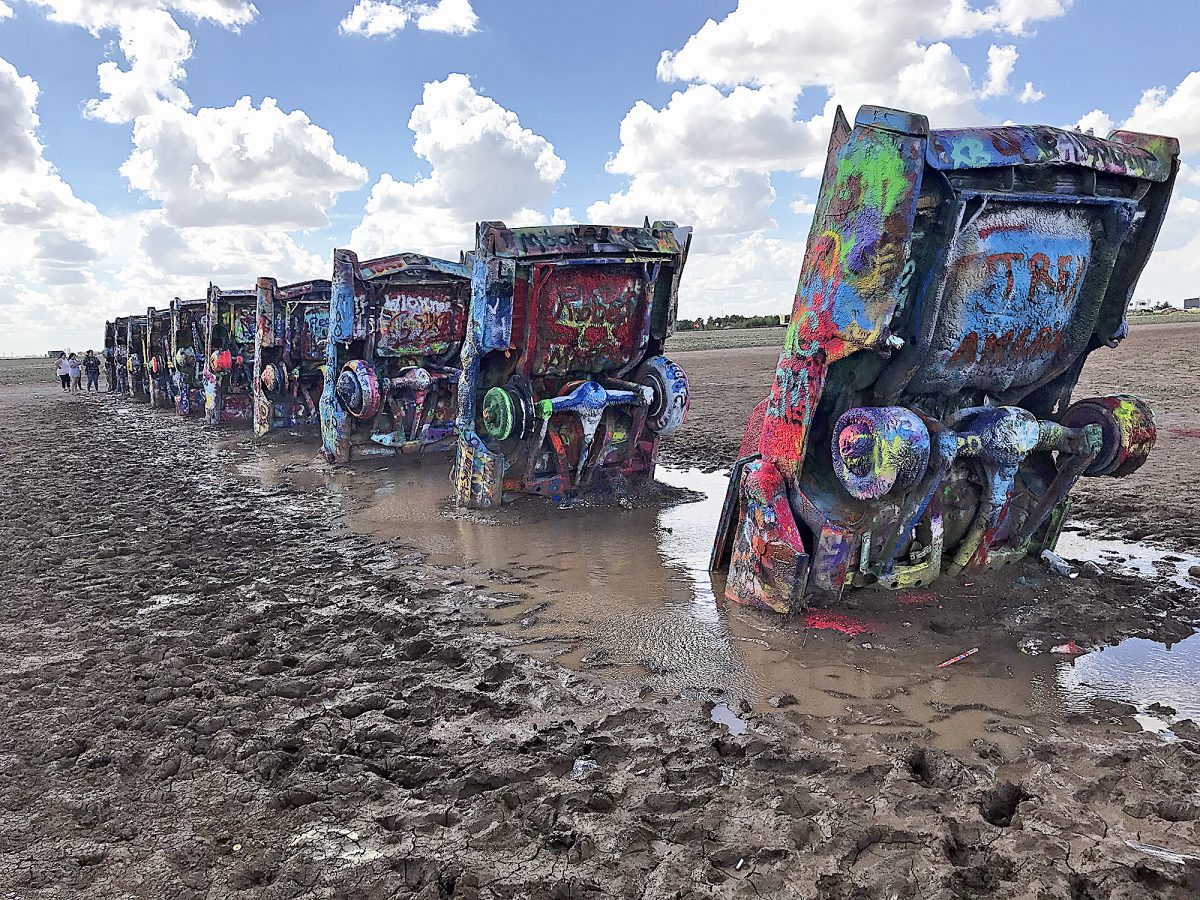
No visit to Amarillo is complete without a stop at Cadillac Ranch, the avant-garde art installation of 10 Day-Glo-splattered Caddies buried nose-first in the dirt – it was mud when we visited – just off Route 66. Colors change pretty in real time, as visitors armed with cans of spray paint add their own touches to the cars. While posing for a photo, I barely escaped the spray of one enthusiastic artist, narrowly escaping a neon-pink hairdo.
Home of the movie stars
The El Rancho Hotel in Gallup, N.M., was considered base camp for movie stars during the 1930s and ’40s, with the area serving as the backdrop for more than 100 westerns. John Wayne, Mae West, Ronald Reagan, Katherine Hepburn and more than 150 others stayed at the elegant old hotel. Autographed celebrity photos decorate the walls of the two-story open lobby, which features a circular staircase and plenty of Native American decor. The hotel is on the National Register of Historic Places and continues to accommodate overnight guests.
Liz Rogers/Observer-Reporter
Liz Rogers/Observer-Reporter
Cadillac Ranch in Amarillo, Texas
A grand landmark
An overnight stay in Flagstaff, Ariz., turned into two after we made a last-minute decision to take a side trip to the Grand Canyon, 80 miles away. While we weren’t exactly prepared for a hike, we managed a short but spectacular day trek into the canyon on the South Kaibab Trail, where we encountered the famous canyon mules carrying riders and supplies as well as a couple of overzealous squirrels attempting to mooch the trail bars we’d stopped to eat at Ooh Aah Point. Photos can’t capture the breathtaking beauty of the national park. It has to be seen in person.
Angel of Route 66
When the newly constructed I-40 bypassed the town of Seligman, Ariz., in 1978, once-thriving businesses on Route 66 quickly saw their revenue dry up. Among those was barber Angel Delgadillo, who helped establish the Historic Route 66 Association of Arizona. In 1987, the state designated the section from Seligman to Kingman as Historic Route 66, and later added the stretch from Kingman to the California border, preserving the longest remaining portion of uninterrupted Route 66 in the country. Considered the Mayor of the Mother Road, Delgadillo, now 91, is a celebrity of sorts, posing for photos with visitors from the world over at his bustling souvenir shop along the road that he helped reinvigorate.
End of the road
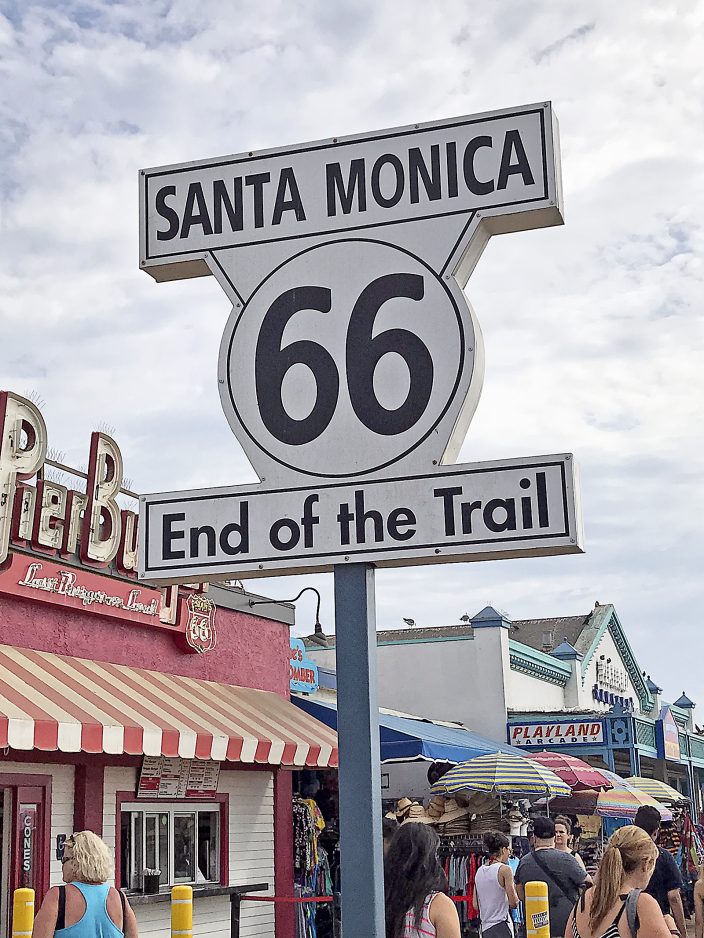
Santa Monica Pier is the end of the line for Route 66. It wasn’t always that way, though. In 1926, the terminus of the road was actually at 7th and Broadway in downtown Los Angeles. It was extended 10 years later to Lincoln and Olympic boulevards in Santa Monica, about a mile from the ocean. In 2009, the Route 66 Alliance and Santa Monica Pier Restoration Corp. erected an unofficial “End of the Trail” sign on the pier.
Liz Rogers/Observer-Reporter
Liz Rogers/Observer-Reporter
Route 66 ends at Santa Monica Pier.