

100 Objects: Whiskey jug
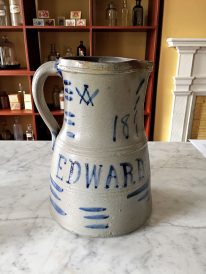
Whiskey jug
This 11-inch, salt-glazed, grey stoneware jug was made by potter Alexander Polk Donaghoo, for Edward A. Burson, in 1865, in Fredericktown. Born in 1829, he learned the trade in the lower Monongahela River Valley pottery district. The availability of high-quality clay found along the river supplied pottery factories in Washington and Greene counties. In 1870, Donaghoo moved to Parkersburg, W.Va., to start his own business, which thrived until the early 20th century, when the new technology for glass manufacturing produced cheaper, lighter glass containers.
In the 19th century, Washington County pottery factories in Fredericktown, West Brownsville and East Pike Run Township (near California) along with Greene County factories in New Geneva and Greensboro became the most prolific producers of salt-glazed pottery in the area. Durable stoneware jugs, water coolers, crocks, canning jars and pitchers were commonly used for storing and preserving food. Potters used “kick” wheels, powered by one foot, to create or “throw” a pot. The pieces were dried, sometimes decorated with cobalt blue brushwork or stenciling before being fired. A salting mixture of sodium chloride and water was introduced into the kiln toward the end of firing to create the orange peel-like texture. Today, stoneware manufactured in 19th century Western Pennsylvania is considered some of the finest.
Alice Burroughs is a volunteer for Washington County Historical Society and a member of the antiquities committee.