

Food Box program feeding needs nationwide
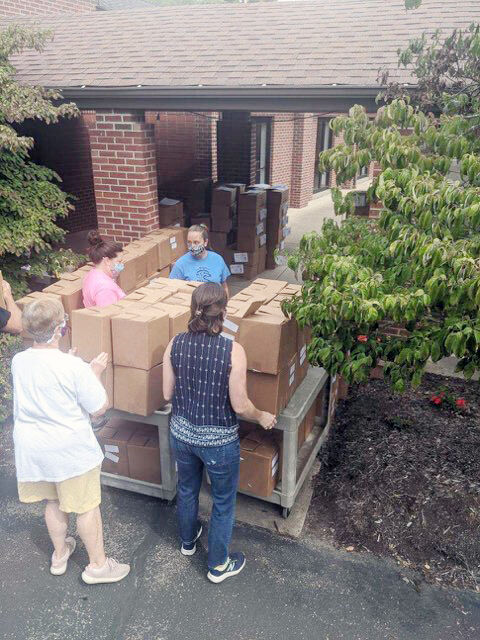
Courtesy of Marketplace at Emerald Valley
Emerald Valley workers prepare boxes for delivery for the Farmers to Families Food Box program.
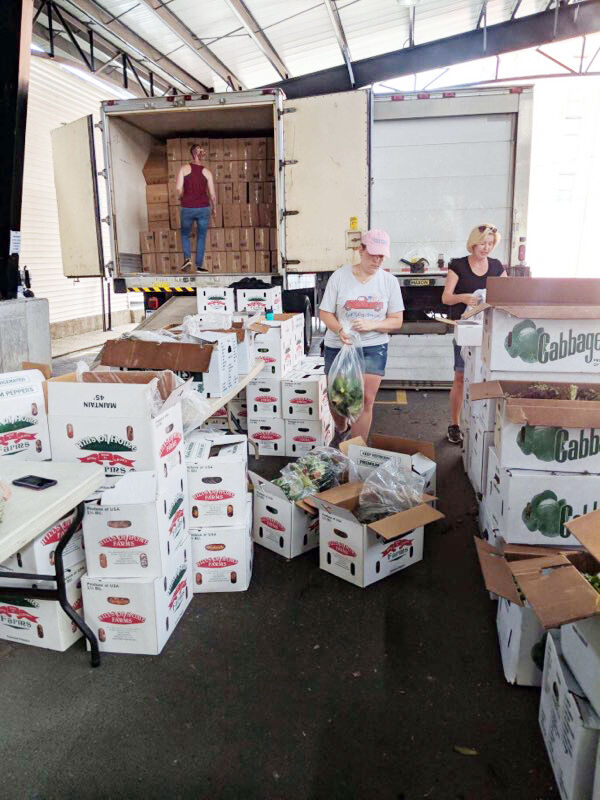
Courtesy of Marketplace at Emerald Valley
Emerald Valley workers prepare and load boxes of food onto a truck for delivery to people in need.
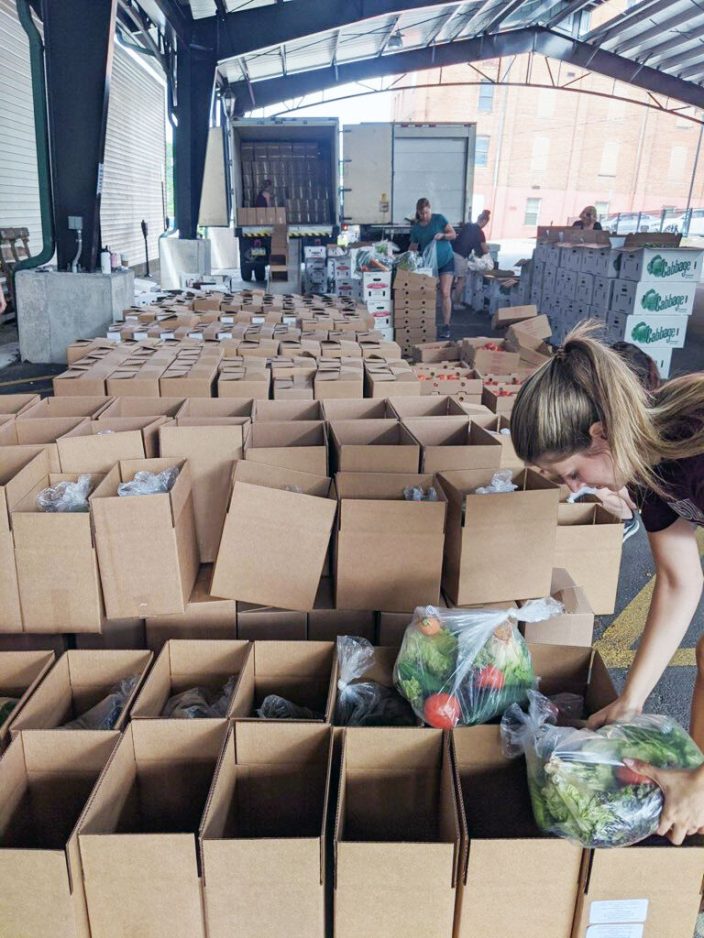
Courtesy of Marketplace at Emerald Valley
It’s boxes, boxes everywhere as Emerald Valley workers fill them with food for delivery for the Farmers to Families Food Box program.
As if operating a specialty food store and a farm weren’t time intensive enough … Alisa-Fava Fasnacht packs and oversees packing of provisions for the food insecure.
Thousands of boxes, sometimes in a rush.
“We built more than 6,000 boxes over the past two weeks,” she said Tuesday, a tad fatigued but able to run Marketplace at Emerald Valley in downtown Washington. “That was an extraordinary number in an extraordinarily short period.”
Fava-Fasnacht and workers at her store/restaurant fill family-sized containers for the Farmers to Families Food Box program, a federal initiative formed in April in response to the arrival of COVID-19. Food boxes brimming with fresh fruits and vegetables, dairy products and meat products are organized and distributed to families or groups in need – whose situations could become dire during a pandemic.
The program was established by the U.S. Department of Agriculture through the Coronavirus Food Assistance Program. USDA is providing up to $4 billion to distributors to purchase produce and agriculture items from farms and producers, which ultimately go to consumers nationwide.
Farmers to Families provides multiple benefits, as the state Agriculture Department explained in late April, leading up to the May 15 start. It creates a revenue stream for farmers, some of whom have lost business from restaurants and bulk purchasers during the pandemic, while dissuading them – especially those specializing in dairy – from destroying excess food.
The greatest benefit, though, is the nourishment it provides to millions of Americans.
Two rounds of this program have been completed and the third is imminent. Last week, USDA announced on its website that it has approved up to $1 billion in contracts for the next round. The department proudly proclaims that nearly 98 million food boxes have been delivered over the past four months.
Details on round three are pending. What is known is that two Pennsylvania distributors have been approved as contractors: Paragon Foods, of Warrendale, which has been awarded $6.55 million for 143,842 combination boxes; and Monteverde’s Inc., of Crafton, which will get $719,026 for 14,704 combo boxes.
Fava-Fasnacht, co-owner of a dairy farm in Scenery Hill, has been involved with the Food Box initiative since it began. Four types of family boxes are filled, and Emerald Valley’s specialty is combination boxes, a laborious duty. These containers must hold 10 to 12 pounds of fruits, vegetables, dairy or meat items.
She fills as many as she can, along with workers she hired to perform this duty.
“An order comes through and we’re committed to a certain number of boxes,” Fava-Fasnacht said. “We have built as many as 1,500 to 2,000 in one day. Hey, you do what you gotta do.”
Emerald Valley isn’t the only organization packing food boxes, of course. Farms, nonprofits and other groups are doing the same.
Boxes are transported to nonprofits – such as food banks, community organizations and faith-based entities – which provide them to consumers. Some organizations have held mass food distribution events, including Greater Washington County Food Bank in Centerville. Two such distributions have occurred at the Washington County Agricultural Fairgrounds in Chartiers Township.
A food bank official, however, said last week that the organization is not currently scheduling such events because it has a surplus of food.
Farm to Table Western PA and 412 Food Rescue are among regional nonprofits that have been been avid participants. In addition to distributing thousands of meals to bus stops in the Pittsburgh area, and implementing a home delivery program, 412 Food Rescue has provided boxes to nearly 2,000 households.
Fava-Fasnacht said she has worked closely with Erin Hart, executive director of Mt. Lebanon-based Farm to Table Western PA.
“We use local farms, and we deliver to local housing authorities or nonprofits,” Hart said. “From our perspective, this is a great program.”
She said Farm to Table submitted its round three proposal about two weeks ago and is awaiting a response from USDA. “We feel pretty confident we will” get a new contract, Hart said. “They are looking a prior local farms and opportunity zones. Fifty percent of our deliveries are in opportunity zones.”
Pennsylvania has 300 opportunity zones, 289 of which are in low-income communities. Farm to Table delivers to a large swath of Southwestern Pennsylvania.
As the pandemic continues, so do Emerald Valley’s owner and workers. Food security can be a tenuous thing. People are relying on the packers of 145 S. Main St. to keep on keeping on.
“We’ve built 15,000 boxes of various dimensions,” she said with a smile. “Tens of thousands of pounds (of food). But we’re taking it to the last mile.”
Despite tensions of the past six months, with a deadly virus and a divisive election as backdrops, Alisa Fava-Fasnacht appreciates the ray of sunshine the Food Box program has been.
“This situation reveals the best in everyone.”