

Doctors attack rising melanoma cases with unique new treatments
Courtesy of Allegheny Health Network
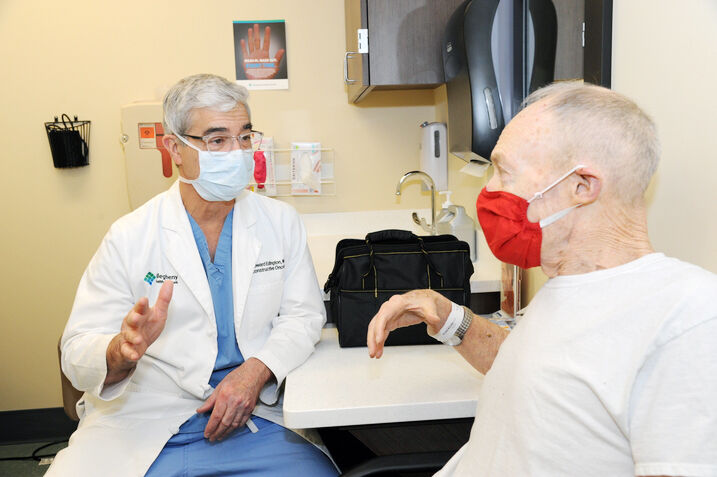
Dr. Howard Edington speaks with patient Paul Kirsch.

Dr. Edington
The arrival of spring and warm weather means many across Southwestern Pennsylvania will be outside enjoying the sunshine more often.
That also means, however, more people’s skin will have increased exposure to the sun’s harmful ultraviolet rays.
Too much sun exposure is one contributing factor to an alarming rise in melanoma cases across the country in recent years. According to the Melanoma Research Alliance, nearly one in 50 Americans will develop melanoma during their lifetimes and its incidence has doubled over the past 30 years. Almost 166,000 Americans are diagnosed with melanoma annually and nearly 7,000 die of the disease.
Skin cancers, including melanoma, are strongly connected with exposure to ultraviolet radiation from the sun or from tanning beds. A new study published in the Journal of the American Medical Association projects melanoma will surpass colorectal and lung cancer to become the second most common type of cancer – behind breast cancer – by the year 2040.
“Skin cancer is extremely common and almost always treatable if it is found early,” said Dr. Howard Edington, an Allegheny Health Network surgical oncologist, who is leading AHN’s development of the Melanoma and Skin Cancer Center. “Melanoma is a less common but more deadly form of skin cancer and the number of cases is rising, particularly in younger people.”
Researchers are finding new ways to attack melanoma including the use of targeted therapies.
“We are enjoying a very exciting explosion in advances in immunotherapy and targeted therapy not just for melanoma but for other diseases as well,” Edington said. “These advances have had a significant impact on management of this too-often deadly disease, with prolongation of survival that in many cases is nothing short of spectacular.”
One unique example of this targeted therapy involves injecting something completely opposite of medication directly into tumors. Patient Paul Kirsch of Green Tree said he was surprised when Edington suggested injecting his melanoma tumor with a genetically modified herpes virus. The 87-year-old retired Marine, teacher and school administrator said he didn’t hesitate, though, and agreed to try the new approach aimed at infecting and killing the cancer cells without damaging healthy ones.
The cancer-killing virus is called T-VEC and doctors inject it directly into tumors where it replicates inside the cancer cells. The virus also triggers the body’s immune system to fight the cancer itself. The FDA has approved the use of T-VEC for some stages of melanoma that can’t be removed entirely through surgery and are beneath the skin or in lymph nodes.
In Kirsch’s case, Edington first removed melanoma from the back of his patient’s neck in 2019. The cancer came back last year under Kirsch’s armpit and that’s when his doctors decided to try T-VEC with injections every other week for six months.
So far, the results are promising.
Halfway through his treatment, Kirsch said he has felt no side effects while his tumor has shrunken in size.
Edington said the tumor is so small now that it’s tough to find a spot for the injection.
“We are happy to offer T-VEC to our patients whose advanced melanoma cannot completely be removed with surgery and who have few remaining options for treatment,” Edington said. “Unlike other therapies for advanced melanoma, T-VEC is usually well tolerated and is suitable for many patients including the elderly. It also has a ‘bystander effect,’ killing nearby tiny lesions in addition to the primary tumor.”
One study found T-VEC completely shrunk melanomas in as many as 68% of patients with response rates varying depending on the cancer’s stage.
While new treatments like T-VEC and other immunotherapy approaches are making progress it the fight against melanoma, doctors warn the rising number of cases means many people have to be even more proactive when it comes to prevention.
Every person should protect their skin with clothing and sunscreen when they’ll be outdoors, avoid sunburns and use of tanning beds and watch for early early warning signs on their skin including any kind of new or changing mole, spot or lesion on the body.