

The Washington County Courthouse has a decorated history – and a decorated interior
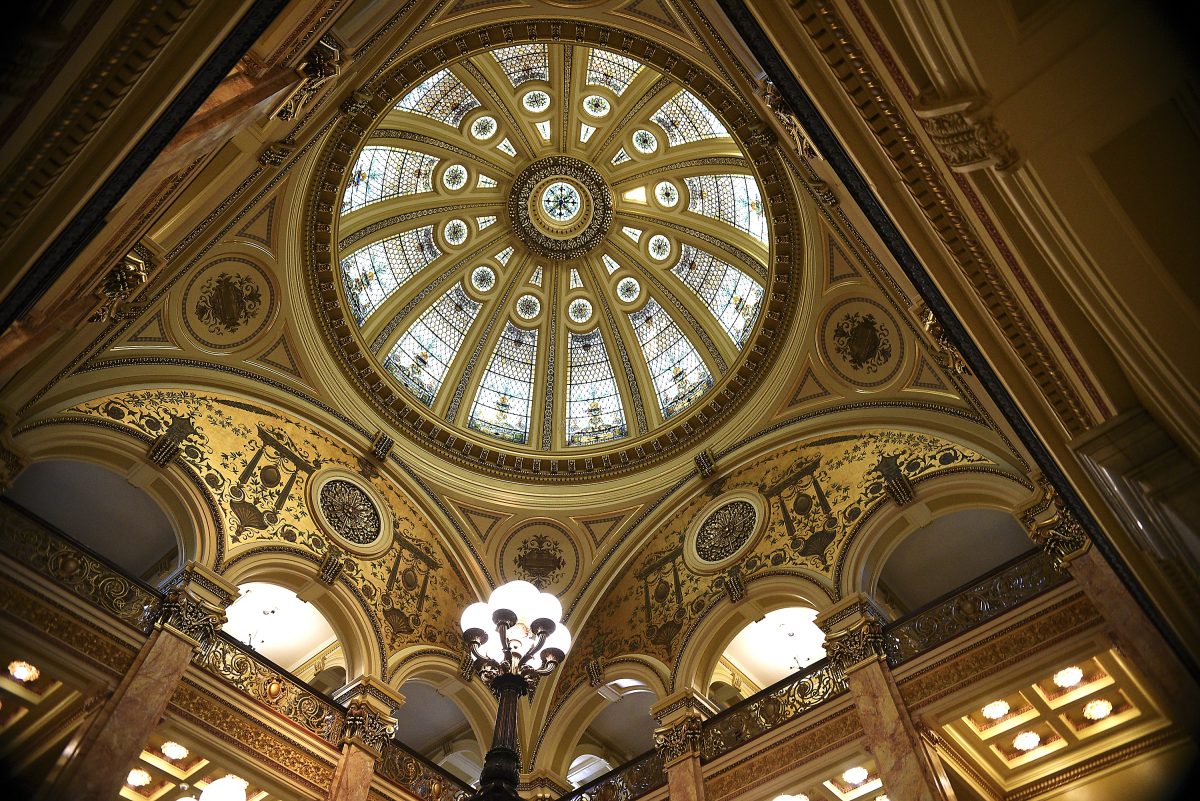
Stained-glass dome inside the Washington County Courthouse.
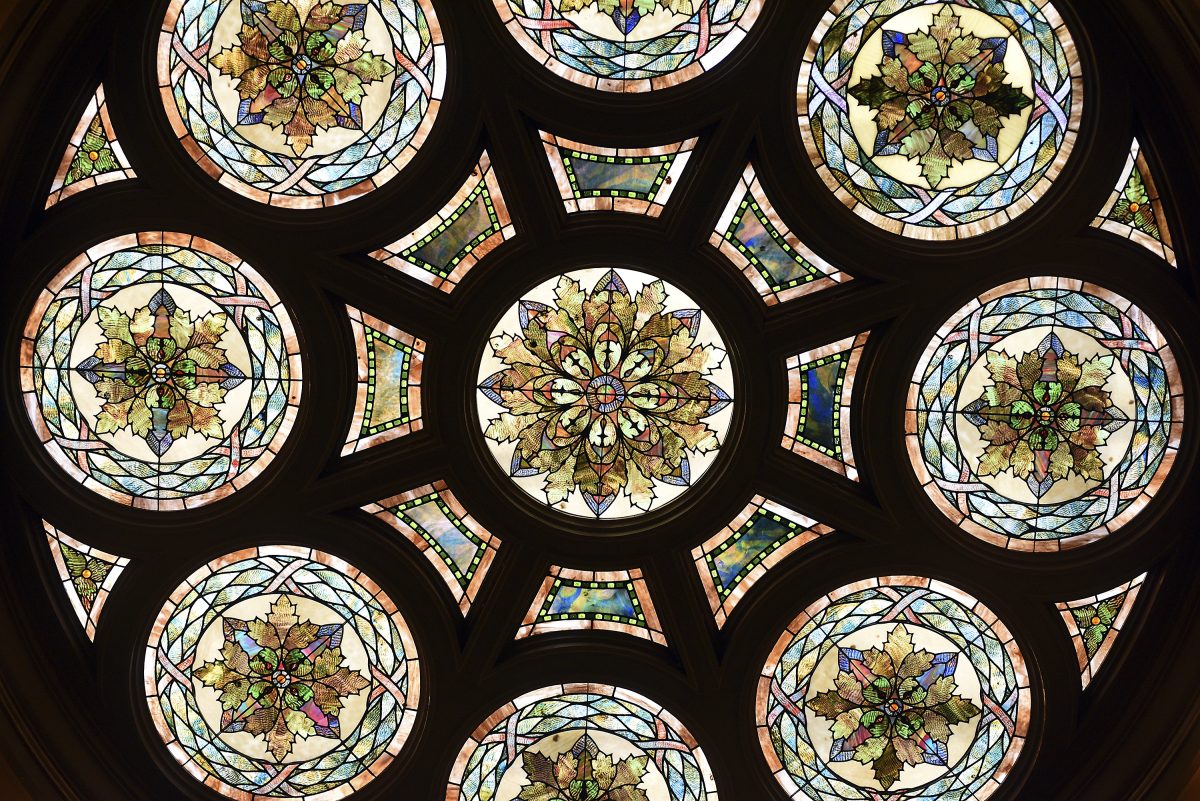
A stained-glass window in one of the courtrooms.
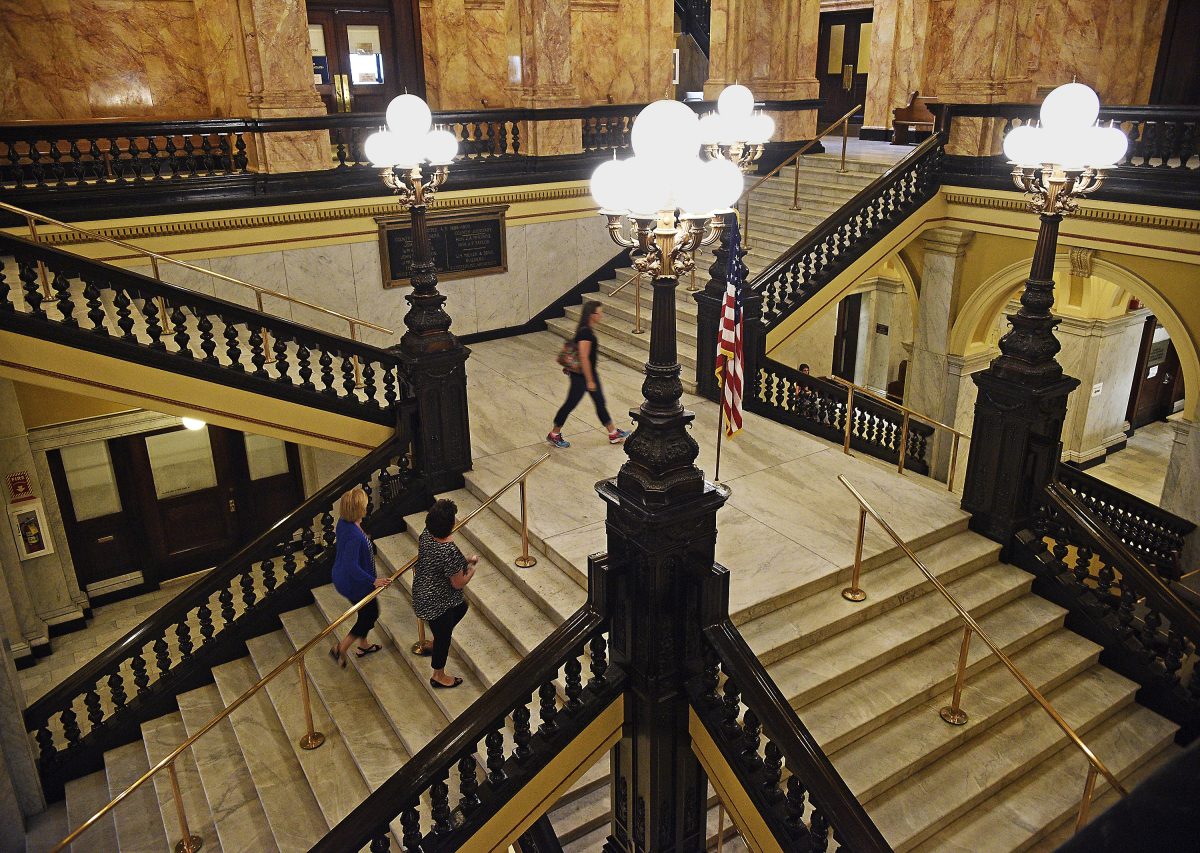
The main steps inside the Washington County Courthouse are one of the building’s focal points.
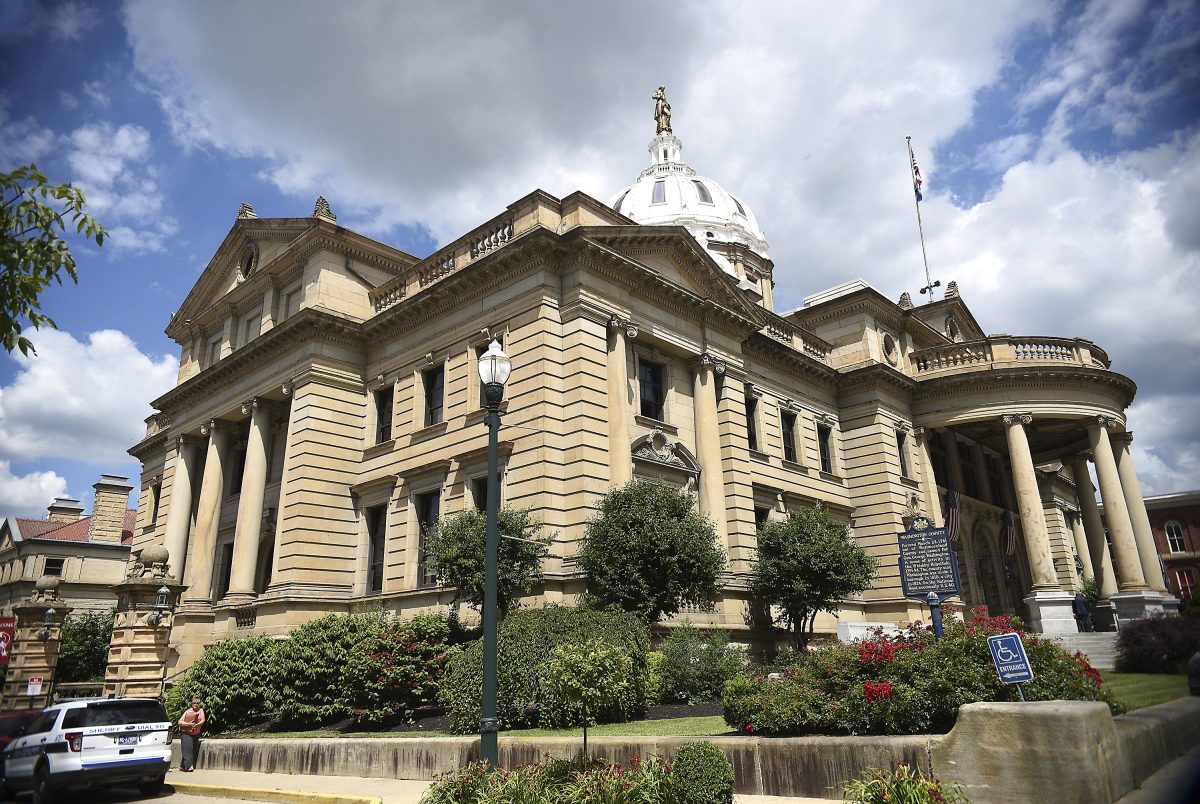
An exterior view of the Washington County Courthouse.
Lynne Thompson, museum educator at the Pennsylvania Trolley Museum, marvels at the architectural magnificence of the Washington County Courthouse. Completed in 1900 at a cost of $1 million, the majestic building, with its massive dome topped by a statue of George Washington, immediately became a modern wonder of its day.
But the courthouse, nicknamed “The People’s Palace,” also has served as the moral compass of the county for more than a century, and is the seat of Washington County’s judicial system.
“It is an architectural gem, and it has become the shining light of Washington County,” says Thompson, who conducts courthouse tours through the trolley museum. “But it is for the people of Washington County. Every day, people walk through these doors to work, to record deeds, to research their genealogy. It is more than a building with courtrooms.”
The Washington County Courthouse came to be for a couple of reasons: In 1781, the Pennsylvania Legislature created a new county, Washington, from a portion of Westmoreland County, so that settlers did not have to travel to Greensburg to record vital documents, such as wills, or to seek justice in property matters and other disputes.
“It was like the Wild, Wild West out here in the old days. Can you imagine going all the way to Greensburg to record a deed for land? You’re leaving your land and your home just to record a deed, and you’re worried that someone will claim your land while you’re away,” Thompson says. “It was a big deal to get our own county and court system.”
The courthouse that exists today is the fourth built on its current spot on Main Street.
The first courthouse was a two-story log structure that housed the jail and was built in 1787. However, Thompson says inmates often escaped from the jail, and the building was destroyed by fire between the winter of 1790 and spring of 1791. It was replaced with the second courthouse, a brick structure topped with a bell. That structure was used for about 45 years before it was deemed too small, Thompson says, and too expensive to keep up with repairs and maintenance.
The third courthouse featured a small dome and a wooden statue of George Washington. As the community grew and thrived, the need for a larger courthouse increased.
The current courthouse, listed in the National Register of Historic Places in 1974, was designed by prominent Pittsburgh architect Frederick J. Osterling, who did not attend formal school but traveled to Europe, where he studied buildings in France, Italy and Germany. He based the courthouse’s Italian Renaissance design on the architectural style taught at the time at the elite Ecole des Beaux-Arts in Paris, a mixture of classical and decorative architecture. It was constructed by Miller & Sons.
The courthouse, which holds the Court of Common Pleas, the Recorder of Deeds, the Clerk of Courts, Prothonotary, Register of Wills and the Judges’ Law Library, wasn’t intended to be so extravagant.
“When the outside was completed, commissioners said it was so beautiful that they’d have to spend more money on the inside,” Thompson says, noting the cost of the project more than doubled, from $479,000 to $1 million.
Several expensive changes were made to the interior: Italian marble was substituted for wooden floors and the grand central stairway and lavish ornamentation was added to walls and ceilings.
Two courtrooms contain stained-glass skylights, and include either mahogany, cherry or oak paneling.
The courthouse was built to last. The exterior of the building is constructed on Columbia sandstone, South Carolina granite, iron, steel, cement and brick.
The dome, which soars above the rotunda, contains 12 sections of stained glass, and some pieces of glass are three inches thick. It is 40 feet in diameter and 30 feet high, and the statue of George Washington stands 18 feet tall.
The original statue, made of terra cotta, was damaged by lightning strikes in 1917, and was replaced by the current six-ton statue in 1927.
The courthouse has also seen its share of notable cases, including the trial of Aubran Martin, one of the triggermen in the 1969 murders of United Mine Workers reform leader Joseph “Jock” Yablonski and his wife and daughter, who were killed in their Clarksville home.
Other cases are detailed in an upcoming book produced by the Washington County Bar Association, which is expected to be released in 2017.
The courthouse has undergone two major renovations. In 1977, after falling into a state of disrepair, the county poured $1 million into a five-phase restoration project that resulted in the cleaning, pointing and sealing of the exteriors of the courthouse and the jail, and the installation of new roofs.
In August 1990, fire heavily damaged the courthouse dome, including six of the 12 stained-glass panels and other pieces of the inner dome. The repairs cost $300,000 and took seven months to complete.
“Urban legend has it that a bird carried a lit cigarette to a nest up there and it caused a fire. Whether that’s true or a cautionary tale about smoking, I don’t know,” Thompson says, laughing.
For three years, the Trolley Museum has teamed up with the Bar Association to offer tours during the Whiskey Rebellion Festival, and Thompson says 300 people attended the inaugural tour.
“People are in awe of the courthouse,” Thompson says. “When you think about it, during that period, a lot of this was hand done. The best craftsmen were brought in, and, for example, each spindle was turned individually. We’re going back in time where people didn’t have cars yet. What they accomplished was remarkable.”