

A Conversation With: Veronica Byers
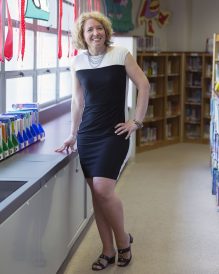
In Peters Township School District’s Pleasant Valley Elementary School, first-grade teacher Veronica Byers stands out. “Veronica is an advocate for all kids – all of our teachers are. But what separates her is that throughout her career, she’s been in several buildings, and she’s been bounced around,” says Michael Fisher, assistant to the superintendent for curriculum, instruction and assessment. “No matter what building she’s gone to, she’s made a huge difference in the kids that she’s taught and the staff that she works with. She impacts kids beyond her classroom by just working with other staff members.” Moreover, according to Pleasant Valley’s principal Greg Marquis, she’s “continuously willing and wanting to explore professional development and new teaching strategies – you never have to push her into those things. Those are things that she seeks out on her own.”
Byers, who grew up in Ligonier and attended Westminster College, just finished her 20th year teaching. Right smack in the middle of summer, we sat down in the library at Pleasant Valley and talked back to school, technology in the classroom and how she takes an individual approach – changing her teaching style every single year.
Q. What made you get in to teaching?
A. I always thought that I would be a teacher. My mom substitute taught when I was little. Of course, that changed about 65 times. After I went to college, I started taking some teaching classes and realized that’s what I wanted to do. I worked in some preschools, Head Start programs, and that’s when I solidified it in college that that was what I wanted to do.
Q. Tell me about your approach in the classroom.
A. In 20 years, the change in my teaching style has been all over the place because the kids are changing. I think that’s what good teachers do – they change based on the needs of their children. I think that’s important. For example, I took some classes on ADHD, and I’m realizing that not just kids with ADHD, but all kids, benefit from increased movement in the classroom. So, I wrote some grants, and I got some ball chairs – an exercise ball that sits on a chair. I worked with my occupational therapist to find out exactly what would be the best tools to help all of the kids in the classroom. And she said they shouldn’t have them all the time, so I just got a few for the classroom. We rotate, they have a system – even first-graders can learn how to do that. After the first two weeks of newness wore off, the kids who truly need them – we call them our tools for our body – the kids who need them will use them. Just finding different things like that, different seating/standing stations, movement breaks for in between lessons, during lessons. First-graders have an attention span that’s very small. So, any time you can give them a break and work in some kind of an activity, that’s huge. We are not a class that sits in our desks. Sometimes we’re outside, sometimes we run around the building; we do a lot of different exercises throughout the day. Our whole school adopted a workout Wednesday program. We start off with some yoga and stretching and some things in the morning, and different classrooms will be spotlighted, and I kind of took off from that in the classroom. My kids actually come into the classroom in the morning and instead of having normal seat work that most classrooms have, they have a list of exercises on the board. If you walk in my room, you’d think there’s chaos going on in there. But they’re really getting their minds and their bodies ready to work for the day. They’ve loved it, I’ve loved it. They unpack quickly because they know if they don’t, they’ll lose some of that exercise time. When the announcements start, they need to be in their seats. So it’s teaching them how to do it, teaching them the expectations, because that’s huge, too.
Q. What is your approach to reading, and how to you get them engaged or excited about that?
A. I taught first grade, second grade, third grade and back to first grade again. So having that whole cycle, I know what they’re going to be coming across in a few years and what they need right now. When they come in to first grade, you have all different levels – kids who are already reading, kids who barely know their sight words. Just getting to know the kids, where they are and what they need and differentiating for each of those kids is a big challenge. I think sometimes teachers want to only teach kids on the level that they’re on, but all kids can have that bar raised for them, and it’s just providing that scaffolding that they need to be successful. One thing that we adopted here is called close reading, and that’s a common strategy. It’s using reading that’s about two grade levels above where they’re reading, so it’s a much tougher, more complex piece. You might not be reading the whole text, but giving them a piece of that text and teaching them strategy to understand vocabulary or develop a deeper meaning or make connections. At first I was a little skeptical, thinking there’s no way first-graders can do this, but they really can – and they get excited when they’re reading this piece and you see them doing those strategies on their own later on. That’s the whole point. With first-graders, a lot of that higher reading is you reading it aloud for them first. Watching them grow is the best part of first grade. I call them my butterflies because they start out as little caterpillars and by the end of the year they are just butterflies – they are all reading, and it’s just so exciting to see that huge transformation. The kids who started out reading are reading chapter books by the end of the year; the kids who weren’t reading are.
Q. At that level, how big of a role does technology play?
A. I go back and forth. There are a lot of schools that tout the fact that all of their books are on tablets, and I’m seeing more and more kids with visual issues, and I’m concerned that the amount of time these kids are on screens – even if they are reading books – is really affecting their vision, their core body strength. So I do integrate technology; we do some things on iPads, we do some things on the smart board, we go to the computer labs, but there’s still something about holding that book in your hand and turning those pages that is just so important to me. And I see the love of it in the kids, too. They want to hold a book and read it, and we do a special thing at the end of the year called PV Camp BEAR – be excited about reading – and that’s the last week of school. They bring in their towels and their favorite books that they’ve now learned to read, and we go different places around the building outside. The kids get out their flashlights, and we build a little campfire out of noodles that we painted and they all gather around and get excited about what we’re reading. We share books with each other, read about camping. It’s their time to shine. They will sit there for 45 minutes and just read, and it’s like, wow, they really can sit without a computer screen in front of them! They can read a book and enjoy it and share it with someone else and talk about it and not bother each other and just love reading.
Q. We keep hearing that kindergarten is the new first grade and things are much more intense. Over the course of your career, have you seen that shift?
A. There’s an increase in rigor that’s a good thing, because I do think the kids are ready for a lot of it, but there are a lot of things that are being pushed into the curriculum (because they’re curriculum writers, they’re not necessarily teachers that write these curriculums). I think as teachers, we still have to look at the standards of the state, look at the curriculum, and say just because someone put it in this textbook doesn’t mean we need to be teaching prepositional phrases to kindergarten. That’s where we as educators have to make professional judgments. Just because it’s in the TSA teachers’ manual doesn’t mean we have to teach it – look at the state requirements, look at the district standards, and say this is what’s best for kids, this is what we need to focus on. Kids will rise to the occasion. I think we can’t keep teaching to that bottom part. We have to keep teaching up. Kids will reach for it. I do teach prepositional phrases in first grade. Do I test them? No. We bring it up, we talk about it, and hopefully down the road when they do learn it, they’ll remember. I think there’s exposure in kindergarten and first grade to things, and that’s OK, and I think there are things they really have to learn.
Q. At what point during the summer do you sit down and start planning for back to school?
A. I started that before the end of the year, especially with language arts because I’m the ELA facilitator for first grade. But I also do things on my own over the summer, too. Each summer, I try to take a class on something different. Last year, it was ADHD. I take online classes just to help myself. This year I’ll be doing it on teaching students with autism. Kids are all being infused in the classroom now, and that’s something I’ve never been trained on, so I know it’s only a matter of time until I start getting children in my classroom who are autistic. I want to learn some things. Not so much planning lessons, but planning for my kids because lessons are going to come and go, and they’re going to change, and depending on my kids I’m going to have to change those lessons, anyway. So I have to wait until I see the class the first few weeks. And that’s what’s kind of nice about the way we start here, too: We spend the first two or three weeks community building and really building that classroom rapport with the students and getting them to understand how a classroom works, teaching them how to be in school for a full day.