

Dr. Mary Jo Podgurski has been impacting local lives since the 1970s
CELESTE VAN KIRK
CELESTE VAN KIRK
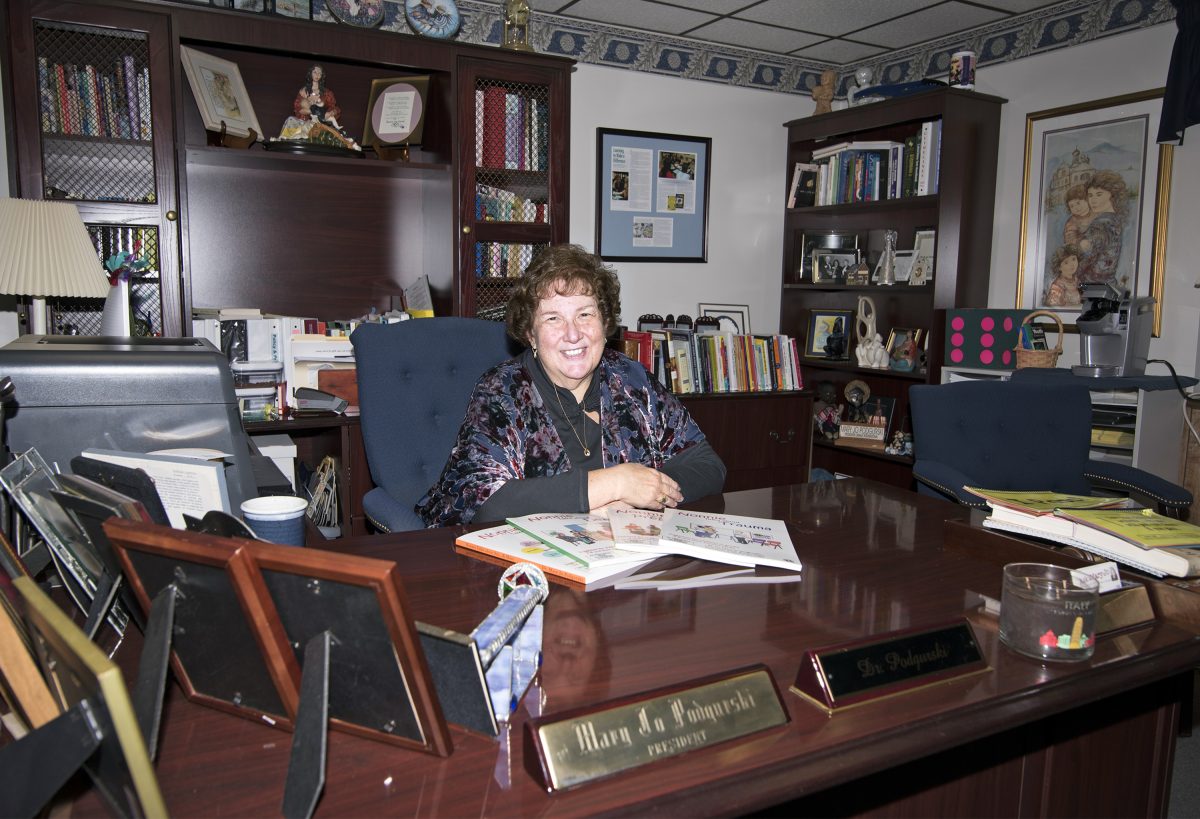
Mary Jo Podgurski at her office at the Academy for Adolescent Health in Washington.
The world needs more Sex Ladies. And by “Sex Ladies,” I mean people like Dr. Mary Jo Podgurski.
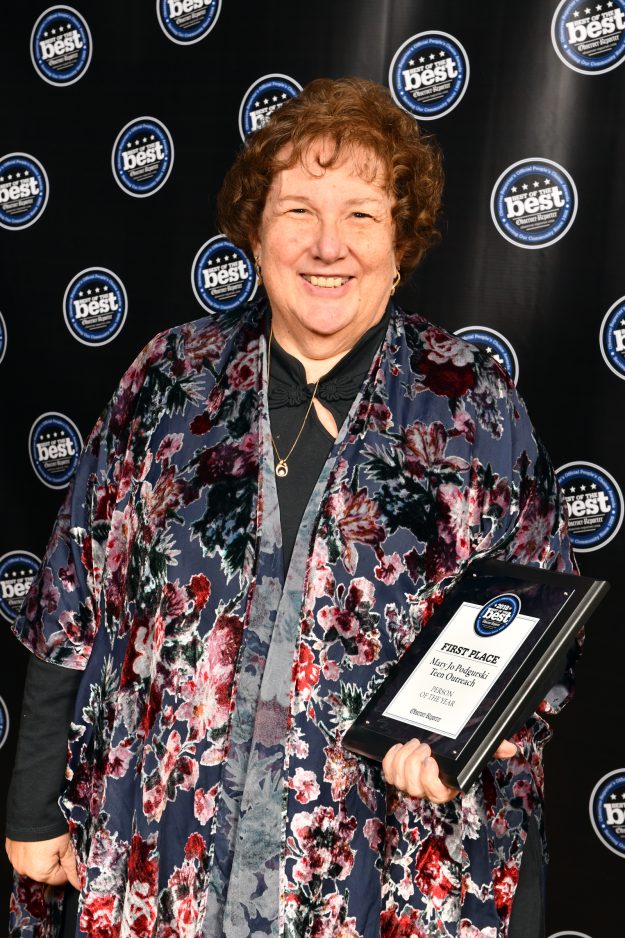
Allow me to elaborate. Podgurski is quite well known in the area, so you, our readers, likely already know that she writes a column for the Observer-Reporter, that she heads up Washington Health System’s Teen Outreach, that she teaches in local schools, that she’s authored a series of “Nonnie” books, that she’s been the recipient of the famed ATHENA Award, and, most recently, that she’s been given the title of the 2018 Best of the Best Person of the Year.
“The Best of the Best award was fully deserved, but I think that what’s even more meaningful is having been the ‘person of the moment’ for each kid she has worked with at the Teen Outreach Center and in all of her activities with Washington Health System. Her mantra of ‘one kid at a time’ has focused attention on respecting and valuing each individual, while changing our whole community for the better,” says Gary Weinstein, president and CEO of Washington Health System.
She’s also known as “The Sex Lady.”
But despite all of her successes, accolades and honors, she’s quick to point that positive attention away from her and towards the many students that she’s had over the years. “They’re the ones who did the work,” she says, seated across the table in her office at the Academy for Adolescent Health Teen Outreach on Washington’s North Main Street. “My young people have taught me. I’ve learned more from them than I’ve ever given to them.”
CELESTE VAN KIRK
CELESTE VAN KIRK
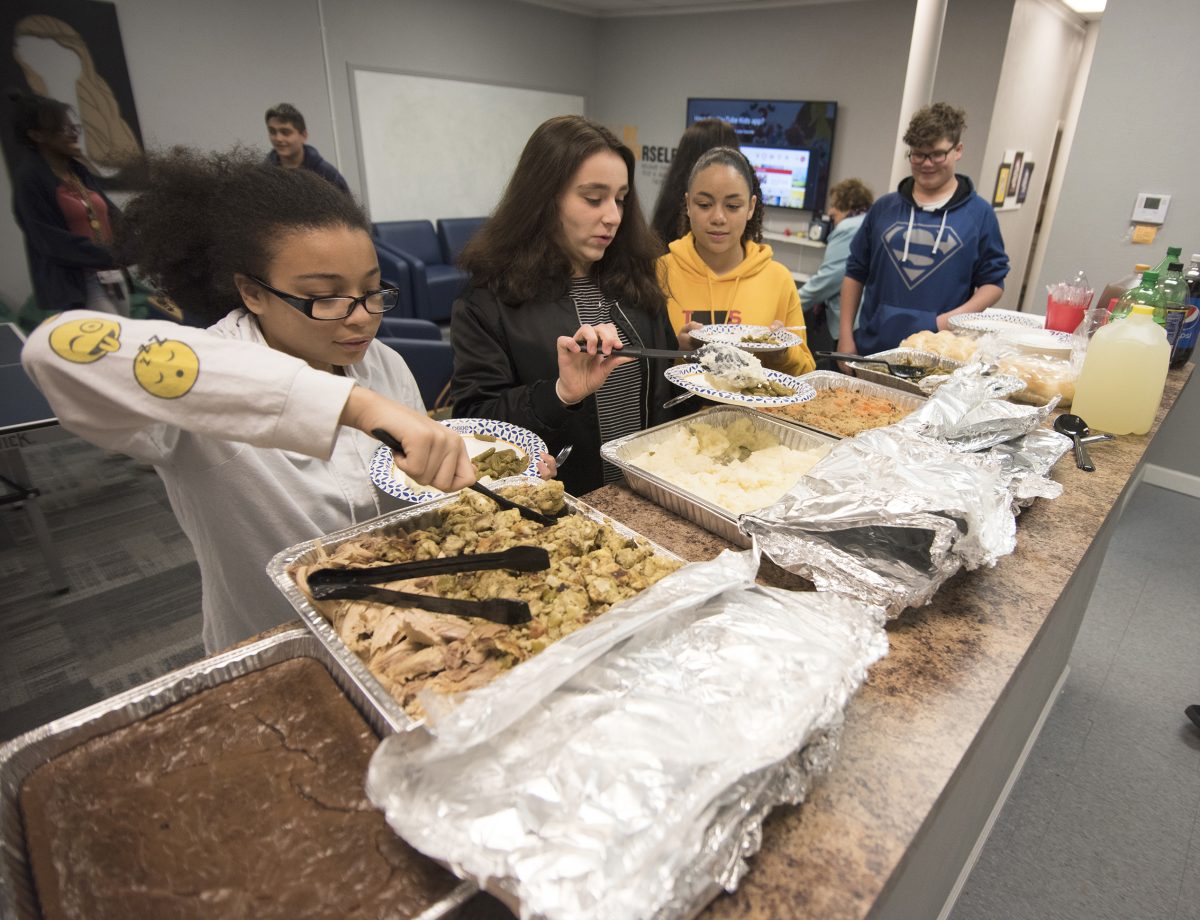
Students enjoy Thanksgiving dinner at Mary Jo Podgurski’s Common Ground Center in Washington.
The estimated quarter million kids she’s taught over the last 30 years might beg to differ. For certain, Toni Maurer, who is currently in her freshman year at Washington & Jefferson College does. “I met Mary Jo about five years ago. She has done so much for me that I don’t even know how to explain it all,” Maurer says. “In broad terms, she has aided me in overcoming insecurity and social anxiety. I am more outgoing, more open-minded, more optimistic.”
Perhaps the most striking thing about Podgurski is her ability to translate feelings of acceptance and compassion into relatable words: “The most important thing is to respect the human,” she says. “You find the humanity in each person. When I teach my trainings, my message to them is you don’t have to understand what a person needs, you don’t even have to truly get it – you just have to respect the humanity in that person.”
And that’s exactly why her own opinions and teaching methods have shifted over the years. “I started off teaching heteronormativity – male, female – and I have changed so much over the last 30 years. I am so much more inclusive,” Podgurski says. “I use terms like ‘the person with the uterus, the person with the penis.’ I’ve learned from trans kids who came out to me before it was (as mainstream as it is now).”
She cites statistics that show that the risk of suicide is very high in gender non-binary kids. Gender non-binary simply means that their gender identity is something other than male or female. “Inclusivity makes it better. So, if we can find adults to support those kids, and have those adults lead other adults, then to me it’s a no brainer,” Podgurski says. “People are really controversial about this stuff. I am not. People have judged me because of that, and that’s OK.”
While the Teen Outreach Center that we know so well has celebrated three decades of existence, the reality is that Podgurski started teaching sex education and working with teen mothers back in 1976. During a stint as a pediatric oncology nurse in New York, she says she saw around 10 or 11 kids die each week. “I had been aware of death – I mean, we all are – but I didn’t really get the fact that we would die until I started working with these kids. So, I always say I learned of my mortality at 23.”
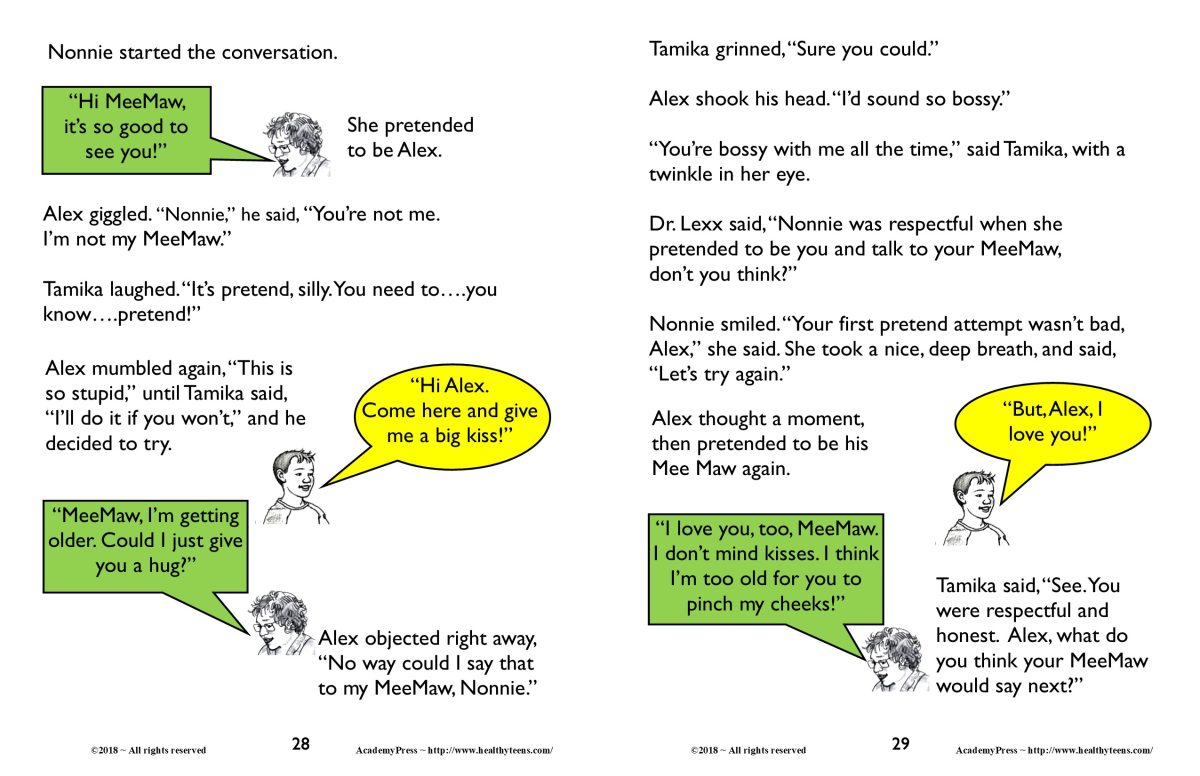
Pages from Mary Jo Podgurski’s “Nonnie Talks About Consent.”
Upon moving to Western Pennsylvania with her husband, Rich, to be closer to her parents, she shifted her medical focus to birth, because she thought that would be “a whole lot happier.”
What she didn’t take in to consideration, however, was teen pregnancy. During birthing classes that she was teaching, she began to notice that in the middle of all of the couples, would be a teen-aged girl who didn’t have a partner, or who had someone different with her every time. So, she decided she would teach teens separately, on her own, for free. She welcomed the mothers to be in to her home, and gave them a meal during the classes.
She recalls one of her first eye-opening moments in this role: being at the hospital while a 12-year-old girl was giving birth. The girl had decided to give the baby up for adoption, and didn’t want to see or hold the baby. She didn’t even want to know if it was a boy or a girl. Podgurski was pregnant with her own first child at the time. “I had big ideas for the birth of my baby. I was going to welcome it into the world peacefully, baptize the baby right away, sing Italian lullabies … it hit me, walking past the nursery after this 12-year-old girl gave birth, that no one had welcomed this baby into the world. So, I picked the baby up, started rocking it and singing. And then my baby started kicking in utero, and I just started to cry, realizing the difference between her (the mother’s) life and mine.”
Since then, she says she’s basically been on call 24/7/365 – the advent of the cell phone making that communication much more accessible. “If a young person needs to call you at 2 o’clock in the morning, then you let them call you at 2 o’clock in the morning. Shit doesn’t hit the fan between nine and five,” she says.
Thankfully, she has a supportive husband and children who understood – but who did always come first. “This is a strong statement: I’ve always been aware of the fact that my children’s childhoods were fleeting because of what I saw as a young nurse, because of the awareness of life being transient and seeing parents wrap their children in their arms and not be able to save them, and later me wrapping them in linens and taking them to the morgue. I didn’t want to lose anything with my own kids,” she explains. “That doesn’t mean I wasn’t on call, but if my child was upset and I got a text or a call, I’d text back, ‘Is this an emergency?’ If they would say no, I would say, ‘I’m available at this time, is that OK?’ If they said that it was an emergency, I’d write back that I was in a crisis with someone and ask if I could get back to them later. If they said yes, I’d clarify and ask if they were at risk. Sometimes emergencies are breaking up with a boyfriend or girlfriend and not knowing to handle it. And that’s real, but it’s not acute. I assess what’s going on, but I don’t turn that phone off.”
Just as she has become more accessible over the years, so has material that children and teens aren’t ready to absorb. Podgurski says that the questions that she got 30 years ago are the same as the ones she gets today: How do I know if I’m pregnant? How do I make a baby? How do I know if I’m gay?
“The questions are the same about basic things, what’s different is that what they’re seeing on their phones needs to be processed. They’re often afraid to admit to their parents what they’ve seen on them. I’d say in the last three to five years, I’m getting questions from sixth and seventh graders that I used to get from 10th and 11th graders. It’s not the quality or the type of questions that’s changed, it’s how much they’re exposed to.”
Mark Marietta
Mark Marietta
Mary Jo Podgurski right after finding out she was named Person of the Year for the 2018 Best of the Best.
They’re not only exposed to more about sex – Podgurski says that research shows that kids are seeing pornography for the first time around age 10 or 11 – but they’re exposed to a lot of judgment online, and a lot of hate. Though, that type of exposure is not something that’s limited to our youth. For Podgurski, it goes back to finding the humanity in each person.
“I would challenge someone who is unhappy about people who are different to sit with them and get to know them,” she says, and then points to a timely example. “I can’t be anti-Semitic because I love people who are Jewish. I could be Jewish – it’s the luck of where you were born and who you are. There’s greatness in being Jewish. When the Tree of Life Synagogue shooting happened, the young people in my group said they wanted to process it. So, we processed grief and we talked about fear.”
Yes, a lot of what Podgurski teaches is sex education. But it goes far beyond that. The Common Ground Teen Center, also on Washington’s Main Street, is run by teens and supervised by students at Washington & Jefferson College. Podgurski points out that it’s successful because of those teens. She says they’ve established a culture that is safe, and accepting of everyone, regardless of gender, race, sexuality, economics. “We have kids who only eat a meal when they are there, and we have kids who come in BMWs. They take care of each other, they’re kind to each other.”
For Maurer, the Common Ground Teen Center has been incredibly impactful. “I’ve been in just about every program Mary Jo offers to teens, but the single most important thing is the Common Ground Teen Center. She pays for it, but she lets us teens run it,” Maurer says. “She is, for many of us, the first adult to put her full trust in us. The Center has provided a safe place, a hangout, a study room, a second home to so many of my peers. She empowers teens and lets us be who we are, while keeping it respectful. Mary Jo has impacted me and every other teen she has ever encountered just by simply being our ‘nonnie.'”
That’s why the world needs more people like Podgurski. We need more people to listen, to answer tough questions. We need more people to open their hearts to those who are in need. We need more people to not give up on kids. We need more people to spread the message of others’ worth and importance.
We need more people to respect the humanity of each and every person.