

A mad genius and his Great American Horn Machine
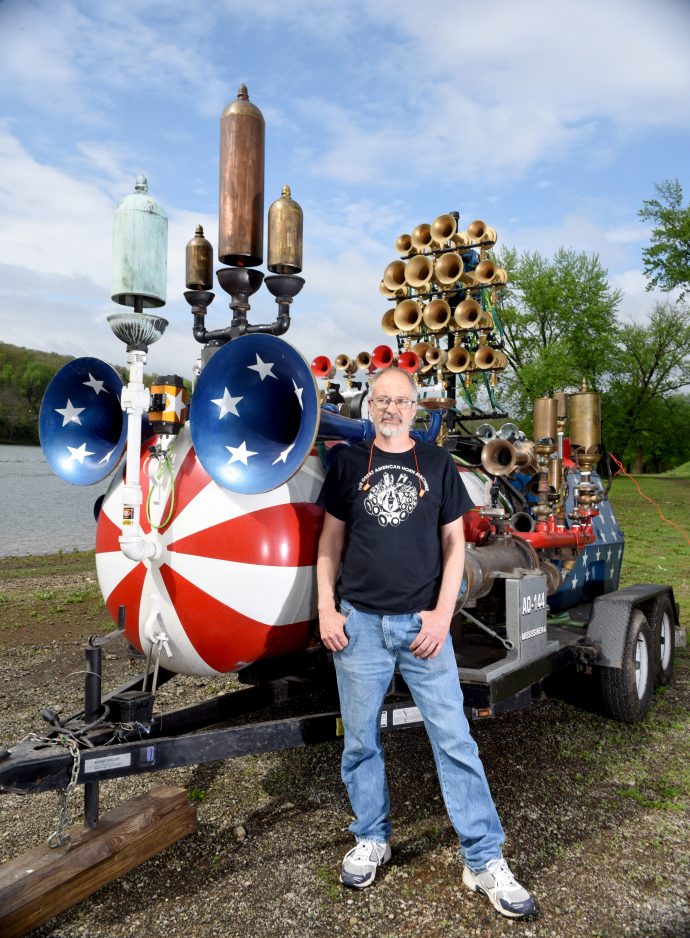
Katie Roupe/O-R Dana Dolfi created the Great American Horn Machine that plays songs from a variety of horns. The horns have historic significance including a whitle from the Donora American Steel and Wire Works, a horn from the USS Missenawa and a horn used on a California drawbridge.
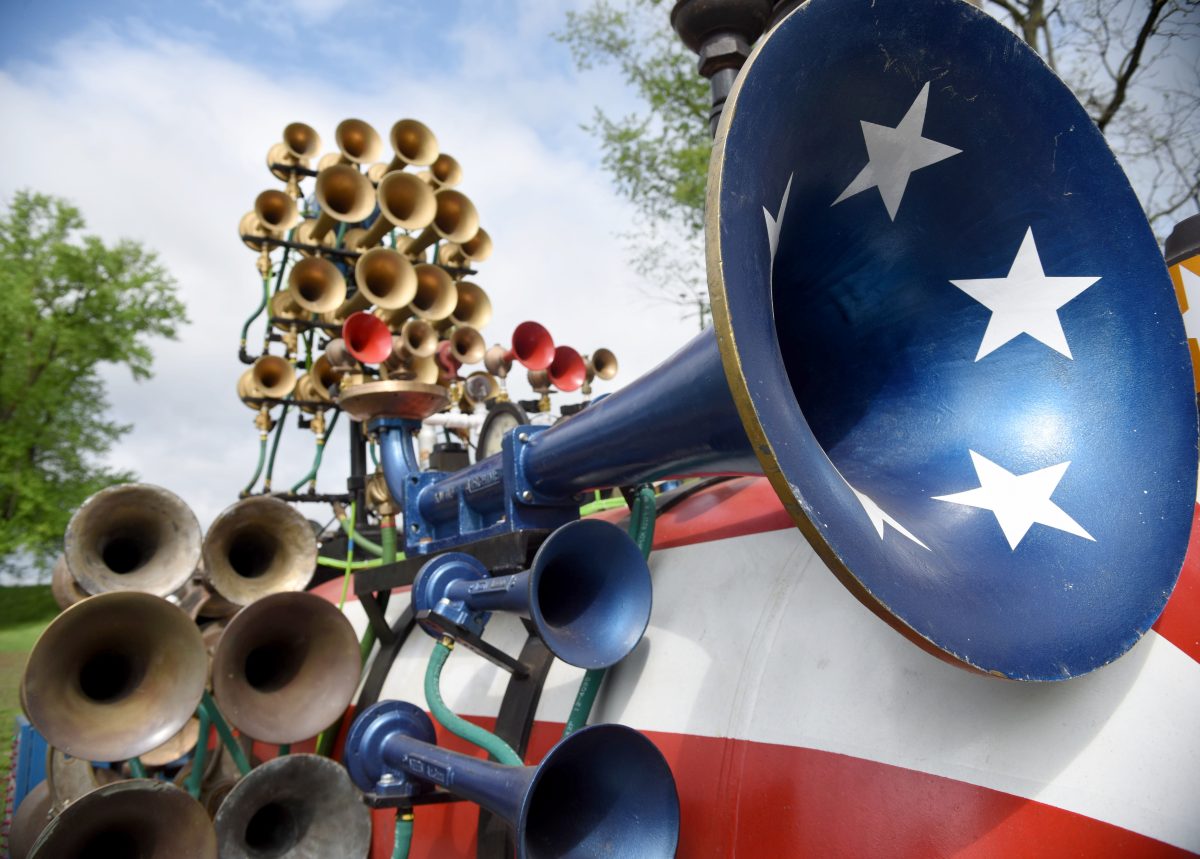
Katie Roupe/O-R Dana Dolfi finds his horns and steam whistles on eBay and from other collectors.
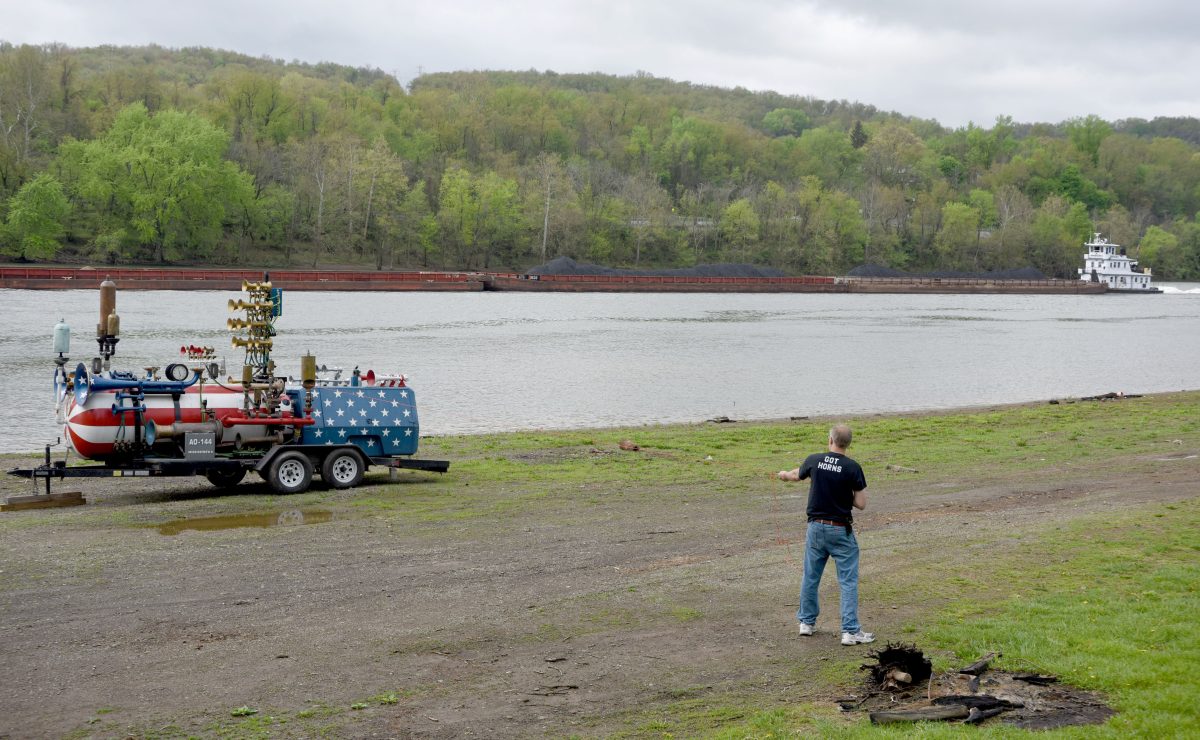
Katie Roupe/O-R Dana Dolfi pulls a rope that plays a single loud horn on his Great American Horn Machine while a barge passes by on the Monongahela River.
Katie Roupe/O-R When Dana Dolfi was young, he would sit by the Monongahela River and wait for the towboats to blow their horn.
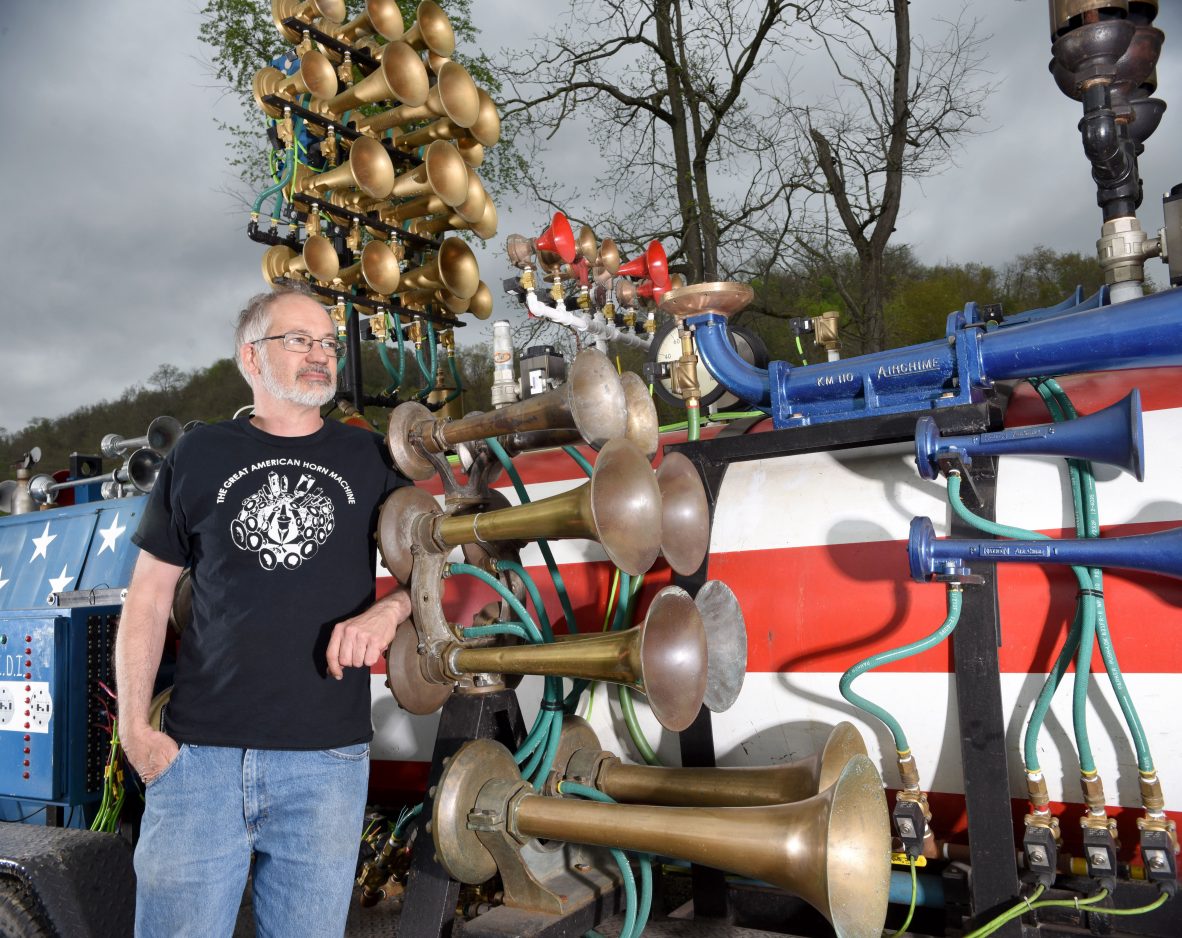
Katie Roupe/O-R Dana Dolfi’s Great American Horn Machine makes appearances at Maker’s Faires, Fourth of July parties and graduation parties.
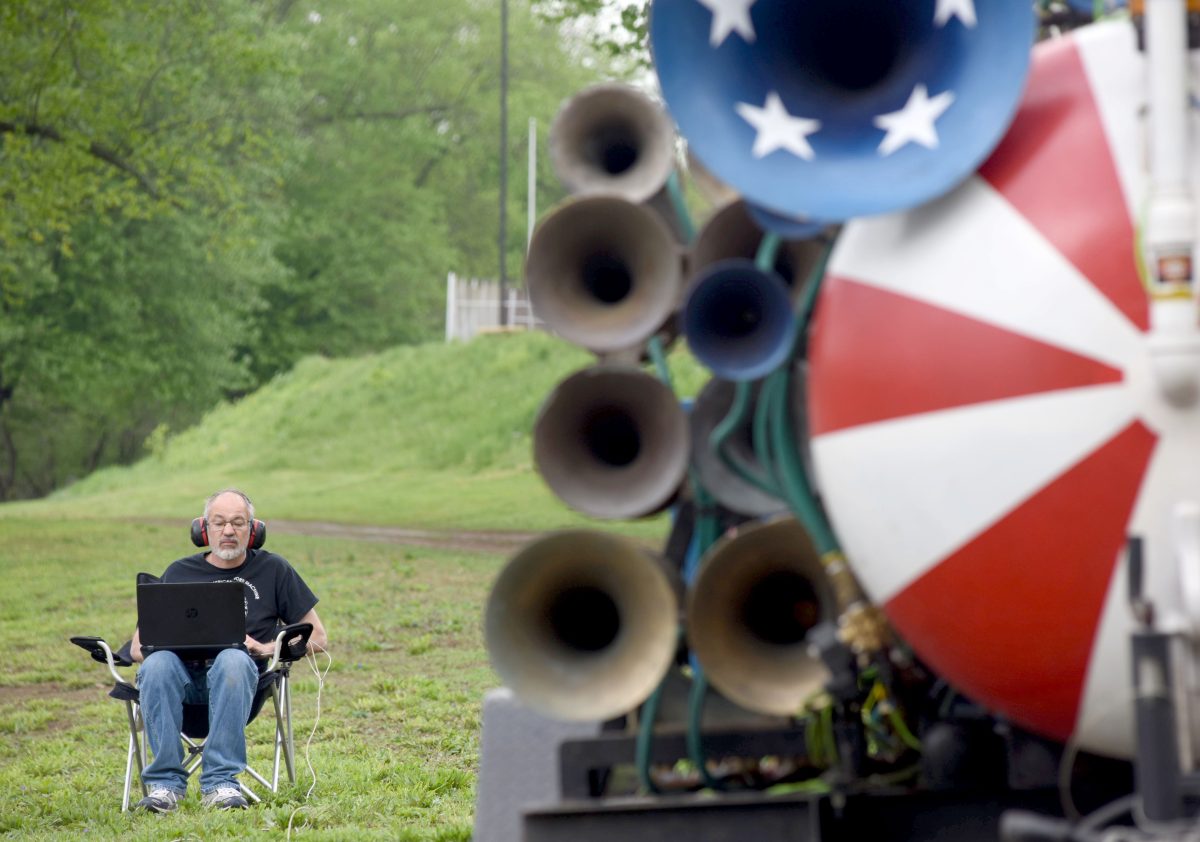
Katie Roupe/O-R Dana Dolfi uses software to control a MIDI board to play a variety of songs from his Great American Horn Macine. The machine can play 34 notes.
Move over, Dr. Seuss, with your Three-nozzled Bloozers, your Hinkle-Horns and your Trum Tupers.
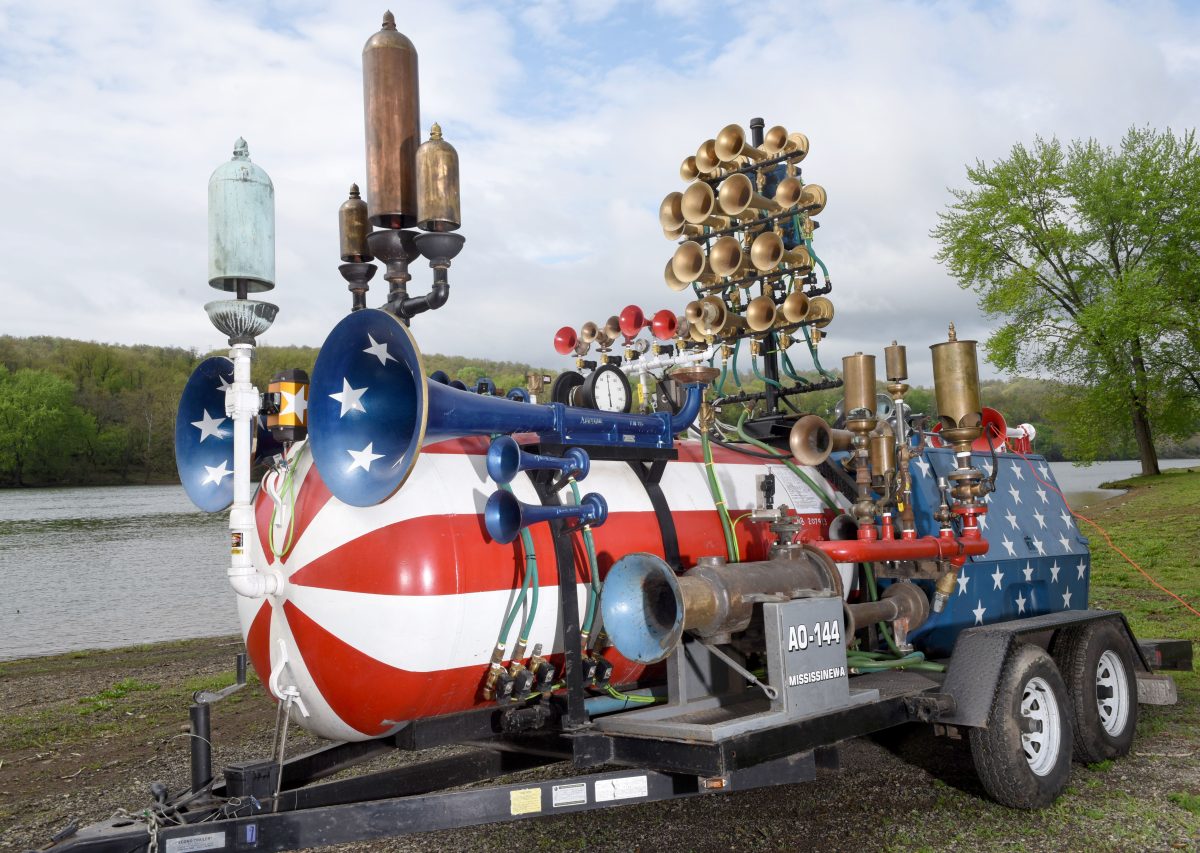
You’ve been spectacularly outdone by Dana Dolfi, inventor of the Great American Horn Machine, a 3-ton, red, white and blue collection of ship, truck and train air horns and steam whistles, set atop a car trailer.
Dolfi, a pipe-fitter and project manager for Chapman Corp. – and, perhaps, a mad genius – originally created the musical contraption, touted as “The World’s Loudest Mobile Musical Instrument,” to display his collection of steam whistles and air horns.
But the horns and whistles, most of which had been silent for years, should be heard, too, thought Dolfi.
So, he tracked down somebody who made a “gizmo” that enabled Dolfi to use a keyboard to turn on the horns and whistles, and to synchronize them to music.
His first attempt, “God Bless America,” went viral on You Tube, Dolfi said.
Up close, the contraption is as loud as a jet engine (he marks off a 100-yard perimeter around the horn machine, and ear plugs aren’t a bad idea), and Dolfi believes it is louder than the Boardwalk Hall Auditorium Organ in Atlantic City, recognized by Guinness World Records as the “Loudest musical instrument ever constructed.”
A gasoline-powered air compressor and a 620-gallon air tank blow the horns and whistles, and Dolfi uses a MIDI board to play songs ranging from “The Star Spangled Banner” to “Down By the Riverside.”
“It was never the goal to build a musical instrument, so the fact that it does play music is really cool,” said Dolfi. “So then I started collecting horns to fill in the voids for the notes I was missing.”
Dolfi sent the horns to a machinist who custom-tuned them to musical notes. The horn machine now plays 34 notes, and Dolfi is working to increase the oversized musical instrument’s note capacity.
“People ask me how long it took me to finish, but that’s a silly question because it implies that it’s done. It’s still evolving,” he said, laughing. “It will never be done.”
The machine itself is a magnificent sight, but each of the horns and whistles – which Dolfi purchased off eBay and from other horn and whistle collectors – has its own rich history.
Among the horns and whistles Dolfi has collected are a large horn from the USS Mississinewa, a Naval replenishment oiler; horns off a Coast Guard cutter and an ocean-going dredge; a horn that was used on a California drawbridge; a set of horns from a Great Lakes ore freighter; whistles from the Donora American Steel and Wire Works; an 1890s whistle from a fire hall in Gloucester, Mass.; a whistle from an antique popcorn machine, and several train and towboat horns and whistles.
“Every piece has a story, and I think that’s what makes the collection interesting. They served a purpose, and knowing where they came from and what they were used for is fascinating to me. The music part is a whole different story,” said Dolfi.
Dolfi’s fascination with air horns and steam whistles began when he was a boy, visiting his grandparents who lived on the banks of the Monongahela River.
“I’d watch the towboats go by, and I’d do this,” he said, tugging at an imaginary cord, “and wait for them to blow their horn.”
The first steam whistles he collected came from his father’s collection.
Dolfi said more than half of his horn and whistle collection is displayed on the machine, and he switches them in and out occasionally.
He purchased his first horn for a houseboat he had bought.
“I found a big horn on eBay, which was OK, but then I found a bigger horn, then a bigger horn, and then I found a bigger horn. Then, I joined the Horn and Whistle Collectors club and figured this was a pretty good hobby,” he said.
Dolfi enjoys displaying the Great American Horn Machine at Maker’s Faires, sponsored by Make: magazine and held across the country, and in May he hauled it to the Buffalo Science Center. He sets out informational papers to help explain how he built the device (Dolfi, who doesn’t own a television, says he inherited his ability to build things from his father and grandfather, and he once built a paddle boat to drive on the river).
He also plays the machine at Fourth of July parties and graduation parties.
Dolfi’s machine has turned into a family project. His son, River, a mechanical engineering student at Penn State, and daughter, Storm, a fashion design major at Kent State University, have pitched in.
“My son is pretty hands-on, and we’ve built the controls together on the dining room table, and my daughter helped do the painting,” said Dolfi.
Dolfi said he’s pleased with the educational opportunities the machine provides for curious onlookers.
“STEM and STEAM is big in schools these days. The horn machine embodies that. You’ve got science, technology, engineering, art and math, but I’ve actually added an ‘H’ in there for history,” said Dolfi. “Also, I figure if I can inspire some kid that he can actually build something, then I’m happy. In society, there are a lot of people who say, ‘You can’t do this, you can’t do that,’ but you can do whatever you want if you set your mind to it.”
Dolfi admits that the horn machine is so loud that residents down river have, on occasion, called police to alert them to a resounding noise.
“Fortunately, I don’t really have neighbors close by,” said Dolfi. “There’s a fine line between awesome and obnoxious.”