

Pulitzer-winning journalist speaks at W&J
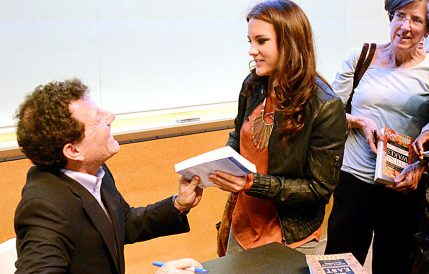
New York Times associate editor and two-time Pulitzer Prize winning journalist Nicholas Kristof spoke to a standing-room-only crowd inside of Washington & Jefferson College’s Dieter-Porter Life Sciences Building Thursday. Filled with stories from his nearly three-decade-long career as a globe-trotting reporter, Kristof spoke for more than an hour in support of his book, “Half the Sky: Turning Oppression into Opportunity for Women Worldwide.”
“In much of the world, being a woman is lethal,” Kristof said. “Just as the most important threat to social justice in the 19th century was slavery… now it is gender inequality for so many people around the world.”
Penned with his wife, Sheryl WuDunn, the book explores the exploitation of women across the world.
Kristof and his wife are not new to working together. In 1990, they became the first married couple to win a Pulitzer Prize for journalism when they were honored for their coverage of the 1989 Tiananmen Square protests.
Kristof explained that in much of the developing world, girls are excluded from providing for themselves. Although women outnumber men in the United States and most of the industrialized world, in developing countries that statistic is reversed.
“You may feed your son but maybe not your daughter,” Kristof said. “The same goes for paying for health care.
“The result is a difference in mortality rate.”
Kristof said these inequalities combined with the practice of selective abortion that occurs in many parts of the world resulted in between 50 and 120 million women missing from the Earth.
In order to combat a wide range of injustices all over the planet, Kristof advocates the education of girls. In a number of places wracked by war and hunger, turning girls from an extra mouth to feed into an economic driver often takes little more than a few years of education. That small difference can have the ability to turn around entire villages.
“Women and girls aren’t the problem,” Kristof said. “They’re the solution to many of the world’s problems.”
Like education, reproductive health is an issue of grave importance. Many Americans may not realize so many women in other parts of the world are negatively affected by pregnancy.
“The most dangerous thing a woman can do is give birth,” Kristof said. “We don’t remember how recently women were dying here, or how many.
“During World War I, more women died in the United States during childbirth than men died in the war.”
Kristof said it wasn’t until the women’s suffrage movement that the mortality rates began to fall.
“At some point, it is about recognizing these as important lives to be saved,” Kristof said.
The subject matter of the lecture was deeply moving and Kristof was able to engage the audience to offer a truly inspiring speech.
Kristof used the opportunity to encourage the students in the crowd to get involved. He said it was important to find a cause that you’re passionate about and fight for it.
Seeing places with different standards of living opens one’s eyes to what is really important in life. While he advocated for traveling abroad to see as many cultures as possible, Kristof said people living differently can be found by going to parts of Pittsburgh.
“Get out there and get out of your comfort zone,” Kristof said.
“It’s really important to you, as part of your education, to encounter worlds you aren’t exposed to.”