

Details of photo certainly make waves
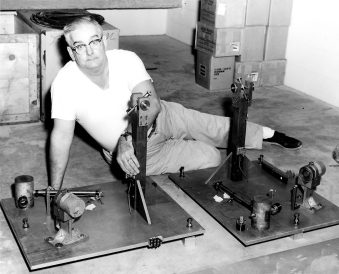
We had hoped that last week’s Mystery Photo would be resolved, but we had no idea the solution would be so earth-shaking. Although a couple of callers guessed that the man stretched out on the floor is the late John Moore, a Waynesburg commercial photographer, they were wrong. He is actually the late James Schroyer, a geology professor at Waynesburg College, and the devices he is displaying are seismometers – instruments that measure earthquakes. Fred Schroyer, 68, a writer and editor who lives in Waynesburg and is the late professor’s son, was quick to identify his father and laughed about others’ speculation. “I knew John Moore,” Schroyer said, “and believe me, the resemblance is extremely superficial.” James “Fuzzy” Randolph, curator of Waynesburg University’s Paul Stewart Museum, and Jim Schroyer, who died in 1987, were fellow faculty members in 1956, when Randolph believes the photo was taken. “I can tell that seismograph is not even completed,” he said. “It had to be read daily, and I helped with that.” How did Waynesburg become a monitoring station for earthquakes? The borough just happened to be in the right spot, Fred Schroyer explained in an email. In the 1950s and 1960s, the Lamont-Dougherty Geological Observatory at Columbia University established earthquake stations worldwide. “The Observatory asked the college to provide a basement for their instruments, so my dad set up the station in the basement of the college library. Two special rooms were built – a darkroom for the earthquake instruments, and a darkroom for developing their photo paper recordings, ” Schroyer wrote. “The photo shows two of three seismometers that measured “seisms” or seismic waves (earthquake waves). Each seismometer detected earth motion in a specific direction: east-west, north-south, and up-down. Each seismometer aimed a light beam at a spring-mounted mirror. When Earth would jiggle from a quake (even quakes on the other side of the Earth), each seismometer’s mirror would bounce slightly, reflecting the light beam onto photographic paper that was wrapped around a slowly rotating drum. Thus, the light beams created three photo-paper recordings of earth’s wiggles and jiggles.” Once a day, Schroyer wrote, the recordings were removed and taken to the darkroom, where they were processed and then compared to determine where tremors originated, and how strong they were. “During my teen years, my dad often had me do the daily maintenance on the earthquake lab. That meant checking the ‘light beam aim’ of the three seismometers, checking the timing clock against the time-standard shortwave station WWV, changing the photo paper on the drums, developing the photo paper in the darkroom, and keeping a logbook. It was quite a science education for this 16- to 18-year-old! My dad also used it as part of his geology courses to show students how earthquake data is measured.” Schroyer graduated from Waynesburg College in 1966 with a degree in English, however, not in the sciences. He would later become passionate not about seismology but rather Brazilian music. He now works in Morgantown, W.Va., as a writer and editor for Continuous Learning Group, and he is a freelance writer and book developer. The instruments in the photo are no longer in use. The earthquake lab operated from 1956 to 1964, when Columbia University moved the instruments to a site in Peru. Watch for another Mystery Photo in next Monday’s Observer-Reporter.