

‘Buckshot’ approach to security
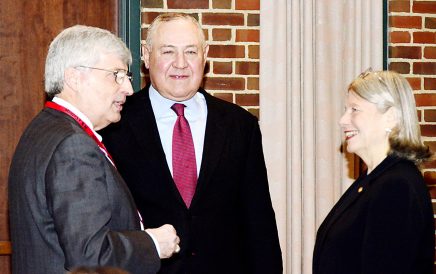
Charles Wald said there is no single, simple way to develop – and maintain – energy security in the United States.
“There is no silver-bullet solution to our energy situation,” said Wald, leader of Deloitte’s Department of Defense Practice. “I would say there’s a silver buckshot solution.”
There are many sources of energy, he said, and many ways to access them and conserve them, and that the nation should strive to employ these numerous options.
Wald, a retired U.S. Air Force general, was the keynote speaker Wednesday at the second annual energy summit organized by the Center for Energy Policy and Management at Washington & Jefferson College. The theme was: “U.S. Energy Security: How Do We Get There?” Wald addressed a crowd of about 150 in the ballroom at Rossin Campus Center.
His 45-minute address was flanked by two panel discussions featuring experts in the energy field.
The general said the U.S. “needs to produce as much energy as we can in a responsible way.” He lamented the fact that the nation still depends a lot on oil from other nations, declaring in a PowerPoint presentation that “U.S. oil dependence undermines national security.”
He said the nation must maintain a military presence at sea to keep shipping lanes open.
“If the Straits of Hormuz are closed, the price of crude oil could go to $300 a barrel,” said Wald, who was introduced by state Sen. Tim Solobay, D-Canonsburg. “Two hundred dollars a barrel could devastate economies and change the balance of power.”
The Defense Department, he pointed out, is the nation’s largest user of energy, and energy-related costs are high in the military.
Wald fielded questions from the audience afterward, and two focused on military threats from Iran and North Korea.
Asked whether a blockade would effectively thwart Iran, he said: “This is tough diplomatically. A blockade could be a good move, but that is a declaration of war, and we would have to be prepared for that.”
As for threats from North Korea, Wald said: “I don’t think they’re going to do anything, I don’t think they want to, but their talk is bellicose.”
The opening panel discussion was spirited, featuring Bill Flanagan of Allegheny Conference on Community Development moderating; Rayola Dougher of the American Petroleum Institute; Andrew Holland of the American Security Project, a Washington, D.C., think tank; and Anne Korin of Institute for the Analysis of Global Security.
Dougher called for a “comprehensive approach to energy security. We need to increase energy production by promoting all sources.”
She also is pushing for construction of the 1,700-mile Keystone XL Pipeline, from Alberta, Canada, to Port Arthur, Texas. “Within 11 years, Canada and the U.S. can provide all of our liquid fuel needs.”
Korin spoke about how China and India are importing much more than previously.
“Most people used to ride bicycles in China,” she said. “Now they don’t want to ride bicycles there. The main street in Beijing is now an eight-lane highway.”
In the summit’s final panel discussion, “U.S. Energy Security and Shale Gas: The LNG Export Debate,” panelists from the chemical and oil and gas industry agreed that the government needs to find a balance between how much gas it should export and how much should be kept here for cost-advantaged chemical production, natural gas transportation and other purposes.
Earlier this week, Dominion Resources announced it was applying to federal regulators to build a $3.4 billion plan in Maryland to export liquefied natural gas.
Panelist Dan Donovan, spokesman for Dominion, told the audience that if the project is approved, his company couldn’t begin shipping LNG to customers in Japan and India until 2017, given the four-year construction time frame.
But panelist Peter Molinaro of Dow Chemical Co. said Dow opposes the export of natural gas, arguing that the fuel can be best used by U.S. manufacturers for a competitive advantage.
Mark Mills, senior fellow with the Manhattan Institute and energy intelligence columnist for Forbes magazine, said exports of LNG could go a long way to helping the U.S. reduce its trade deficit.
According to Mills, the gas industry is deploying modern technology that should enable it to produce enough gas for export and also produce enough gas to “keep Dow happy.”
But like other panelists, Molinaro said the government needs to move slowly in deciding the export question.
“Let’s not make all of the decisions about this 100-year supply in the next five years,” he said.
Business editor Michael Bradwell contributed to this story.