

W&J honors
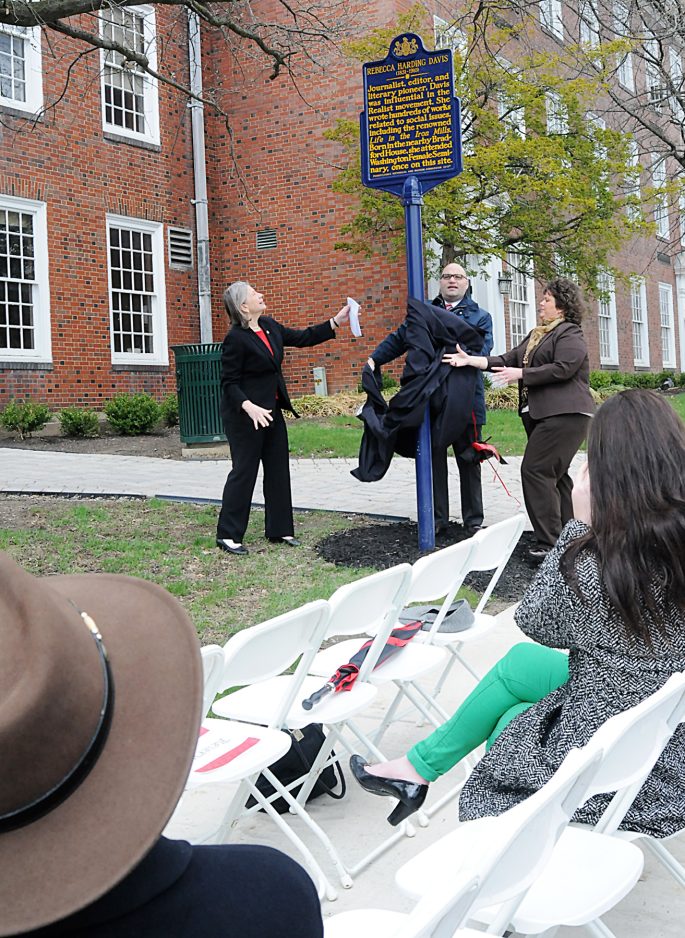
From left, W&J President Dr. Tori Haring-Smith, Robert Matzie of the Pennsylvania State Historical and Museum Commission and Washington Mayor Brenda Davis, right, unveil the new historical marker honoring the late Rebecca Harding Davis.
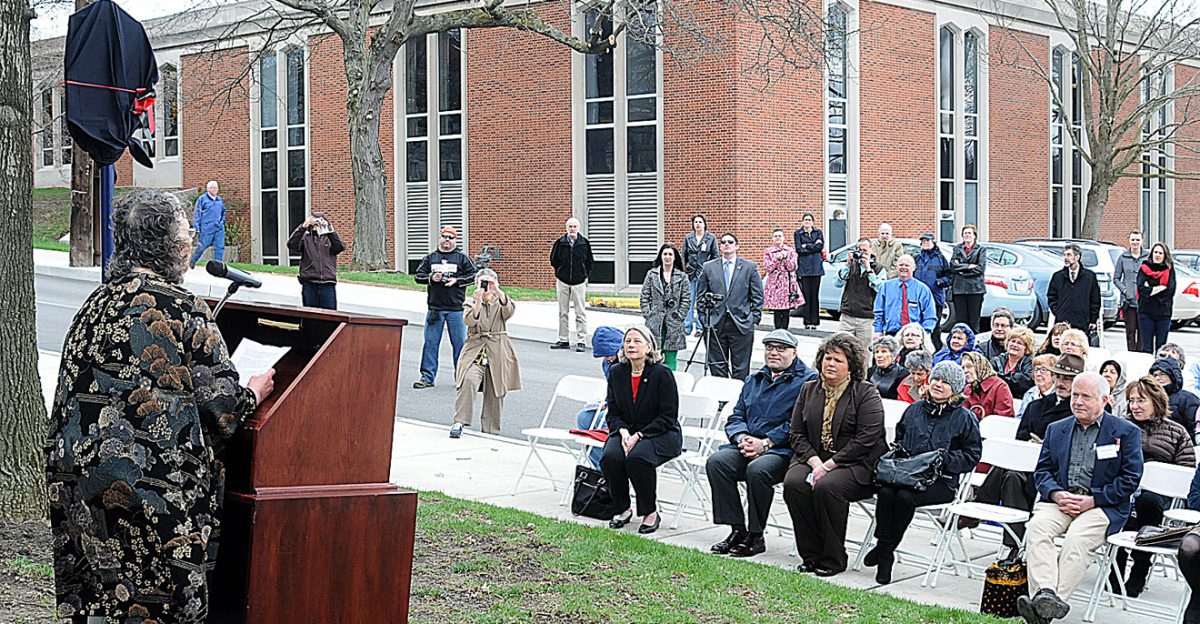
Rachen Loden, the great-niece of Rebecca Harding Smith, speaks to the sudience during dedication ceremonies Saturday morning.
Few people driving on South Lincoln Avenue through the campus of Washington & Jefferson College may have ever heard of Rebecca Harding Davis, let alone know her significance to the city of Washington.
Thanks to a historical marker dedicated Saturday, they will be reminded of a woman praised for her revolutionary writings of social concerns and women’s issues during the Civil War and as the industrial revolution was beginning in the United States.
The marker is placed on the campus not far from the site of the former Washington Female Seminary, where Davis graduated from as valedictorian in 1848.
Davis was a first in so many ways, said Dr. Tori Haring-Smith, noting the marker is the first dedicated to a woman in Washington.
“She was one of the first to discuss the painful realities of the Civil War and to document the life of workers in the mills and tension in the life of women,” Haring-Smith said Saturday. “She was a fresh voice even recognized in her own time.”
Haring-Smith said Davis believed everyone should not “tell the story of his own life, but of the time in which he lived as he saw it.”
Rachel Loden, Davis’ great-niece and an award-winning poet, said for her, her great aunt was a great permission giver.
Loden recalled seeing the gold, engraved titles of her aunt’s books at her grandmother’s home. Her grandmother, Emilie Harding Gow, was Davis’ younger sister. Gow eventually inherited the Bradford House that had been initially left to Davis.
“We have Rebecca Harding Davis to her birthplace in Little Washington,” Loden said Saturday.
Davis was born June 24, 1831, in the Bradford House, which at the time was owned by her aunt.
“When her mother became pregnant with her first child, she came back to Washington to be close to her mother and sister,” said Dr. Jennifer Harding, associate professor of English at W&J, and an organizer of the symposium celebrating Davis. “Her mother’s family, the Wilsons, were early settlers. She was named Rebecca Blaine Harding. The Blaine was in honor of her aunt’s married name.”
Davis grew up in Wheeling, W.Va., where she was home-schooled. She also read a lot, Harding said.
She was sent to Washington to attend Washington Female Seminary, which was her only formal schooling, Harding said. Davis lived with her aunt and uncle at the Bradford House.
“Sarah Foster Hanna was the principal at the seminary,” Harding said. “I think she benefitted from her guidance.”
After Davis’ father died, her mother and younger sister, Emilie, moved to Washington, and Davis would make periodic visits. Even after she moved away to Philadelphia, her visits to the area were often noted in the Washington Observer and Washington Reporter. Harding said Davis was described as a noted author from the region.
Later in her life, Davis became overshadowed by her son, Richard Harding Davis. A journalist, he was described as charismatic and a friend of Teddy Roosevelt.
When her aunt died, Davis was left the Bradford house. Davis left the house to her sister since she was living in Philadelphia with her own family.
Harding said Davis’ best known work, “Life in the Iron Mills,” tells the story of two cousins who were extremely poor Welsh immigrants living in Wheeling. Deb worked in textiles while Hugh was an iron worker and an aspiring artist. Hugh would take korl, a by-product of the iron work, and make sculptures. Hugh felt trapped in his job, preventing him from his artwork.
Deb took money from the pocket of one of bosses at the textile mill, apparently because she felt entitled to it, Harding said. She gave the money to Hugh so he could quit his job. But Hugh ends up taking the blame for it and goes to prison.
“It is the symbol of being trapped in a life,” Harding said. “And he is literally trapped in prison, accused of a crime he didn’t commit.
“Davis was given a lot of credit for the realism movement in the late 19th century,” the professor added. “Her work has stood the test of time.”
Harding’s students read Davis’ work and selected four that were presented during the symposium.
Harding has some story suggestions, in addition to “Life in the Iron Mills,” for anyone interested in reading work by Rebecca Harding Davis.
“In the Market” is a story about two girls who feel pressure to marry so they will not be a financial burden on their family, and who must make compromises and think creatively in an era when many men had gone West or been killed in the Civil War.
“Anne” is a story about a middle-aged widow who suddenly abandons her simple, predictable life to go on a journey to rekindle the excitement of her youth.
“The Promise of the Dawn” is a story about a prostitute who tries to obtain help from her long-lost brother, who rebuffs her.