

Aviator’s legacy may return to airport
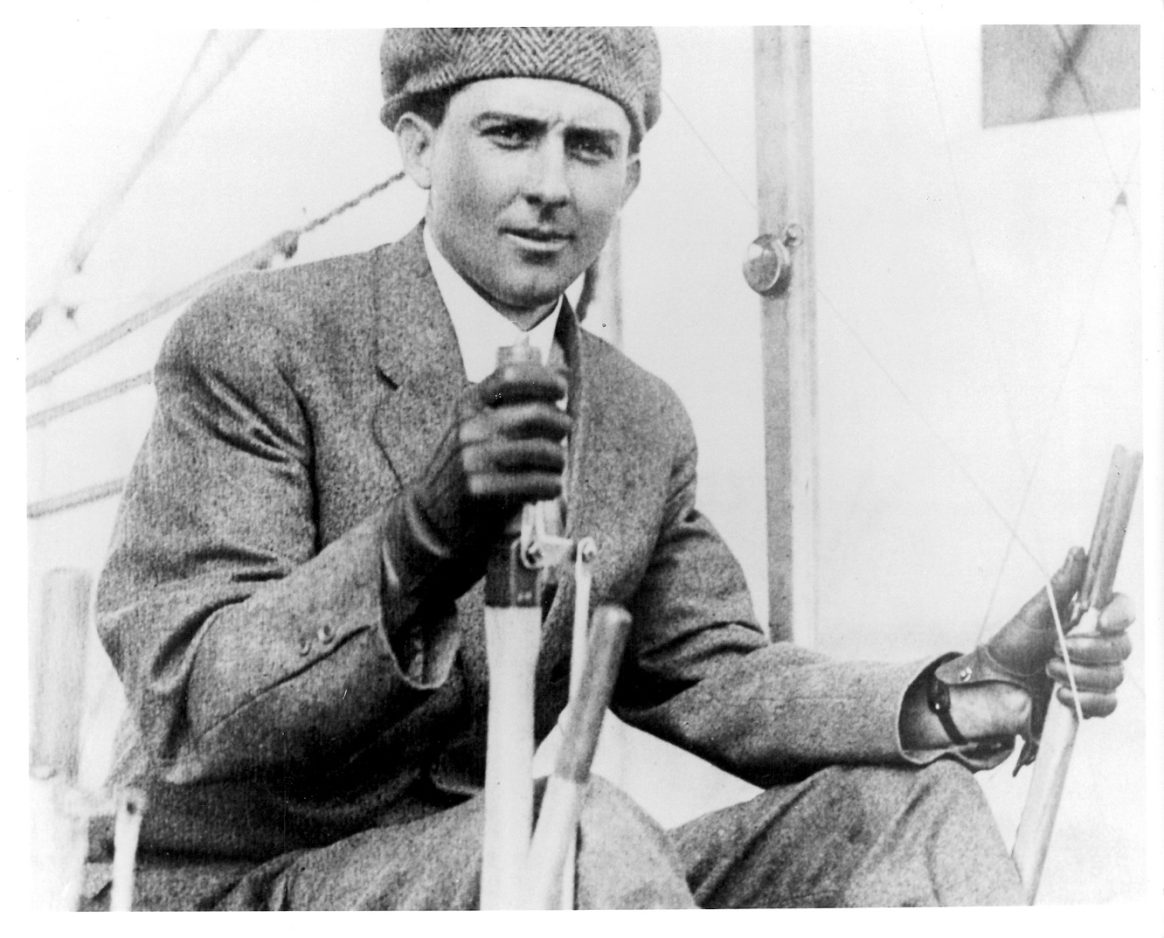
DeLloyd “Dutch” Thompson at the controls of a Wright biplane in 1910.
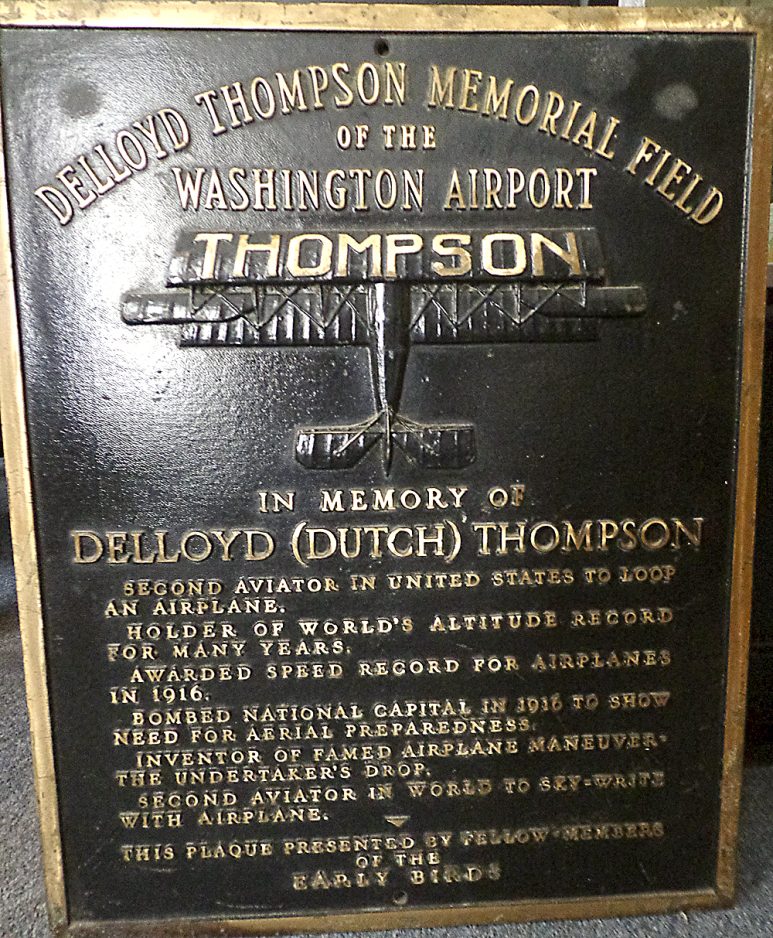
One of two plaques honoring Dutch Thompson that once hung at Washington County Airport
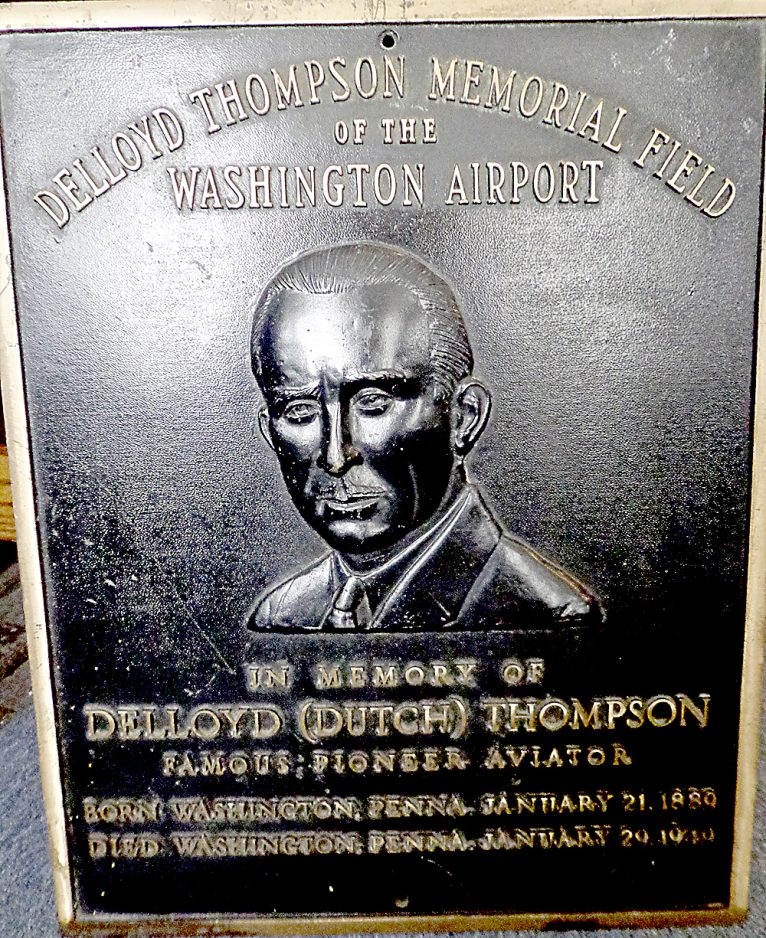
One of two plaques honoring Dutch Thompson that once hung at Washington County Airport
Today we know the location as the Washington County Airport, but the airfield was dedicated in 1949 to commemorate DeLloyd “Dutch” Thompson, a local aviation pioneer who, in the words of a former Observer-Reporter editor, “made sensational headlines from coast to coast as he smashed speed and altitude records, and outlived most of his fellow stunt pilots in the early, crazy days of flight.”
There’s nary a trace of Thompson’s memory at the airport today, but some history-minded residents would like to change that by moving two bronze plaques from the LeMoyne House, home of the Washington County Historical Society, back to the airport, where they once adorned metal gates.
Thompson was the second aviator in the United States to perform a loop with an airplane and sky-write. He demonstrated the potential use of aircraft in warfare and held both altitude and speed records for many years.
“Every pilot who lands on the field once named for him owes a debt of gratitude to Thompson and the other ‘Early Birds’ whose courage and ingenuity made flying as we know it today possible,” Park Burroughs, former editor of the Observer-Reporter, told the commissioners last week, asking the county to again mark the runway and taxiways at the county airport as DeLloyd Thompson Memorial Field.
He submitted a letter he had signed along with Margaret Thompson, whose late husband, Bob, was the aviator’s son.
As the airport grew, the gates were abandoned, but in 1969 the county commissioners had the plaques refurbished and hung them in the airport administration building.
“It was the intention of these officials, both in 1949 and 20 years later, that Thompson’s name and all of his accomplishments never be forgotten. Sadly, it has been,” Burroughs and Margaret Thompson wrote.
“I’m not asking the commissioners to spend a single penny, just to take the plaques back and put them at the airport where they belong so his memory will be preserved,” said Burroughs, who wrote about the aviator in his 2009 book, “Enter, With Torches”
More than 5,000 people attended the 1949 air show at the county airport that accompanied the ceremony to honor Thompson, who had died that year. Dignitaries representing the Early Birds, a group of air pioneers who flew before 1916, also marked the occasion. The Washington County Redevelopment Authority now administers the airport, which the county took over in 1950.
“We will review the data and see what we can do,” said William McGowen, executive director of the redevelopment authority, after being shown a booklet highlighting Thompson’s accomplishments. McGowen, a retired admiral and former U.S. Navy aviator, said he did not know the Washington County airfield once bore Thompson’s name.
According to Burroughs’ and Thompson’s letter, the dedication of DeLloyd Thompson Memorial Field of Washington Airport, an effort by the Washington Jaycees and the airport authority, was made possible with money raised from friends and the public. Next year will be the 125th anniversary of the birth of “Dutch” Thompson, which Burroughs and the aviator’s daughter-in-law noted would be an appropriate time “to reaffirm our appreciation for all that he did for the aviation industry and as an ambassador of the Washington area.”
Commission Chairman Larry Maggi said the proposals were worth looking into.
After being removed from the airport office, the bronze plaques might have been sold for scrap had Margaret Thompson, who was not able to attend Thursday’s meeting, not rescued them. They are now displayed in the military history room at the LeMoyne House on East Maiden Street in Washington. Burroughs’ book and the website of Early Birds of Aviation Inc. flesh out the notations on the plaques:
DeLloyd Thompson set an altitude record in 1914, when his plane rose to the height of 15,600 feet above Kansas City. In 1916 his plane launched pyrotechnics in the night sky above Washington, D.C., to demonstrate that bombs could be dropped from aircraft. That same year, over Long Island, he broke the air speed record by traveling at 108.4 mph. In Boston, he was known as the “Human Comet.” He did stunt flying at Arden Downs in 1917, and piloted his final flight in 1937 to demonstrate the DeLloyd monoplane he had designed and built. This was during the Great Depression, and only two were produced.
Donna Riggle of Nottingham Township, who also attended the commissioners’ meeting, said she saw the proposal to return the plaques to the airport as “another reason for fliers and those in the aeronautics industry to visit us.”