

Winning a battle with ’bots
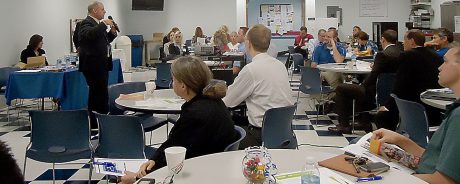
The video images of high school students holding remote controls to battling robots they created drew laughter and delight from the audience of teachers and administrators gathered at Penn Commercial on Friday morning.
But there was a more serious message about the skills these students learn as they compete in annual “BotsIQ” competitions in the region and how they can connect to careers in industry here.
The program, sponsored by state Rep. Brandon Neuman, D-North Strabane, and attended by local officials and two area employers, established the link between the seven-year-old BotsIQ program and the rudiments of science, technology, engineering and math, or STEM courses, and their connection to possible careers in manufacturing and industry.
William Padnos, executive director of the Southwestern Pennsylvania BotsIQ program, which works with high schools and career and technology schools to create competitive teams that build robots from scratch, said the program has grown from six schools and 66 students in 2006 to 47 schools and 600 students this year.
The BotsIQ final round for the 11-county region is held each spring at California University of Pennsylvania. Cal U. offers an associate degree in robotics engineering technology, as well as a bachelor of science degree in mechatronics engineering technology.
A cornerstone of BotsIQ, Padnos said, is that it connects each participating school with a partner manufacturer in their area to help with exposing students to their production processes.
Padnos noted during his presentation to about 30 educators that the Bots program and its delivery of many STEM components also contribute to other skills the participants learn, including technical writing, documentation, drafting and computer-aided design, electronics and safety.
Students also learn purchasing, budgeting and project management, as well as teamwork, troubleshooting and problem-solving.
The manufacturing component of BotsIQ has also grown over the past seven years, Padnos said, moving from six company sponsors in 2006 to 100 companies, post-secondary institutions and workforce development organizations this year.
Padnos was joined by Michael Amrhein of Cal U.’s Office of Integration and Outreach for Technology, Engineering, Art, Math and Science. Both men said the BotsIQ program’s vision is that every student in the region consider manufacturing as a viable career option. The program’s mission is to provide an exciting, hands-on experience through business/education partnerships to build the current and future workforce needed by the manufacturing industry.
That demand was underscored by representatives of two area businesses who spoke Friday.
“We need your help” in convincing students to consider careers in manufacturing and construction, said Alex Paris Jr.
Paris, president of Alex E. Paris Contracting in Atlasburg, has seen his business grow along with the area’s growth as an energy center.
“We’re in a unique position in Southwestern Pennsylvania with this new energy source and manufacturing now coming back to the area,” Paris told the audience.
Paris, who now employs 450 in the tri-state area, said some of his employees earn between $50,000 and $125,000 in skilled labor positions, but he has trouble finding the talent he needs.
“It is so hard to find people, but the biggest issue is the next 10 years. Even if Shell doesn’t build the cracker plant (proposed for Beaver County), there’s going to be a lot of manufacturing here.
“It’s a battle we have to win here,” Paris said. “A lot of people have moved away.”
Paris was preceded by Jim Johnston, North American facility manager for Caterpillar Inc.’s underground mining operations unit, a four-plant unit in Pennsylvania, Viriginia and West Virginia headquartered at Cat’s Houston production plant, which employs 377 in metal fabrication, machining and assembly of mining machinery.
Johnston, who noted that the local plant has partnered with its neighbor, Chartiers-Houston High School, said it needs to do more in promoting the manufacturing culture it has here to local schools.
When McGuffey School District Superintendent Beverly Arbore asked how the district could access manufacturing representatives to work with its teachers, Johnston said, “That falls on us. We have the experts.”
Both Johnston and Paris said they would visit schools or have schools come to their facilities for tours.
Earlier Friday, Washington County Commissioner Diana Irey Vaughan opened the meeting, describing the progress the county has made in attracting businesses of all types, the buildout of office and industrial parks such as Southpointe I & II, Starpointe and Alta Vista, and the impact the arrival of the Marcellus Shale oil and gas extraction has had, which she said now accounts for 40 percent of the county’s growth.
“We have a bright future, but what we really need is to provide a skilled workforce for all of you,” Irey Vaughan said.
“We have a global job market in our backyard,” Neuman added. “Manufacturing is alive and well, and we don’t want our graduates to miss out.”