

‘Life was sad and depressing’
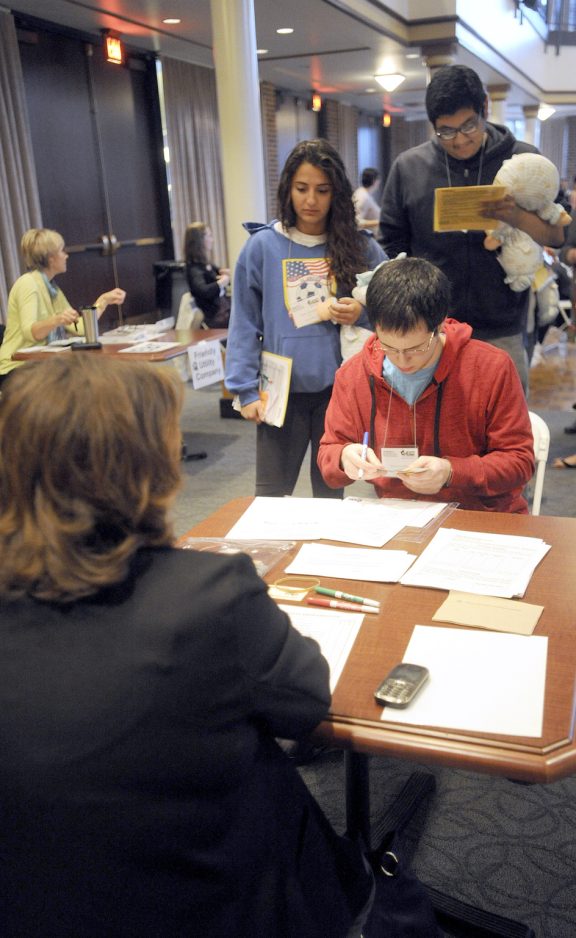
Junior Greg Hrutkay fills out paperwork at the Department of Social Services booth during the poverty simulation. Behind Hrutkay, other students role-play as parents, carrying baby dolls as they wait for their turn to apply.
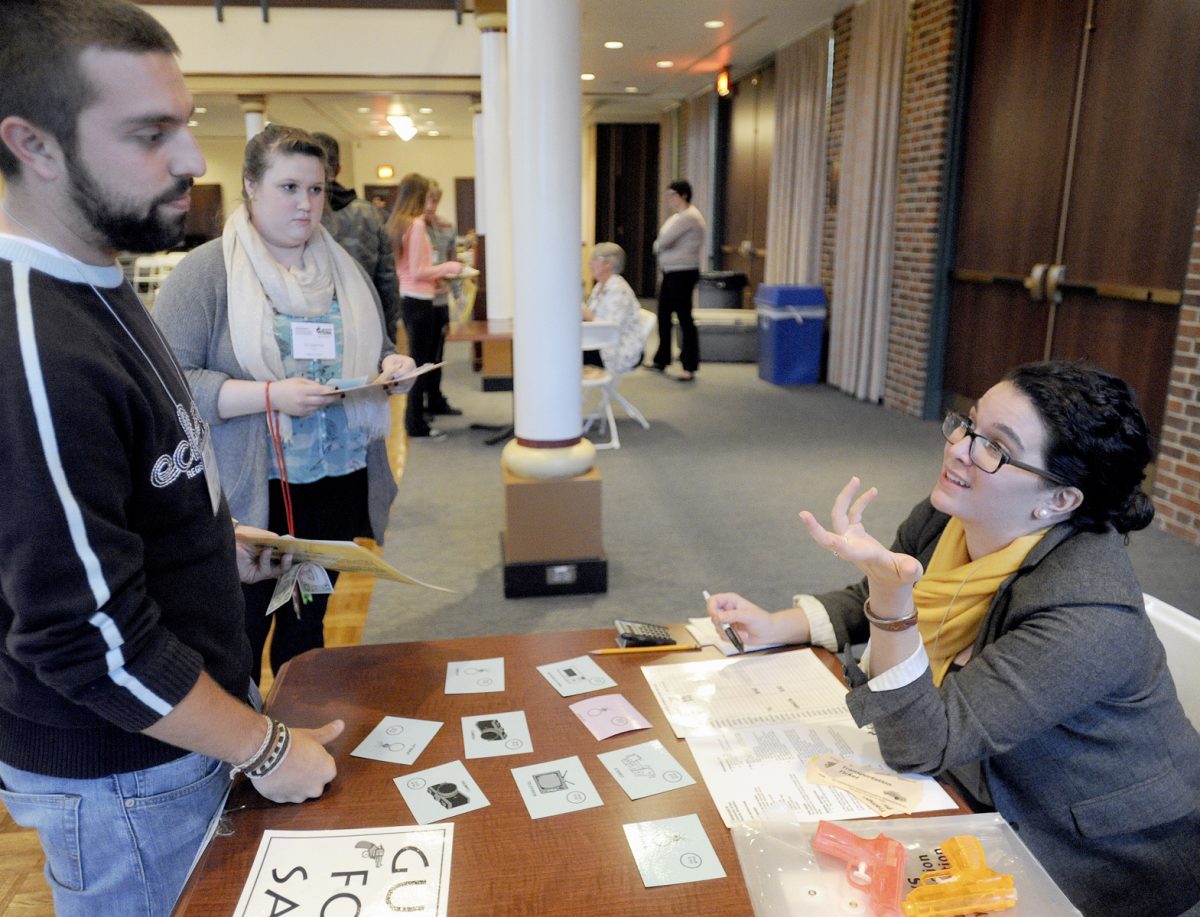
Luis Gargallo, an international student from Washington & Jefferson College, barters with Madeline Innis, a case worker with Community Action Southwest, to get a few dollars for a camera and ring. W&J students spent a simulated four weeks in poverty in 15-minute segments in which they were required to pay bills, go to work, pay for transportation and manage families. The simulation was designed to help show students the struggles families in poverty deal face.
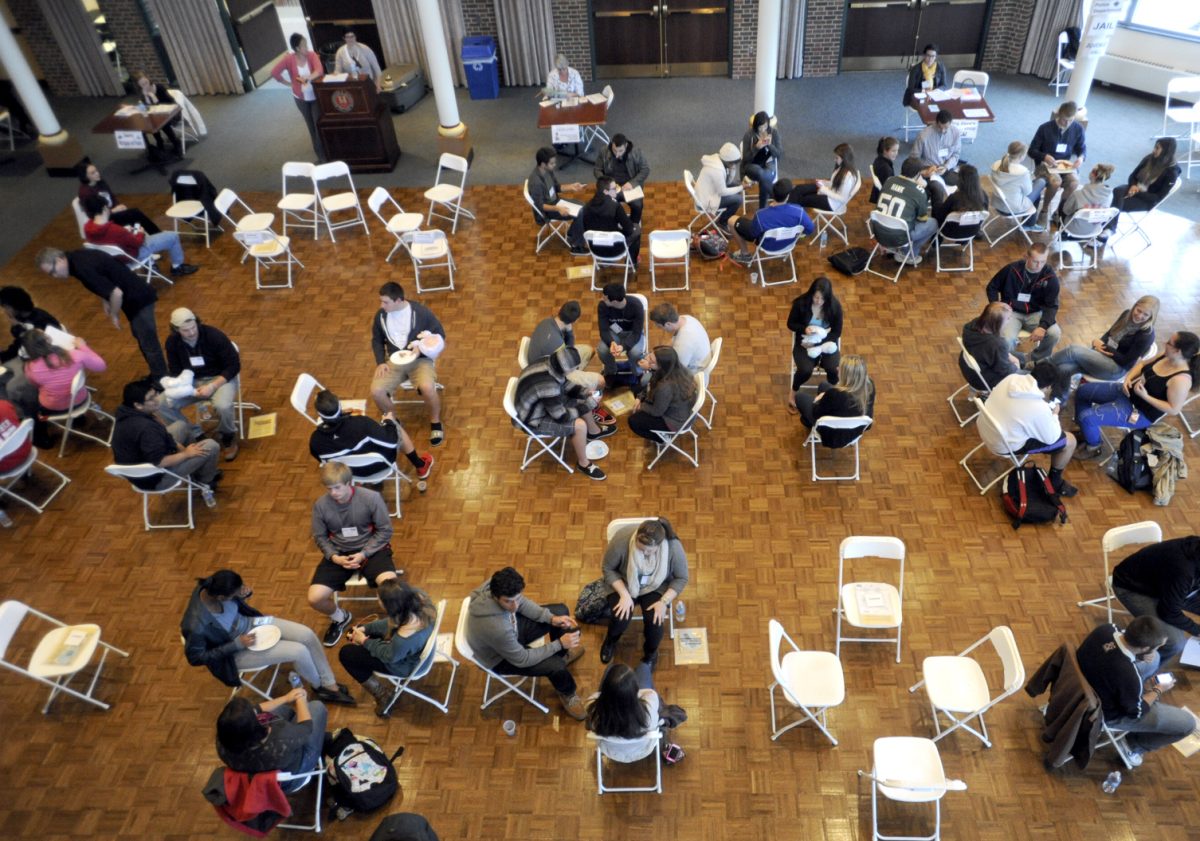
About 60 students attended a poverty simulation at Washington & Jefferson College Tuesday.
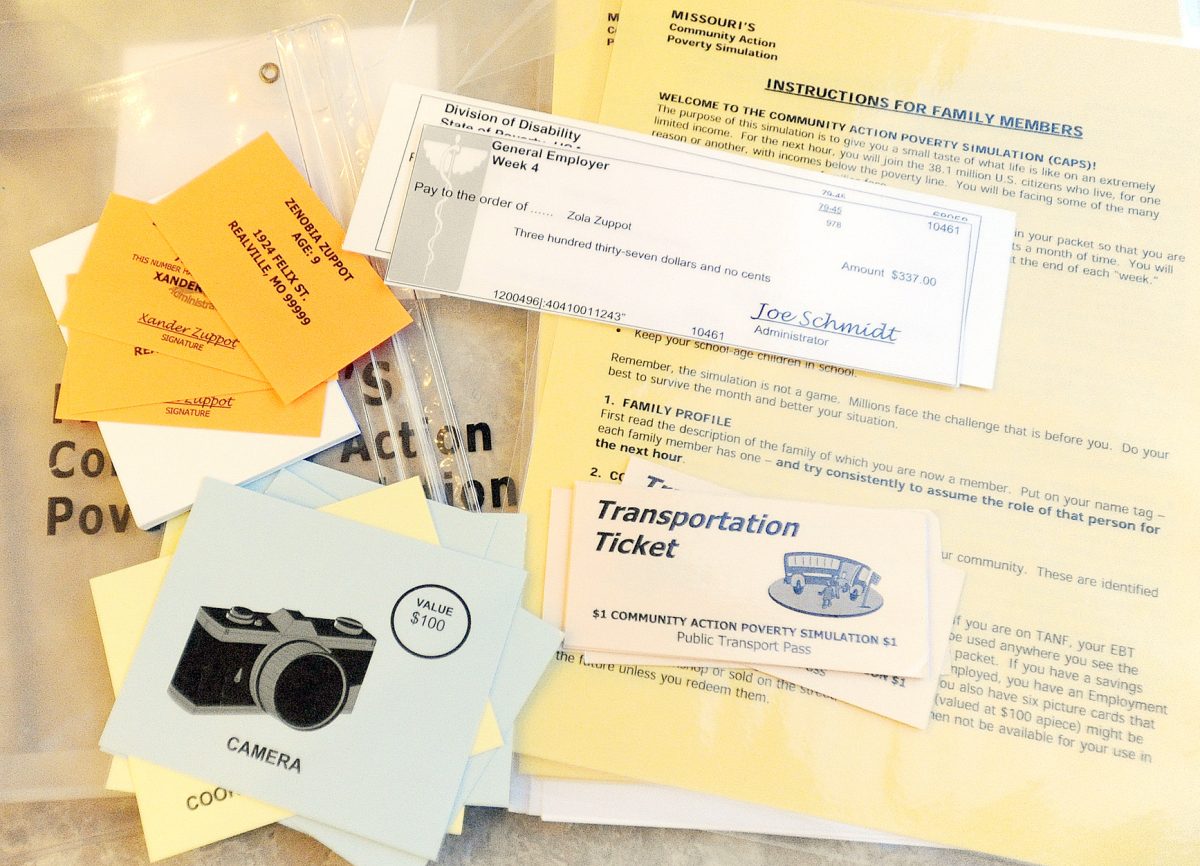
Students taking part in the simulation received packets with instructions, details about family members, transportation tickets, paychecks and items of value that could be sold.
It’s hard to imagine how things could get much worse for “Iris Isaacson.”
The 18-year-old has a child who happens to be both her son and her brother, her boyfriend can’t find a job, they have no means of transportation, they just lost cash and possessions in a burglary and they’re on the cusp of eviction.
She’d better be on the lookout for locusts. A plague of them could be descending at any minute.
Fortunately, “Iris Isaacson” doesn’t really exist, at least not with that set of trials. It’s a role Washington & Jefferson College freshman Brianna Frederick adopted Tuesday night in a poverty simulation in the college’s Rossin Ballroom. Sponsored by the social services organization Community Action Southwest, it drew about 60 students like Frederick who learned, at least for a few hours, what it’s like to travel the same terrain as the woe-beset “Iris Isaacson.”
Of course, munching pizza slices and then participating in a role-playing exercise before returning to the warmth of a dorm room and the reliable routine of class and homework is hardly a replication of the nitty-gritty of poverty. Nonetheless, through the poverty simulation “they can get a better grasp that it isn’t easy,” according to Justin Dandoy, W&J’s director of the volunteer programs. “So many students haven’t experienced poverty.”
Created by the Missouri Association for Community Action, based in Jefferson City, Mo., it has participants taking on the roles of a variety of low-income Americans, from young single parents to seniors having to eke out a living solely on Social Security checks. Each family has to get food and shelter in the course of four, 15-minute “weeks,” while a host of obstacles are thrown in their path, such as a lack of transportation, usurious payday lenders, hard-nosed pawn shop proprietors or school schedules that demand changes in child care regimes.
Sometimes the participants are sidelined into jails or homeless shelters. Once they are evicted from their “homes” – represented at W&J by four encircled chairs, which are overturned – the homeless shelter beckons.
“We wanted it to be a tool for communities to educate about poverty and do further action from it,” said Heidi Lucas, the membership services and project manager with the Missouri Association for Community Action.
Tuesday night’s poverty simulation was the fifth time Community Action Southwest has presented it at W&J. They will be doing one again Nov. 12 for the Washington Hospital School of Nursing at the Church of the Covenant on East Beau Street.
Other staffers and volunteers at Community Action Southwest take on different roles in the simulation. Madeline Innis who, by day, is a caseworker and financial literacy coordinator, took the part of the pawn shop owner and was driving some hard bargains. Participants would approach her with cards representing goods like cameras, jewelry or television sets, usually valued at $100 apiece. Innis would usually offer a much lower price, typically in the $30 or $40 range. “Hey, I need to make a buck, too,” she would inform the crestfallen students. “Take it or leave it.”
“I know how hard it is and I want them to experience the same difficulty people in poverty experience,” Innis said.
And Frederick said she understood just how rough it would be to conquer the set of challenges faced by the Iris Isaacsons of the world.
“Life was sad and depressing,” she said.