

Saving lives for 20 years
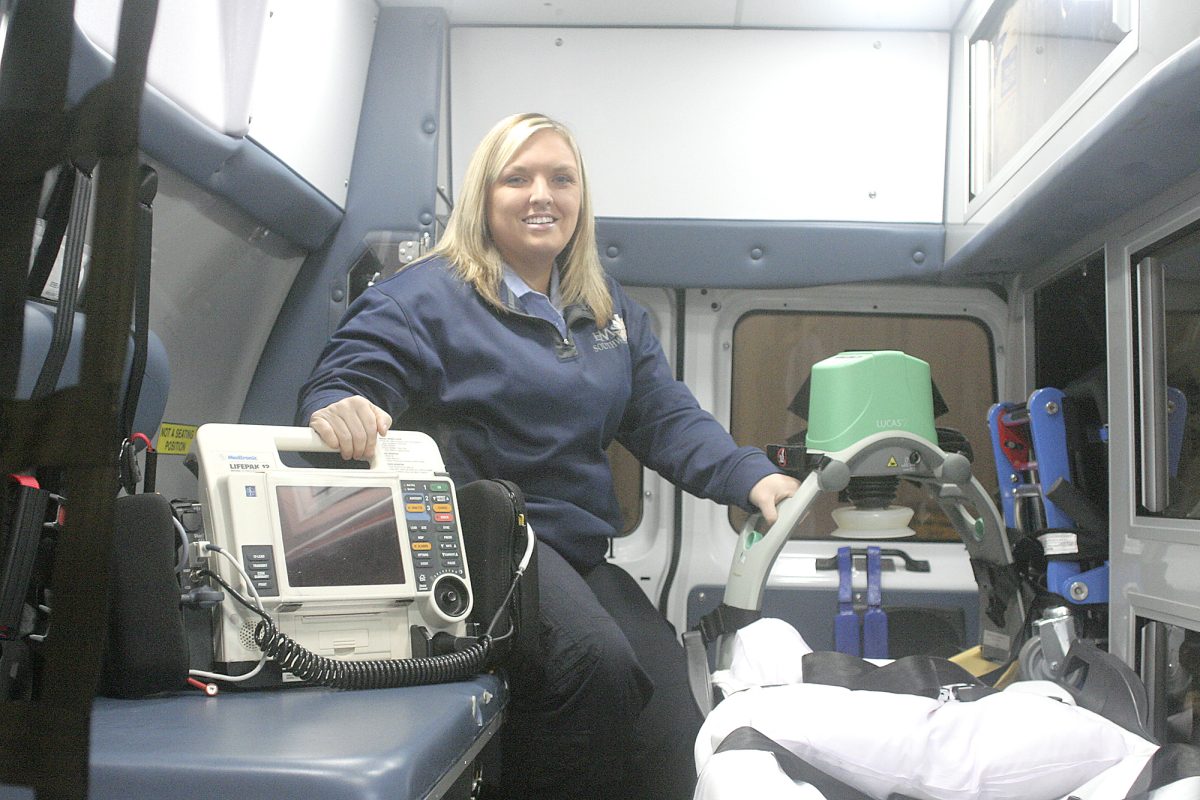
EMT Arielle Workman displays some of the life-saving equipment inside an ambulance at the Carmichaels station of EMS Southwest Inc.
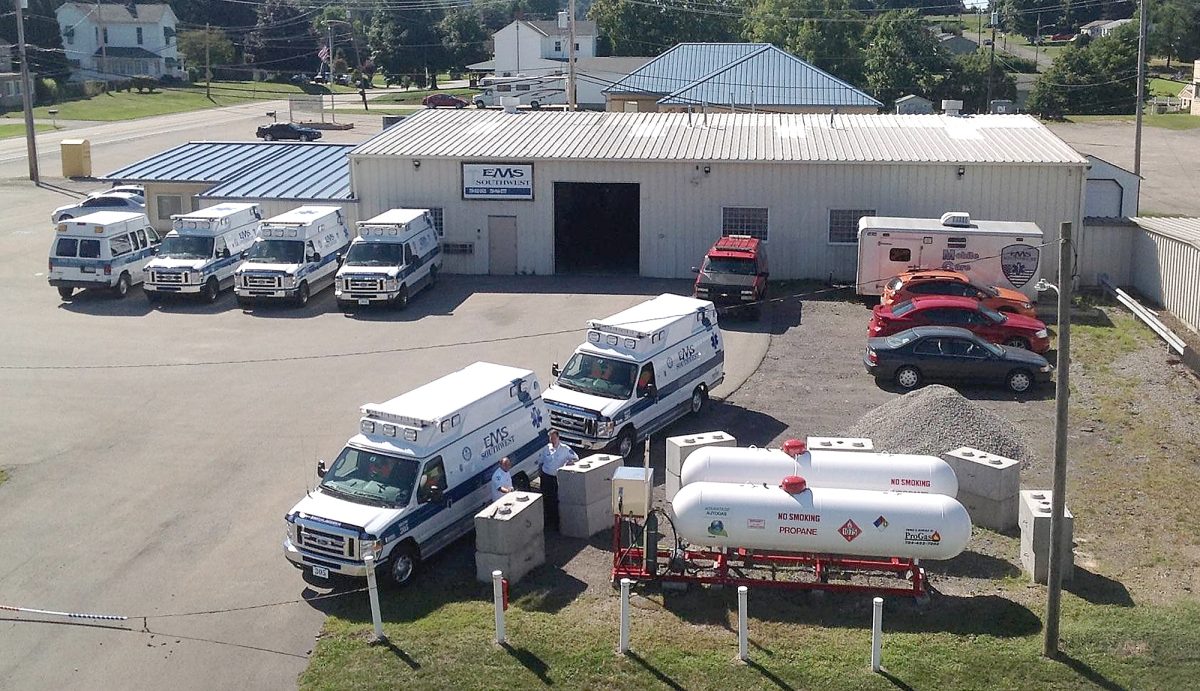
The Waynesburg station of EMS Southwest with its propane fueling tranks in the foreground
WAYNESBURG – It’s been 20 years that EMS Southwest Inc. has been saving hundreds of lives in Greene County.
Looking at its evolution during the last two decades is like comparing the beginning of the Apple computer to its modern-day counterpart. Ever evolving, EMS Southwest Inc. does more than just transport people to medical facilities; it is its own medical facility on wheels.
The company’s EMTs and paramedics are trained in the most up-to-date methods of providing CPR, administering life-saving medications and completing on-the-spot triage. They are versed in what to do, from responding to an accident on the highway to descending to the depths of a coal mine or dealing with medical issues within the intense environment of a state correctional facility.
Rob Bowman, director of operations for EMS Southwest, said there were multiple ambulance companies that came and went in Greene County in the years leading up to EMS Southwest’s founding on Dec. 4, 1994.
“Everybody was trying to make it and nobody could quite get it together. There just wasn’t enough business for more than one paid company to run in Greene County at the same time,” Bowman said. “The reason I think we succeeded is we ran it like a business. If the company is paying for everything and not the customers or insurance companies, there is no money for fuel in the trucks, buying new equipment or paying people. That doesn’t help anybody.”
He credited having an attorney and certified public accountant as owners of the company with creating the business model that has sustained it all these years.
Bowman got into the business at one of the earlier ambulance companies that ran in Greene County. It was only to be a temporary job while he recovered from an injury. He had no insurance, and the owner of the GEMS ambulance service gave him a dispatching position so he could heal and still make money.
“I thought it would be cool to go out on the ambulance. There was a diabetic emergency. When I saw them treat her and she became alert and talking after being unconscious, I thought, ‘I need to be able to do that.’ It really does grab you,” Bowman said.
Jason Beal, assistant director of EMS Southwest, wanted to be an architectural engineer. He is in his 15th year with the company.
Beal and Bowman talked excitedly about the company’s advancements in the years they’ve been with it, including the ability to send a 12-lead electrocardiogram reading directly from the ambulances to a local hospital physician. That capability, coupled with the Lucas II, a device that performs perfect CPR compressions, has more than doubled the company’s lifesaving capabilities.
EMT and paramedic-in-training Arielle Workman said the Lucas II frees crew members to concentrate on other necessary medical care for a patient, instead of only being able to do chest compressions.
Workman, Bowman and Beal shared the moments in the field that left the biggest marks on them personally. There was the crew that saved the lives of contract workers doing electrical work at Hatfield Ferry Power Plant in 2004. The workers were shocked and burned when a crane they were operating came into contact with a 138,000-volt line.
Then there was the Avalon Court apartment complex fire in 2010.
“It happened right at shift change so we were able to take the on- and off-duty crews and send them to the fire. That scene ran very well. It was something that said a lot for EMS,” Beal said. “We had stations on all four corners of the building and communicated with each other by radio.”
The company is believed to be the first to use the LIFEPAK 12 defibrillator/monitor inside a working coal mine, when in 2009 a miner at Cumberland Mine suffered a heart attack. Crew members sent the data from the monitor to physicians and the miner’s condition was accessed before he ever reached the cardiac unit.
Often these highly trained paramedics and EMTs never learn the outcome of a patient’s recovery once they are taken to a hospital. Bowman said they aren’t in it for the pat on the back, but all three said when a former patient comes to them later and says, “Remember me?” or “thank you,” it means the world.
In some sense, those times help to ease the cases where there was little or nothing that could be done when they arrive on a scene.
“The worst one I had was an car accident on the interstate. I was one of the first to arrive and it was one of the toughest calls I’ve had because of the age of the patients,” Workman said. “Another was a baby that was dead on arrival. Anytime it is an unexpected death like that, it’s really hard.
Halfway through paramedic training, with a plan to eventually become a registered nurse, Workman is one of the many employees who have used the company as a career springboard. In fact, her instructor in the paramedic program is a former paramedic turned emergency room physician.
“We are not just ambulance drivers,” Bowman said.
Bowman said companies such as EMS operating in small communities are vital at a time when “volunteerism is dying.” The amount of training that is required and the time it takes to receive certifications makes it nearly impossible for most working people to complete it today, Bowman said. That leaves volunteer services hurting for manpower.
EMS Southwest operates with a force of 64 employees, including 26 paramedics, 25 emergency medical technicians (EMTs), four van drivers, six dispatchers and three office staff.
They cover Greene County’s 500-plus square miles populalted with 40,000 residents, and are on call 24 hours a day, seven days a week helping the remaining volunteer forces to provide emergency care.
The company receives 7,000 calls a year, and as many as 10,000 in some years, Bowman said. Obviously, operating in a four-season area, there are moments when getting there is tough.
Bowman recalled a particular instance when a major snow storm struck the area. EMS driver Eric Burwell was following a PennDOT truck, but it got hung up. Eventually, a farmer arrived with his tractor and the lifesaving equipment was placed in the bucket of the tractor, and that was how they reached the residence.
“It was such an effort by that crew. They never gave up,” Bowman said. “We’re going to get there.”