

PTI students, faculty light up the holidays
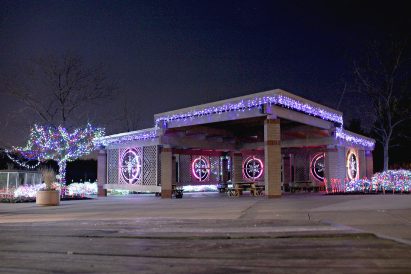
Four years ago, Dave Becker and Jim Mueller needed a new project for students in the School of Energy and Electronics Technology at Pittsburgh Technical Institute, and after watching online videos on light programming, they had an idea: put on a light show.
To sell their idea,Becker and Mueller bought a single controller and decked out a hands-on learning lab area, called a “smart house,” with lights. A song was programmed to go along with the decorations, and their pitch simulated an outdoors house and light program.
“We kind of demonstrated the idea to the staff,” said Becker, the academic chair of the School of Energy and Electronics Technology. “I think this was a really unique way to pitch an idea.”
“(It) was pretty easy to find helpers for that first project,” Becker continued. “(It) actually started with a Halloween show. That was just purely to work the bugs out of the system.”
Now, the light show is put on at Christmastime and lights up the holiday for students and faculty alike. The show also serves the local community, running from 4 p.m. to 11 p.m. daily. Admission is free.
Students attend PTI for only 18 months, so Mueller said they try to recruit students to be a part of the project every quarter.
Doug Newman, a Finleyville native and fifth-quarter student who graduates in July, said he really enjoyed going out every day and working on the project.
“It gave me more of a real-world experience instead of an out-of-a-book experience,” he said.
Newman was part of the audio and video class that worked with other students putting the light show together. The class was able to sit down with Becker as a client and do a needs analysis for the project, a site survey, and material acquisition for it.
When the project is finished, the 2,500-square-foot campus pavilion is transformed into a three-dimensional holiday light show synchronized to 22 holiday songs and more than 10,000 sequenced lights.
“We’ve got all of the bushes covered. Some LED (lights) and rings go on the pavilion outside, and snowflakes and icicles,” Mueller said. “There are four different colors on each bush and tree, so when (we) program the music, there are different effects and lighting.”
The biggest benefit of the programming is that it gives students a lot of troubleshooting skills, Mueller said. The project never works the first time, he said, so students must learn to make it operate.
At one point in the project, an audio hum would not go away and students had to diagnose the problem and come up with a solution.
“It took a week to even figure out,” Newman said.
Seven students volunteered to produce the light show this year, and while a semester-long project, they were often outside for a couple hours each week diagnosing problems and putting it together. When the weather grew worse, they even had to climb ladders and work in the rain and wind.
“I just want someone to come up here and get a Christmas feel,” Newman added. “Everyone needs a little bit of Christmas at some point in time.”