

Horseback riders willing to volunteer at Mingo
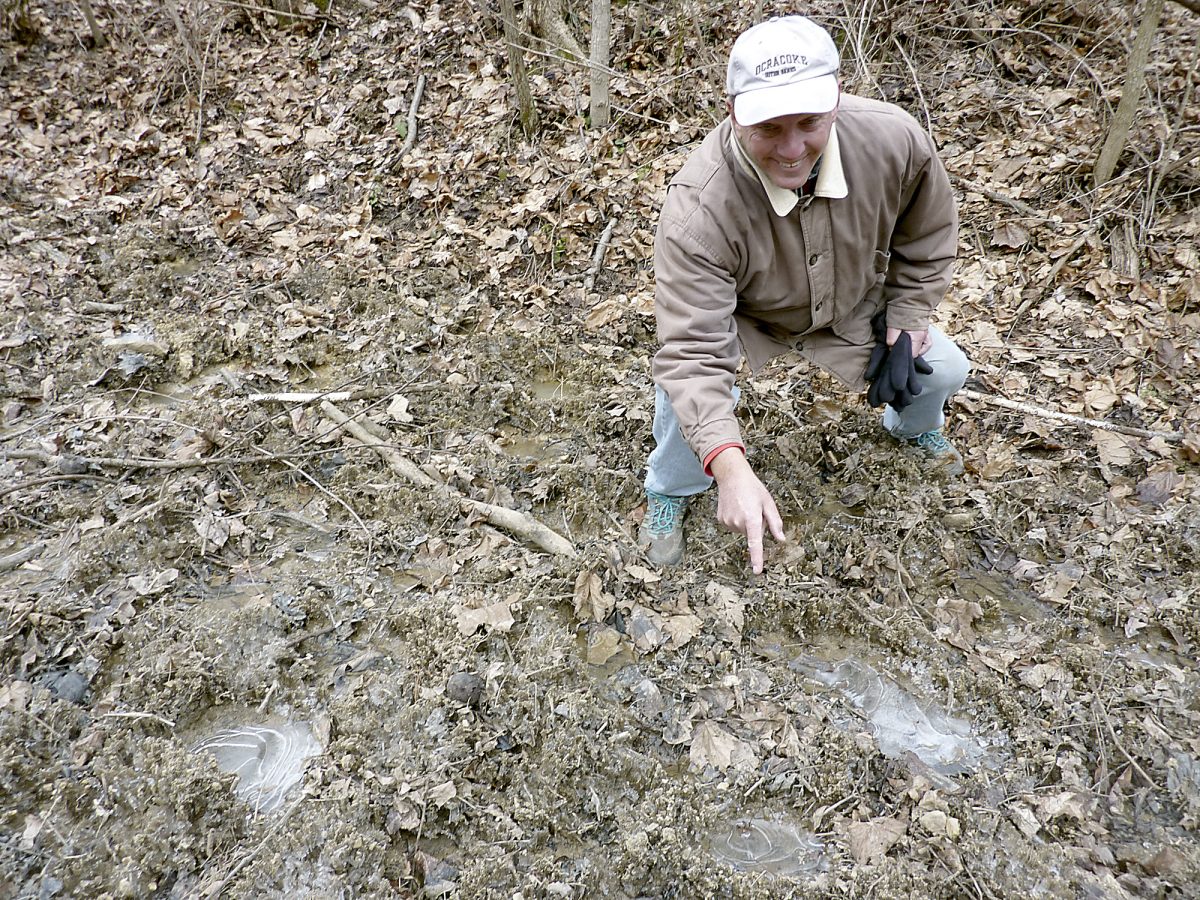
Jim O’Kelly of Nottingham Township, who runs on trails in Mingo Creek County Park, points to hoofprints that have filled with water and frozen.
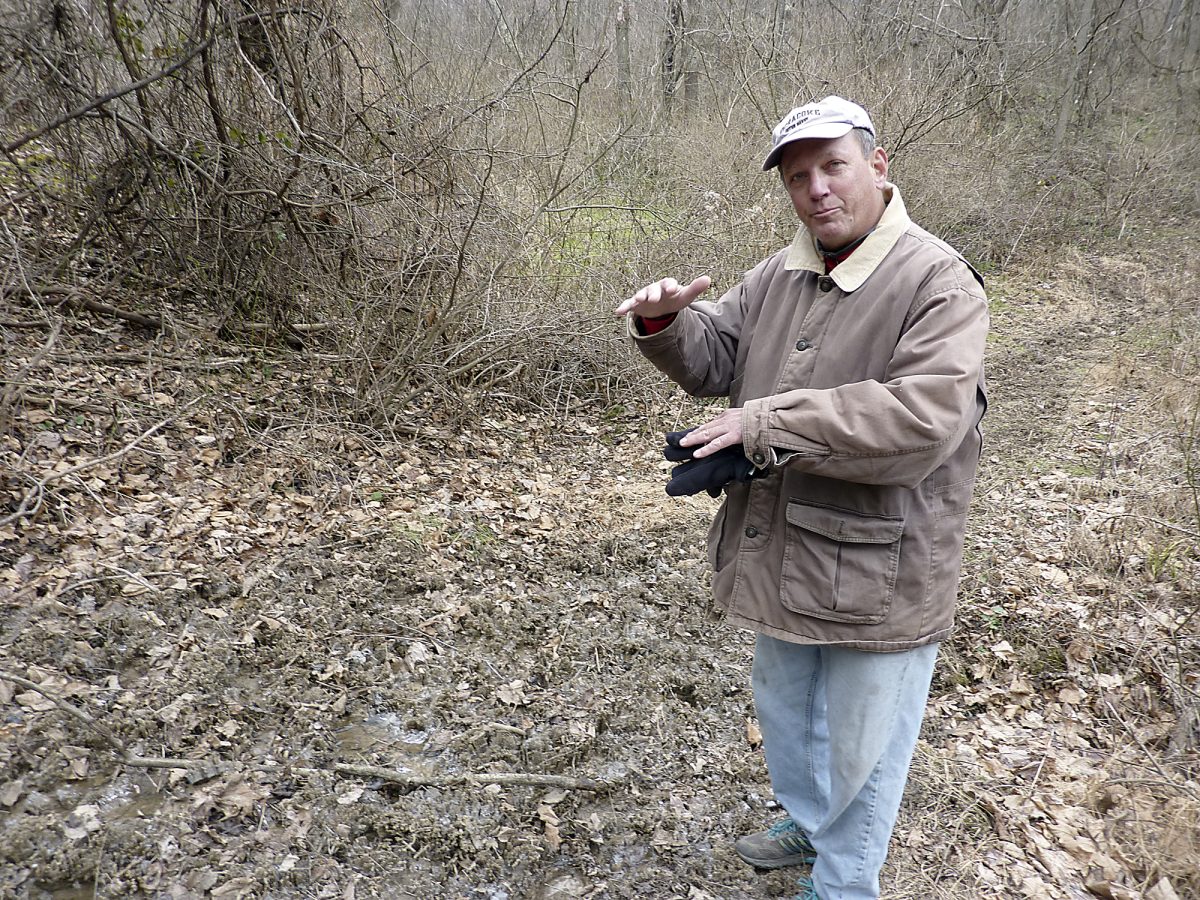
Jim O’Kelly of Nottingham Township, who runs on trails in Mingo Creek County Park, talks about how far a horse can sink into a muddy trail.
Jim O’Kelly runs in ultra-marathons, any race longer than 26.219 miles. He prefers to train at Mingo Creek County Park near his Nottingham Township home, but his workouts are hampered by rutted trails that he shares with other park users: hikers, mountain bikers, horseback riders and deer.
On a recent December day, he straddled a wide, trough-like void, hiking uphill with one foot on each embankment in, to say the least, an odd gait.
“That’s how we run,” he said, leading a treacherous tour. “When we’re heavily into our training, we’ll do one loop and then another loop.”
Shown a photo of a visitor astride the washed-out trail, Lisa Cessna, executive director of Washington County Planning Commission, which oversees county parks, questioned if what used to be a path was actually on park property.
O’Kelly said it was part of the park’s 18-mile perimeter trail, marked with an occasional orange blaze.
With the temperature hovering around freezing, the mixture of muddy clay and ice was eel-like in its slipperiness, making footing precarious.
Need to hold on for dear life as balance gives way? A walker can grab vegetation to keep from falling. Beware of those, too. Thorny bushes have their own way of grabbing, one that draws blood. Don’t want to engage what those from Southwestern Pennsylvania tend to call “jaggers”? Good luck. They have a way of catching hair, hats, mittens, coats and slacks.
Mingo Creek forms a valley, so the terrain of the park, as one leaves the main road along the creek, slopes steeply on each side.
“This was never like this,” O’Kelly said as he descended the slope. “It used to be smooth. It keeps getting worse and worse. The runoff is crazy. Three years ago, it was beautiful. You had three, four times the people in the park. The minute it starts to thaw a bit, it’s horrendous.”
Now, O’Kelly said, the trails are the province of those who travel on horseback because conditions make it nearly impossible for hikers, runners or bicyclists.
“Horses are pretty adept,” he said. ” These stickers have all grown up. Nobody can get past except the horse people.”
The O’Kellys once counted themselves among horseback riders, but the upkeep of $15,000 a year was too expensive as the Great Recession hit, prompting them to give their horses away.
There used to be five to seven places in the park, O’Kelly said, that were impassable or nearly impassable. The dangerous areas are growing, he said.
A shod hoof print left an 18-inch-long track that appeared to be part of a slide.
“At some point, somebody’s going to get hurt.”
A horse and rider weigh so much more than a pedestrian or bicyclist that the horse will sink more deeply when a trail is saturated.
A standardbred horse, for example, weighs between 800 and 1,000 pounds.
These areas were still open. On the recent visit, O’Kelly stayed away from the part of the trail near Sugar Run Road that was closed since summer.
Even the equestrians are worried Mingo park will no longer be open to them. That was a rumor that drew several members of the Mountain Valley Trail Riders to a county commissioners meeting Dec. 4.
The rumors weren’t true, but Cessna said the trails will be closed when conditions deteriorate. Those who travel the park by hoof must register for a permit, and she said equestrians would be notified by postings, via email and through the county website. Cessna said the closure took place over the summer.
A segment of the 18-mile perimeter trail was in such bad shape the county is installing culverts and adding drainage to the area that remains off-limits. Cessna did not have an estimate on what the repairs will cost.
The Mountain Valley Trail Riders, through spokeswoman Elaine Clemens Mowl, want to volunteer for work details in Mingo park so that trail users don’t have to slog through a morass.
Mowl said last week she is still waiting to hear from Cessna or the commissioners “concerning to what point we can volunteer and do work to maintain and help control the problems that are happening. We’re very concerned, and we’re willing to put in volunteer hours.”
She’s been in touch with representatives of the Pennsylvania Equine Council, which will likely send a speaker to a club meeting this spring to discuss trail stewardship and how to correct eroding trails.
The equine council’s website warns, “Your trails could be in jeopardy of being closed and you may not even know about it. State and national budget cuts are affecting maintenance and repair of the existing trails and thus many trails with environmental issues are being closed or may be in the near future.
“Everyone can become part of the solution to our vanishing open space. Sometimes all we need to do is ride smarter.”
O’Kelly opined that if someone takes the time to drive a horse in a trailer to Mingo park, the person is likely to ride regardless of conditions.
“The trail riders need to know before they get their supplies and horses ready, load up their trailers and drive to the park whether the trail conditions are conducive for a fun and safe ride,” he said, noting he’s seen the most damage to trails occur during winter months.
In neighboring Allegheny County, South Park has a stable on Corrigan Drive, so it serves equestrians who board their horses in and around the park and, as in Mingo park, also those who drive their equines onto the premises in trailers.
South Park has 17 miles of trails open to walkers, runners, horses and cyclists, and it has had success with an organized group of volunteers.
The Pittsburgh Trails Advocacy Group has “helped us with thousands of hours” as volunteers, said Andy Baechle, who, until 2001, was Washington County’s director of parks and recreation. “They’ll work on trails in state parks, city parks and county parks, wheel stone and lumber a half mile into the woods and smile about it.”
The volunteers are not permitted to operate heavy equipment or power tools, and one reason is legal liability should a mishap occur.
“We work in about a dozen different city, state and county parks to improve the trails,” said Jamie Pfaeffle of PTAG. “Management approves any work that we do. We build trails and we maintain them, and return rogue trails to forest. Give people good trails and they don’t have to make their own.”
Asked how a park can control the public, Pfaeffle said, “You can’t. You make trails that drain and don’t hold water.”
The PTAG website refers mostly to mountain bikers, but not equestrians. Asked about this, Pfaeffle replied, “Despite our efforts to include them, they have failed to come to the table.”