

Circuit riders topic at meeting
WAYNESBURG – When we think of circuit riders, we seldom think of Methodists, but in 1740 John and Charles Wesley created circuits or charges by assigning traveling preachers or ministers for one to two years at a time.
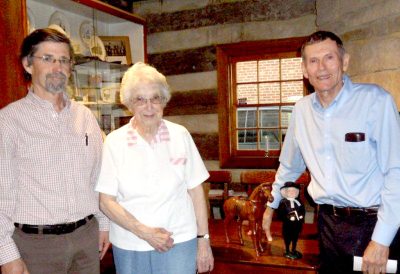
“Most people think of circuit riders as being the Clint Eastwood-type, dressed in black like Johnny Cash, with a Bible in one hand and a six shooter in the other, myself included,” said William Miller of Fordyce, who addressed the May meeting of the Cornerstone Genealogical Society.
In the very early days, settlers suffered many hardships, but it was just as difficult for the circuit riders. Robert Ayers, a Methodist circuit rider from this area, kept a diary, and July 16, 1786, he wrote, “an attentive congregation.”
“Preached and received one; preached to a few; preached to a small number; preached to a small congregation” are just a few of his entries in his diary.
In 1840, information came from a circuit rider’s wife of the Harrisville, W.Va., circuit. This was a six-week circuit; he covered 500 miles on horseback and preached every day of the week except Wednesday, a day of rest, and three times Sunday. He usually led class after preaching.
The preaching was all done in private homes or likely, in cabins that consisted of one room with a loft that was reached by ladder. This one room served as a preaching place, living room, cooking and sleeping area and quite often there was a place in the chimney corner for the pig, with a hole in the wall for pig to go in and out as he pleased.
A priest by the name of Father Patrick Lonergan purchased five lots in Waynesburg for $217 in November 1799, with his own money. Lot 136 is where the present day Catholic Church sits. Lonergan said Mass, distributed sacraments, went to private homes to instruct the widely scattered Catholic community. Despite his zealous work, Father Lonergan was not able to establish a Catholic Church and left Greene County in 1801 discouraged and ill. He willed the lots to the Bishops of Philadelphia for the erection of a church and priests’ residence.
In 1681, William Penn was granted the land grant of Pennsylvania. In 1701, “the Charter of Privileges” was issued by Penn, giving religious freedom to the Colony of Pennsylvania. Pennsylvania had the most diverse religion of any of the colonies. There were Quakers, French Huguenots, Scotch Irish, Presbyterians, Irish Catholics, Jews, Methodist and later on, Baptists.
Some of the early circuit riders in this area were Robert Wooster, Richard Owens, Robert Ayers, Matthias Eaton and John Corbly.
It is written that Corbly, ordained in 1775, trekked through the dense countryside providing a valuable service to the Monongahela valley settlers with his presence and fiery oratory. He would appoint an assistant to go out and protect the settlers from the Indians during the service. He is credited with establishing 30 Baptist churches west of the Appalachians.
Bishop Francis Asbury, a former Methodist circuit rider in the late 1700s, spoke at the dedication of Mapletown Methodist Church Aug. 17, 1803.
On June 10, a covered-dish picnic will be held at 6 p.m. at the Greene County Historical Society barn on Rolling Meadows Road. The Oliver Stockdale band will perform and there will be a whistling contest.
For more information, call Cornerstone Genealogical Society at 724-627-5653.