

Women in politics then and now
Ask a random person on the street to name the first female vice presidential candidate from a major party in the United States, and the answer might be, “Sarah Palin.”
The former governor of Alaska, reality TV show star and conservative pundit who ran with Republican nominee John McCain was the most recent female vice presidential choice – in 2008 – but another woman was making headlines 30 years ago.
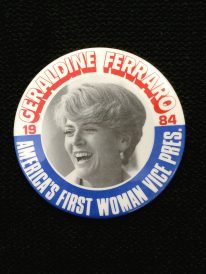
Geraldine Ferraro, a member of Congress, was Walter Mondale’s pick for the No. 2 spot on the Democratic ballot to square off against incumbent Republican President Ronald Reagan and Vice President George H.W. Bush. She and Mondale lost in a landslide.
Ferraro was not the first American female vice presidential candidate. That was Marietta Stow, who in 1884 was the vice presidential candidate on the National Equal Rights Party ticket topped by fellow suffragist Belva Ann Lockwood, who previously headed a similarly named party with Frederick Douglass as her running mate.
Voting by women throughout the United States has been taking place for less than a century. Women did not gain the right to vote until the 19th Amendment to the Constitution was ratified in 1920. Its brief text reads, “The right of citizens of the United States to vote shall not be denied or abridged by the United States or by any State on account of sex,” and notes Congress would have the power to enforce the article with appropriate legislation.
State Rep. Pam Snyder was a Greene County commissioner in 2004 when she met Ferraro, who attended the Greene County Democratic dinner to speak on behalf of John Kerry, who was running for president against incumbent George W. Bush.
“It was so nice to get to meet her and talk to her as the first female Democrat for vice president ever,” said Snyder, D-Morgan Township.
“There’s no question in 1984 that was an extremely bold move. Women really weren’t stepping into the limelight like that. I really admire Walter Mondale for his pick.”
Ferraro, a three-term member of Congress, died in 2011 at age 75.
After a stint as a sheriff’s office deputy, Snyder worked for eight years for the late U.S. Rep. Frank Mascara, whom she called her mentor, as deputy district director, mostly in Charleroi, before becoming the second woman elected as a Greene County commissioner. (The first, in the 1990s, was Pauline Crumrine.)
Snyder became part of Greene County history when she was part of a majority female board. Judy Gardner was appointed by the court after the death of her husband, John, in the spring of 2007. Her appointment to the board marked the first time in Greene County that the three-member board of commissioners includes two women, or as Judy Gardner described herself and Snyder, “alpha females,” telling Commissioner Dave Coder, “You’re in the minority now.”
Snyder made local history in her own right as the first woman presenting Washington or Greene counties in the Pennsylvania House of Representatives. A Democrat, she is running unopposed for a second, two-year term. The 50th Legislative District includes all of Greene County and East Bethlehem and Centerville Borough in Washington Counties.
A local politico referred to her as “Mrs. Greene County.”
Both sets of her grandparents emigrated to the United States from Italy and Yugoslavia, and she choked up wishing her parents could have seen her take the oath of office in the state House.
“They had pride in what it is to be an American,” Snyder said. “I can’t remember them not voting.”
The citizens of Washington County elected women to public office before and after 1984, most notably row officers and mayor of Washington. But it wasn’t until 1995 that the county had its first female commissioner, Diana Irey, now Diana Irey Vaughan.
In 1984, she was moving to Pennsylvania, but she remembers watching Mondale debate with Reagan and Ferraro square off with George H.W. Bush.
“Isn’t it amazing that it took so long for another woman to run for vice president?” Irey Vaughan said. “She was the first woman to blaze that trail for all of us.”
When Irey Vaughan, a Republican who had married into a politically connected family, ran for commissioner in 1995, a reporter chose to include her weight – 90-some pounds – and her height in his story. “Not to bash the Observer-Reporter, but my election night photograph on the front page was a picture of my backside standing on this little box behind a podium. Several days later, in a letter to the editor, three women I did not know wrote that they were disappointed not to see the backsides of Joe Ford and Bracken Burns,” who were elected commissioners the same night.
Among one of the commission’s first acts was to promote Marlene Luketich from acting director of planning to a full directorship. Luketich later became the county’s director of administration.
When Irey Vaughan was first elected, her children were 2, 5 and 6. When she was re-elected in 1999, she became only the second woman to be re-elected commissioner in the region. Barbara Hafer in Allegheny County was the first. Burns, while a county commissioner, ran as a delegate to the 2008 Democratic National Convention, committed to Hillary Clinton. He said recently he might try that again should she announce a presidential candidacy.
Irey Vaughan ran unsuccessfully for Congress in 2006 against incumbent John Murtha and for state treasurer in 2012, losing to incumbent Rob McCord. She said in the most recent campaign, an interviewer asked her how, if elected, she’d juggle job responsibilities of running statewide and those at home while her husband was serving in the U.S. Army. With her youngest child a college student majoring in political science, she said she didn’t regard that as an issue.
Irey Vaughan pointed out that Washington County has nearly achieved gender parity among its seven row officers, and that the six-member county court is evenly split between male and female jurists.
“So many women step out of the workforce for a period of time,” she said of why more women don’t hold political office. “I look for one or both of my daughters to run for office.”
Gender optional
When registering to vote, checking a box for gender is optional in Pennsylvania, as is identifying one’s race. Only 37.3 percent of those registered in Washington County chose to do so: 26,770 women and 25,453 men of the 139,837 voter total.
In Greene County, where a total of 22,032 voters are registered, 5,135 females and 4,946 males, or 45.7 percent, identified themselves as such.
Women are running in several contests on area ballots on Tuesday.
They are Alanna Hartzok, Democrat, of Franklin County, who is challenging U.S. Rep. Bill Shuster, Republican, of Blair County, in the 9th Congressional District; Camera Bartolotta, Republican, of Carroll Township, who is challenging state Sen. Tim Solobay, Democrat, of Canonsburg, in the 46th Senatorial District; Lisa Stout-Bashioum, Democrat, of Somerset Township, who is challenging state Rep. Rick Saccone, Republican, of Elizabeth Township, in the 39th Legislative District; and Sonia Stopperich, Republican, who is challenging state Rep. Brandon Neuman, Democrat, in the 48th Legislative District. Both are North Strabane Township residents.
Also on the ballot is the Pennsylvania gubernatorial contest, in which Tom Wolf of Mt. Wolf, York County, and Mike Stack of Philadelphia, Democrats, are challenging, respectively, Gov. Tom Corbett of Shaler Township, Allegheny County, and Lt. Gov. Jim Cawley of Middletown Township, Bucks County, Republicans. The pair of candidates from the same party run as a slate. Paul Cain, Democrat, of Center Township, Beaver County, is challenging State Rep. Jim Christiana, Republican, of Beaver, Beaver County, in the 15th Legislative District; Jason Ortitay, Republican, of South Fayette, is challenging state Rep. Jesse White, Democrat, of Cecil Township, in the 46th Legislative District; and Bud Cook, Republican, of West Pike Run Township, is challenging state Rep. Peter J. Daley, Democrat, of California Borough, in the 49th Legislative District.
Polls are open from 7 a.m. to 8 p.m. Tuesday.
In the 2015 local election, voters will see a long ballot when seats for municipal and county government and school boards are up. Will we see a woman or two or three running for president in 2016? It seems likely. Will one be nominated by a major party? Maybe. Will she be elected? Only time will tell.