

South Fayette police officers trained on Project Lifesaver
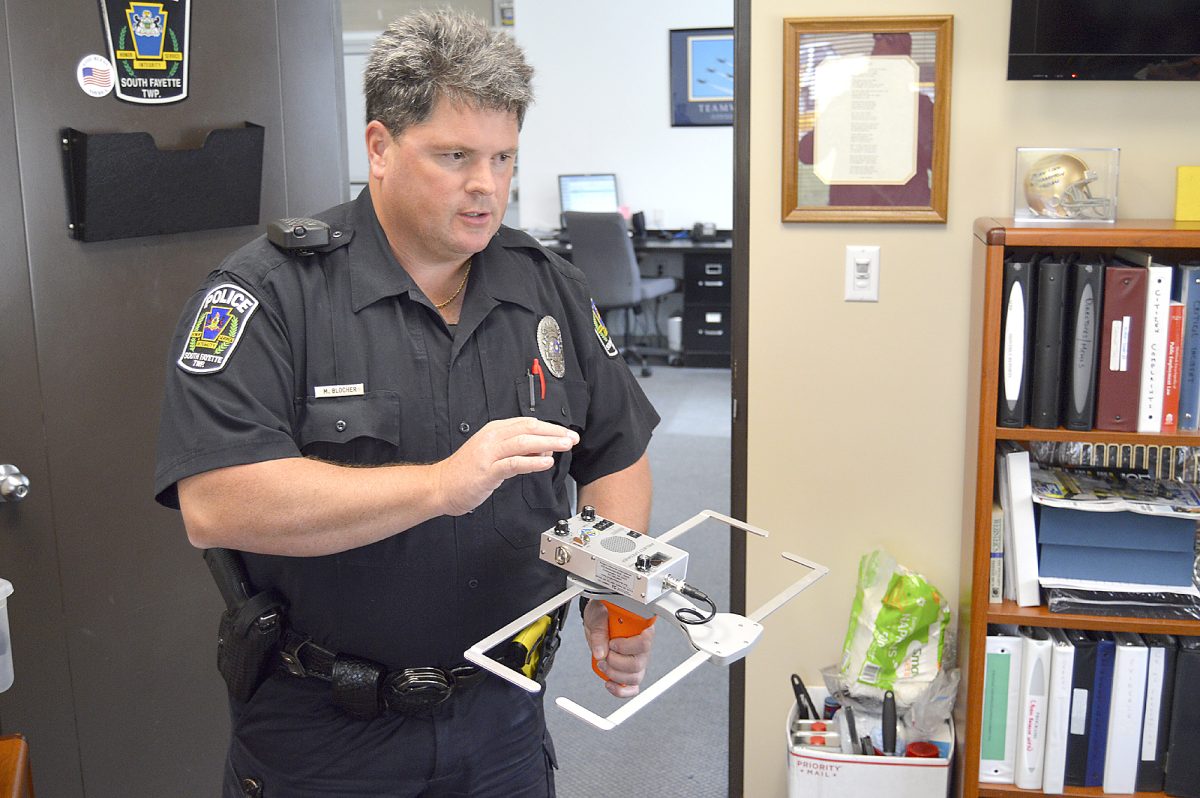
Officer Mike Blocher demonstrates the Project Lifesaver transmitter, which can track a missing person for up to 1 ½ miles.
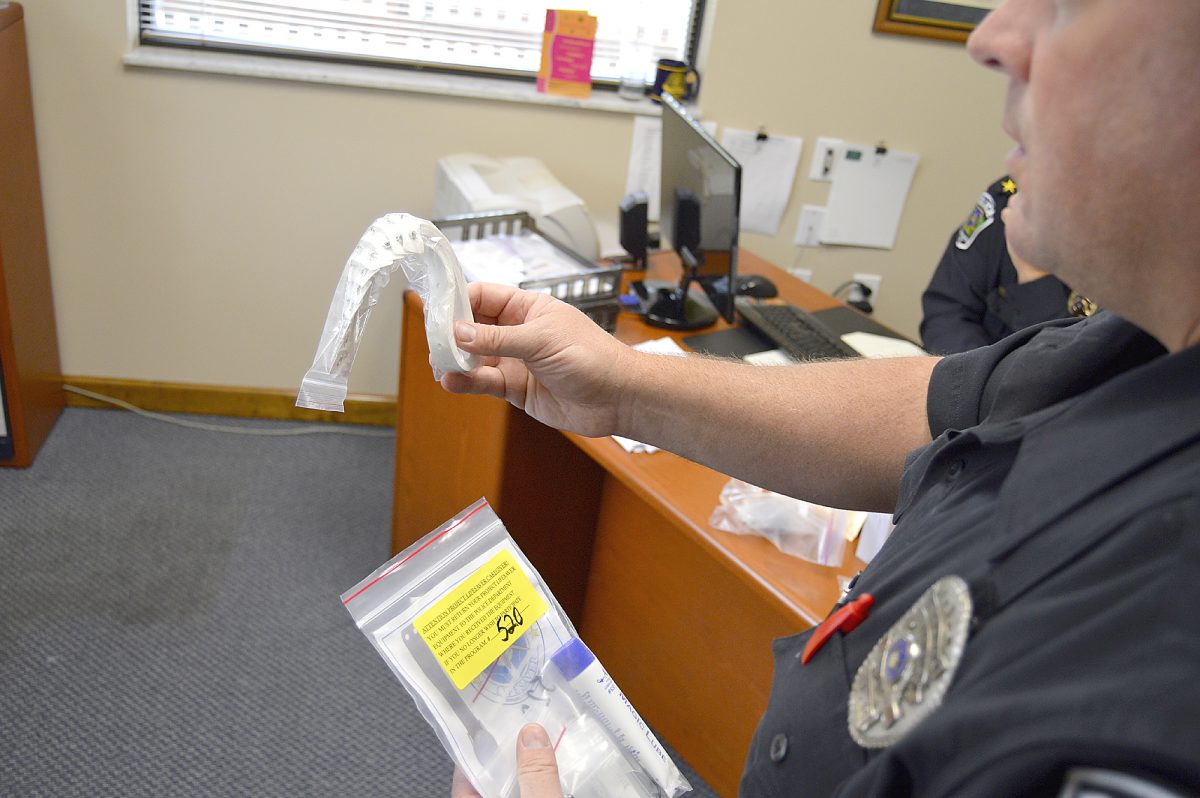
Officer Blocher holds the bracelets, which are given to those likely to wander off and can be tracked for more than a mile.
One of the worst fears of caregivers is that their loved one – an adult or a child – will wander away.
In the next few weeks, Project Lifesaver will be implemented through the Allegheny County district attorney’s office to help track, through a radio signal emitted by a bracelet, an individual who goes missing.
Recently, two officers in the South Fayette Police Department earned certification to operate the system and are ready to respond when a person with a cognitive disorder goes missing.
Officers Mike Blocher and Bryan Monyak spent two days in mid-September in training sessions. There are about 40 certified responders in Allegheny County affiliated with 16 police departments. South Fayette police were selected to participate because of its location in southern Allegheny County, said police Chief John Phoennik.
Tom Swan, deputy district attorney in Allegheny County, said the project is funded completely through drug forfeiture money. The service is free to at-risk individuals and their families. Currently, about 40 people are registered with about half of those being elderly and the other half having some type of cognitive disorder, Swan said.
The response has been so great, Swan said he had to order additional bracelets.
Blocher and Monyak will be on call around the clock.
The concept is relatively simple – a person is fitted with a thin white bracelet, usually worn on the dominant wrist to make removing it more difficult, Blocher said. The bracelet holds a small battery-operated transmitter that is set to a distinctive radio frequency. If the person wanders away, the caregiver notifies the district attorney’s office and the emergency responders are notified.
“If they wander, we put their (radio frequency) in the receiver, and we hear a chirp,” Blocher said as he demonstrated the receiver in Phoennik’s office. “The louder (the chirp) is, the closer they are.”
The receiver’s range is up to a 1 ½ miles.
“If they wander, we go to the last location where they were seen and we do a 360 (degree turn) until we hear a chirp,” Blocher said.
Once a chirp is received, the responders follow an almost grid-like pattern until the chirp is louder.
“When we get closer, we like to have the caregiver near as well,” Blocher said.
Phoennik, who has a 53-year-old sister with special needs and knows the importance of providing every level of protection and security, said when he was approached by Swan he jumped at the chance to help.
According to Project Lifesaver’s website, the nonprofit organization was founded in 1998. Its motto is “Bringing Loved Ones Home” and offers added protection to those with autism, Down syndrome, Alzheimer’s disease, dementia or other cognitive disorders.
For more information, caregivers or guardians may call Swan at 412-350-4401. If the person is eligible, the name will be placed on a waiting list until additional bracelets are received.