

ShaleNet forum focuses on educating new workforce
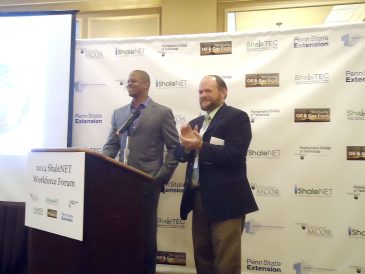
MEADOW LANDS – For the past several years, the annual ShaleNet Forum has worked to keep emerging trends in the natural gas industry in front of educators, the public and the local business community.
This year’s forum, held Wednesday and Thursday at the DoubleTree on Racetrack Road, explored how work in the Marcellus and Utica shales is impacting the workforce and how the region’s education professionals can help students prepare for the industry’s needs, which are increasingly formidable.
This year’s event, titled “Tools for the Future,” focused on current workforce development needs required to tap the vast potential of shale exploration, production and use. Speakers both days addressed the importance of including science, technology, engineering and math at all levels of education and workforce preparedness.
Designed to assist high schools, career and technical centers, community colleges, universities and government agencies in building a strong local natural gas workforce, the two-day conference drew about 100 people.
Wednesday’s keynote speaker, Marc Payne, business development and planning manager for Chevron’s Appalachian/Michigan strategic business unit, began the forum by describing the sheer magnitude of the Marcellus as a game-changing producer of natural gas.
He noted that with more than 489 trillion cubic feet of recoverable reserves, the strata is the second largest gas field in the world.
While describing Chevron, the second-largest energy company in the United States, as a relative newcomer to the Marcellus, Payne, a mechanical engineer who has held a variety of positions for Chevron in gas development around the world, said the Appalachian Basin’s workforce needs will be formidable.
“We’re a start-up player here today,” he said, adding that the company has 1 million acres in the Marcellus and Utica shales with 700 employees.
It produces about 500 million cubic feet per day, but its own workforce needs mirror those of other exploration and production companies now working here: designers, lawyers, construction crews, drilling and completion specialists, environmentalists and remediation specialists.
He cited U.S. Energy Information Administration projections that the natural gas industry will generate 387,000 jobs by 2035.
And many of the jobs Chevron and its competitors will fill in the future – from entry level through top management – will require people with a background in science, technology, engineering and math.
“STEM is critical,” he said, noting that 15 to 20 of the top careers will require competency in those core areas.
The regional demand for workforce readiness was further underscored by Sean O’Toole, a human resources manager for oil and gas completion specialist Baker Hughes Corp., which employs 3,000 in its “Central Geo Market.” That region includes operations in Pennsylvania, Ohio and West Virginia.
While stating that the company often hires people with little or no experience for its entry-evel positions, O’Toole outlined a process for advancing employees to higher levels of work and responsibility.
“We look for someone with a foundation of skills, someone who can make a career in Baker Hughes,” he said.
O’Toole also said he wanted to correct a common perception that people who may start work on an oil and gas rig spend their entire careers there, noting that people with field experience are valuable resources in an office setting.
He added that the company also seeks people for non-field positions such as financial analysts, accountants and in logistics.
He said Baker Hughes makes its offices available for job shadowing by high school students.
Wednesday’s session also included a presentation by Dr. Hilary Olson from the University of Texas at Austin, who discussed creative ways of teaching hands-on STEM-related projects that she created with her husband. She said they can be scaled for teaching students from middle school through graduate school.
According to Olson, hands-on project criteria should include learning by doing, engaging students with in-depth investigations of objects, materials or phenomena; ensuring that the process or project is completed; and helping students to explain results.
“We want to train people to think critically,” she said.
The workforce development theme carried over into Thursday’s sessions, which included an informative and enlightening presentation on mechatronics and a panel discussion on filling the need for skilled workers.
Mike Amrhein held court on mechatronics, a design process that incorporates five forms of engineering: mechanical, electrical, telecommunication, control and computer.
Amrhein wears many hats at California University of Pennsylvania. In addition to being an assistant professor, he is director of the Office of Outreach and Integration for T.E.A.M.S. – all STEM disciplines plus Arts – and director and outreach coordinator of the National Center for Robotics Engineering and Technology Education. He helped launch the robotics program there years ago, funded through a hefty Department of Defense contract.
“Why mechatronics? It’s because of the demand for workers, and people are seeing the sense in (mechatronics),” said Amrhein, whose university a year ago instituted a bachelor’s program in mechatronics engineering technology.
He said a mechatronics graduate can parlay that degree into a number of careers including the energy sector, defense systems, aerospace, medical, automotive, manufacturing and consumer products.
“Mechatronics,” Amrhein said, “is found in some aspect of nearly every modern field.”
The recently unveiled Appalachia Partnership Initiative, fueled by a $20 million contribution from Chevron Corp., was a topic of the panel discussion that focused on undersupplied workforces. Chevron contributed $20 million to the project, while partnering with the Allegheny Conference on Community Development, the Benedum Foundation and Rand Corp.
Dennis McCarthy, director of Western Area Career & Technology Center, was literally in the middle of the three-man panel. He was flanked by Trip Oliver, manager of policy, government and public affairs for Chevron, and Jim Denova, Benedum vice president.
McCarthy’s school, on Route 519 in Chartiers Township, strives to prepare students for the jobs that abound in the oil and gas and support industries and manufacturing.
“Some students are making decent money now in jobs they may not have gotten if they had left our program,” he said.
In January, WACTC will initiate a two-year diploma programs in mechatronics, machining and welding – which were funded by $445,000 in grants from the Benedum Foundation.
Denova, whose foundation primarily targets rural areas for funding, is keenly aware of workforce demand and the need for training.
“This is the era of technical education,” he said. “One challenge of a technical education is closing the skills gap. Now is the time.”