

Threat of nuclear weapons still present, historian says
This August will mark the 70th anniversary of freshly built atomic bombs being dropped on Hiroshima and Nagaski in Japan, bringing the curtain down in decisive fashion on World War II, but launching an era of duck-and-cover drills and anxiety that the next mushroom cloud was just over the horizon.
Although the threat of nuclear annihilation no longer looms as large as it did during the Cold War, with the perils posed by viruses and climate change having largely replaced it in the public imagination, it has not evaporated completely, a Pulitzer Prize-winning historian said at Washington & Jefferson College Thursday night.
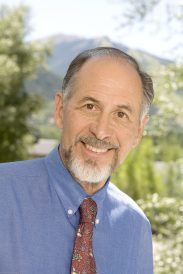
Martin Sherwin, a professor of history at George Mason University outside Washington, D.C., told students that “this is as big a problem for you as it was for those of us who are older.”
Sherwin has immersed himself in the study of nuclear weapons and their role in recent American history, with his most notable contribution being the 2006 biography of the “father” of the atomic bomb, “American Prometheus: The Triumph and Tragedy of Robert J. Oppenheimer,” which won several other prizes along with a Pulitzer. Though only a handful of nations possess nuclear weapons, or the technology to manufacture and launch them, we are not out of the nuclear woods, according to Sherwin.
“We ignore its danger at our peril,” he said. “We owe it to ourselves, our children and our grandchildren.”
Sherwin pointed out that, while none of the world’s superpowers are at nuclear swords’ points now, that could change if relations deteriorate between the United States and China, or if Russia’s Vladimir Putin becomes even more belligerent to America and the West.
Much of Sherwin’s discussion, which was jointly sponsored by the college’s history and physics departments, centered on the turbulent life of Oppenheimer, a gifted and troubled theoretical physicist raised in comfort on Manhattan’s Upper West Side. After tours of duty through Harvard and Cambridge University in England, he had settled into teaching at the University of California-Berkeley when he was tapped to be the technical director of the Manhattan Project, which developed the first atomic bomb.
Though he and his colleagues struck pay dirt in testing and manufacturing the bomb, Oppenheimer was almost immediately plunged into remorse over what he had done. He warned against the proliferation of atomic weaponry, but his pleas mostly fell on deaf ears. After working as the chairman of the general advisory committee to the Atomic Energy Commission, he was stripped of his security clearance in 1953 amid McCarthy-era hysteria over possible communists hiding in nooks and crannies of the federal government. He died at age 62 in 1967, with nuclear stockpiles continuing to grow steadily.
“Nuclear weapons are totally irrational and good for nothing but killing,” Sherwin said. “That’s what Oppenheimer tried to tell the world in 1946. It’s not too late to realize he was right.”