

Myanmar troubles jeopardize big Obama goal
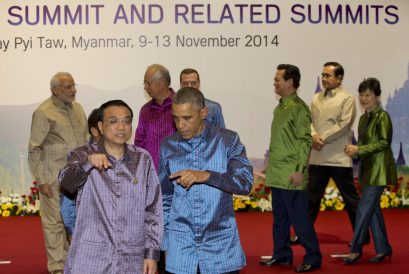
NAYPYITAW, Myanmar – For President Barack Obama, Myanmar’s stalled progress on promised political and economic reforms is jeopardizing what was to be a crowning achievement for his foreign policy legacy.
Obama arrived in Myanmar’s capital of Naypyitaw Wednesday amid persistent questions about whether the government would follow through on its pledges – and whether the United States had made too many overtures to the long-isolated country too soon. Myanmar won wide sanctions relief from Obama after its sudden and unexpected shift from a half-century of military rule, but there’s little certainty about the country’s future.
“Progress has not come as fast as many had hoped when the transition began,” Obama said in an interview with Myanmar’s The Irrawaddy magazine. “In some areas there has been a slowdown in reforms, and even some steps backward.”
White House officials said Obama has always been realistic about the challenges ahead for Myanmar, a country that in many cases lacks the infrastructure and capacity to enact the reforms its leaders outlined. But critics of the administration’s policy said the United States gave up its leverage too quickly by rewarding the government for promises rather than results.
“With so many avenues for pressure lost, it can indeed seem like the U.S. doesn’t have a lot of cards left to play,” said John Sifton, the Asia director at Human Rights Watch.
Critics also contend the president got caught up in the notion that opening Myanmar to the outside world would be a central part of his legacy as America’s self-proclaimed Pacific president. Indeed, a successful democratic transition would fit neatly into Obama’s broader Asia strategy, which includes deepening U.S. political and economic partnerships in the region, particularly with countries seen to share America’s values.
The so-called pivot to Asia raised concerns in China – Myanmar’s neighbor and largest trading partner – that the United States is seeking to contain Chinese influence.
Despite Obama’s hopes for Myanmar, optimism within the administration faded somewhat since the president’s trip here in 2012. He was the first sitting U.S. president to visit the country, and aides still fondly recall the massive crowds that lined the streets to watch his motorcade pass.
Yet, there’s little question Myanmar failed to make good on the promises its leaders made to Obama during that short visit.
More than any other issue, White House officials said it’s Myanmar’s persecution of minority Rohingya Muslims in the Rakhine state that threatens to alienate the United States and other nations that were drawn to the country. Attacks by Buddhist extremists since mid-2012 have left hundreds of Rohingya Muslims dead and 140,000 trapped in dire conditions in camps.
With presidential elections in Myanmar looming next year, the status of the Rakhine state became mired in politics. The Rohingya are deeply disdained by many in Myanmar, and most officials dare not publicly call for better treatment, not even the country’s pro-democracy hero Aung San Suu Kyi.
Obama planned to meet with Suu Kyi at the end of his trip. First, he was holding talks with Asia-Pacific leaders, then meeting with the country’s President Thein Sein.
White House officials acknowledged Obama almost certainly wouldn’t be visiting Myanmar at this point had the country not been hosting the Asia-Pacific summits that he had pledged to attend as president.
Beyond concerns about the Rakhine state, the United States is warily watching the lead-up to Myanmar’s presidential election next year. The country’s constitution currently bans Suu Kyi from participating in the election.
The United States has sought explicitly aligning itself with a potential Suu Kyi candidacy, and Ambassador Derek Mitchell called her inability to run for the presidency “strange.” Obama’s schedule here clearly signals his preferences, given that he is holding his news conference in Myanmar with Suu Kyi, not the country’s current president.
The administration argues that the mere promise of a broader Myanmar relationship with the U.S. gives Obama leverage. American businesses are waiting for more political certainty before investing in Myanmar, officials say, and there are still U.S. sanctions that have not been repealed.
“The United States can best move that forward by engagement,” said Ben Rhodes, Obama’s deputy national security adviser. “If we disengage, frankly I think that there’s a vacuum that could potentially be filled by bad actors.”